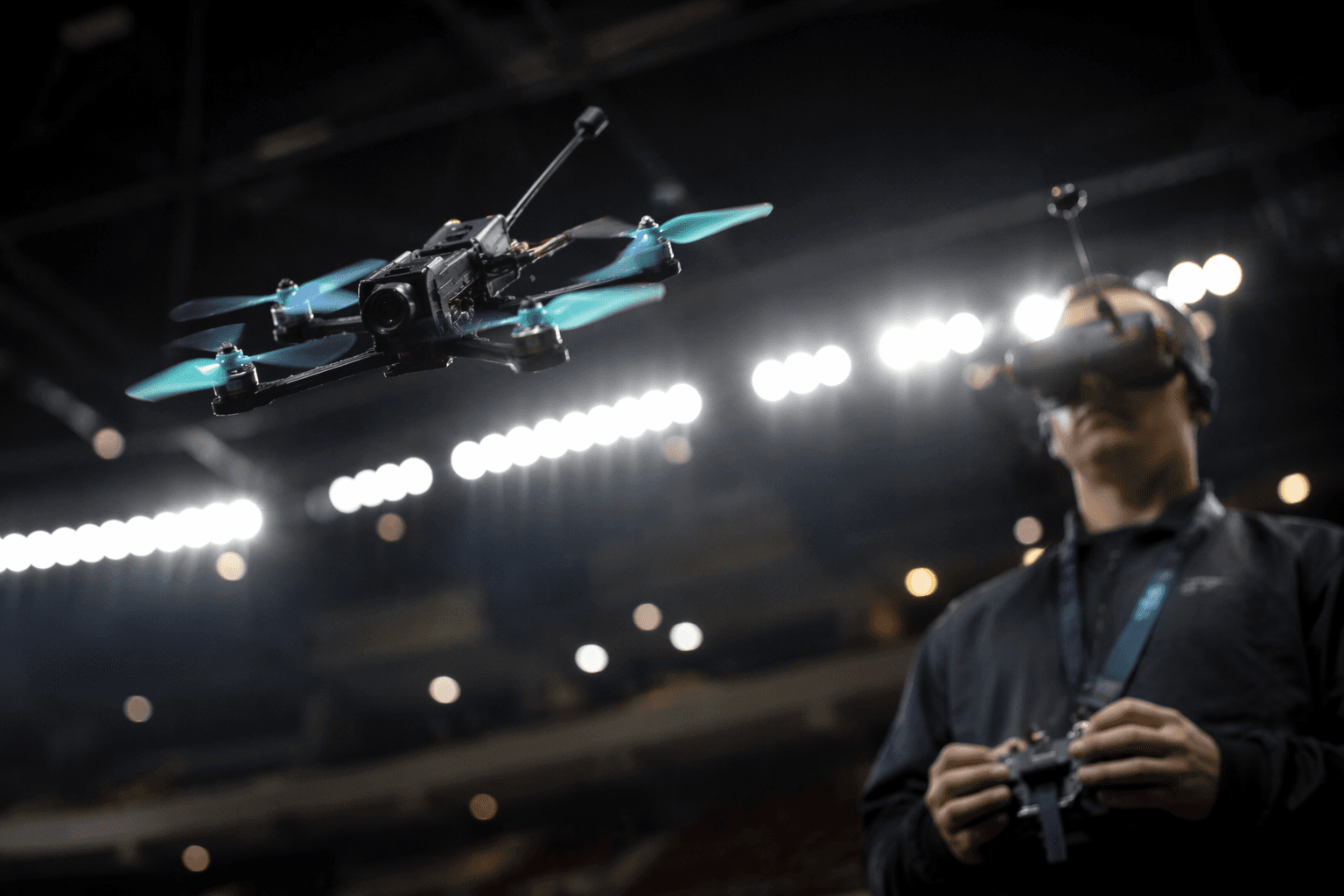
FPV racing guide explains control, practice, and drone setup
FPV racing rewards clean lines and repeatable drills, not raw speed. The path runs from simulator practice to whoops, then 5-inch race quads and sanctioned world events.

FPV pilots fly from onboard camera footage, usually in acro mode, where the drone does not self-level and every stick movement has to be deliberate. A race quad is built for agility, acceleration, and precision control, while a stabilized camera drone is tuned for smoothness and ease of use.
The machine is only half the story
The hardware stack matters because it shapes the way a pilot learns. A racing setup typically centers on a lightweight carbon fiber frame, high-thrust motors, ESCs, a flight controller, an FPV camera, a video transmitter, a radio link, and goggles or a monitor. Those parts determine how sharply the quad can change direction, how quickly it can recover from a bad line, and how much feedback the pilot gets when a gate is approaching too fast.
The move from camera drone habits to race habits feels abrupt. A camera drone hides small errors by leveling itself and smoothing input. A race quad exposes them immediately. If the pilot is late on the roll, the gate gets missed. If throttle comes in too hard, the quad balloons above the line. If the radio input is sloppy, the drone drifts wide and the clock pays for it.
Start with control, not courage
The cleanest progression begins in a simulator, then moves to a small whoop or toothpick-style quad, and only after that into a full 5-inch race drone. That progression builds the reflexes that make the bigger machine usable at race pace. A simulator gives unlimited reps without broken props, and a tiny quad gives real-world feedback without the cost and force of a full-power race build.
Flight modes are part of that progression. Angle mode is the easiest because the drone self-levels, which helps a new pilot understand orientation and stick direction without fighting the quad. Horizon mode sits between the two, while acro mode is the race setting because it gives the most precise directional control once muscle memory is in place.
Line discipline is what saves laps
The difference between a clean lap and a crash-heavy one usually starts in the corners. A racer who cuts the line too wide adds distance and loses speed on exit. A pilot who pitches too hard into a turn can overcorrect, clip a gate, or drift into the wrong angle for the next section. The fastest laps are built on repeatable paths through the same turns, not on dramatic bursts of speed.
The best drills are simple and repetitive. Flight-line work teaches the pilot to hold a straight, stable path through gates instead of weaving around them. Corner practice isolates one turn at a time so the pilot can learn where to enter, how much throttle to carry, and when to level out. Gradual transitions from hovering to full-course laps let the pilot build control in stages instead of trying to survive an entire track before the basics are stable.
Throttle control is the other half of that equation. On a race course, too much throttle is not just faster, it can be worse. It can lift the quad above the racing line, make the turn radius balloon, and force a correction that steals more time than it saves.
Safety habits keep practice repeatable
Crashes are part of the learning curve, but good habits keep them from turning every session into a reset. Preflight checks catch loose propellers, damaged frames, and wiring problems before the quad leaves the ground. Reliable radio links matter because a dropped signal at speed is not a small inconvenience, it is a broken lap and often a broken drone. Battery discipline matters too, because a pack that is pushed too hard or flown too low changes how the quad behaves in the air.
The FAA adds a legal layer to that discipline in the United States. Recreational operators must keep drones within visual line of sight, and if a flyer uses FPV devices that limit what can be seen around the aircraft, a visual observer is necessary. Under 14 CFR 107.33, the remote pilot and visual observer must communicate effectively, and the observer must be able to see the aircraft as required by the rule. The FAA also recommends joining an FAA-recognized Community-Based Organization to learn safe flying habits.
The sport is already built around that ladder
FPV racing is not an isolated hobby scene anymore. FAI, the world governing body for air sports recognized by the International Olympic Committee, has made drone racing part of its international structure. It launched the first FAI World Drone Racing Championships in Shenzhen, China, from November 1-4, 2018, and that inaugural event drew 128 pilots from 34 countries. The first FAI E-Drone Racing World Cup series followed in 2024, and the Drone Racing World Cup began in Riyadh from January 23-25, 2025, as an inaugural season event.
FAI says 15 drone-racing events are sanctioned on its 2026 calendar. MultiGP has more than 30,000 registered pilots and 500 active chapters worldwide, and it calls itself the largest drone racing league and FPV community in the world.
This article was produced by Prism’s automated news system from verified source data, official records, and press releases, then run through automated quality and moderation checks before publishing. The system is built and supervised by the people who set the standards it runs under. Read our full AI policy.
Did this article answer your question?