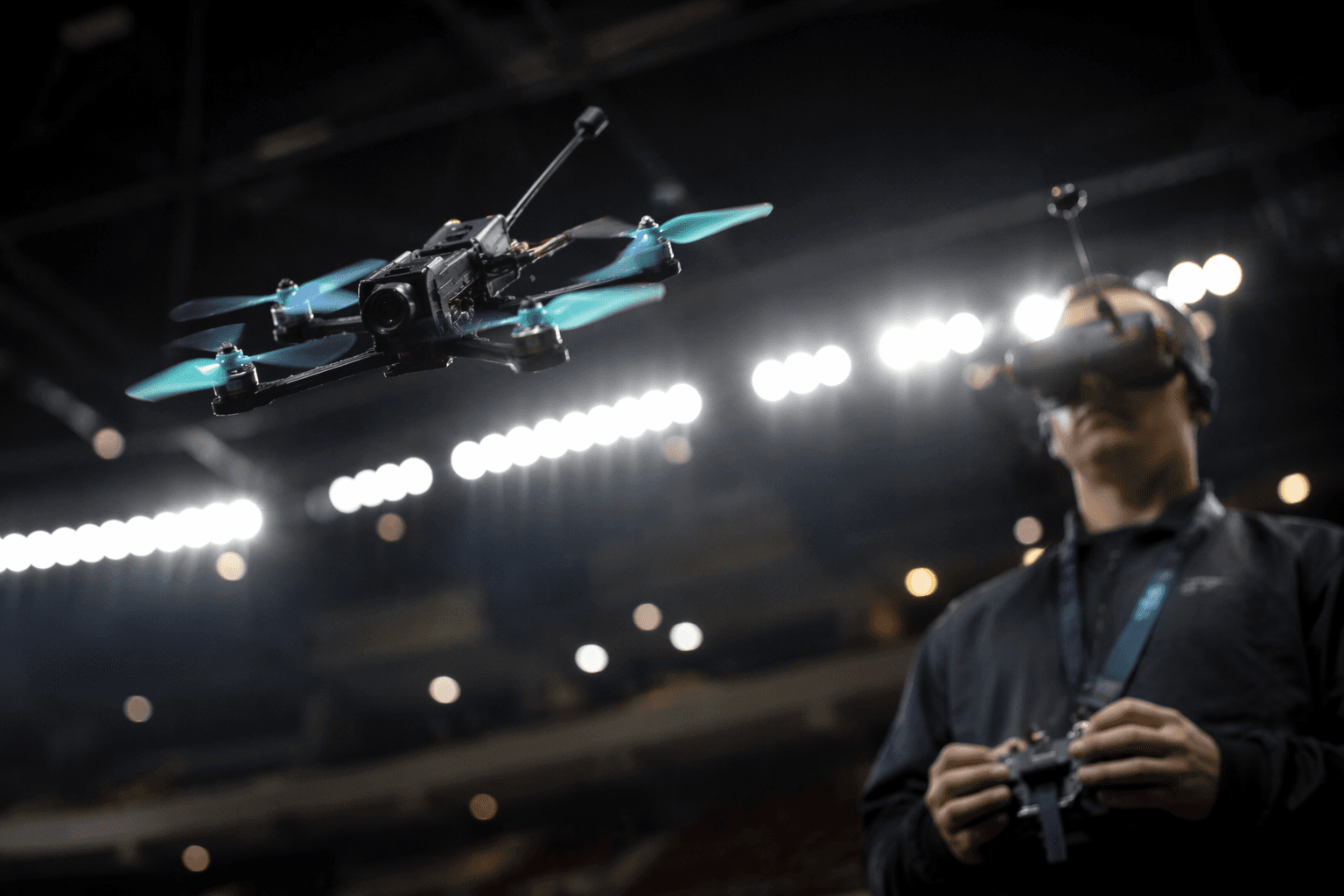
How Betaflight tuning shapes faster, more responsive drone racing rigs
The fastest race quads are won in software before they leave the line. Betaflight’s rates, filtering, and launch tools decide whether a stick input turns into speed or chaos.

Betaflight turns stick position into turn rate in degrees per second. In drone racing, the difference between a twitchy quad and a locked-in one often starts with how the controller is tuned, not how hard the pilot pushes the sticks.
Rates are the first lap-time separator
Betaflight’s current rate model uses three parameters, RCRate, Rate, and Expo, to shape the curve from center stick to full throw. That matters because racers generally want a more linear response than freestyle pilots do, with a maximum turn rate that usually lands around 550 to 650 deg/s. Too much curve and the quad feels numb near center, then jumps at the end; too little and it can get nervous on tiny corrections through chicanes and split-S entries.
That is why modern race tuning leans on more than raw aggressiveness. Improved feedforward, dynamic battery sag compensation, and newer filter behavior are the pieces that make a quad feel immediate without becoming sloppy. Feedforward sharpens the response as soon as the pilot moves the stick, battery sag compensation keeps throttle feel steadier as voltage drops through a pack, and the newer filtering aims to preserve race-friendly responsiveness instead of smoothing away the detail a pilot needs in a fast corner.
Filtering is where speed stops becoming noise
If rates shape the pilot’s intent, filtering decides how much of that intent survives the vibration coming back from the frame, motors, and props. In Betaflight 4.0, RPM-controlled multiple dynamic notch filtering over bidirectional DShot improves motor-noise suppression while cutting filter delay. That tradeoff is the whole game in racing: remove enough noise to keep the craft stable, but not so much delay that the quad feels like it is reacting through syrup.
Bidirectional DShot is the bridge that makes that possible. DShot is the digital communication protocol between the flight controller and the ESC, and bidirectional DShot sends RPM data back over the same single wire. JoeLucid developed that code in March 2019, and support arrived in Betaflight 4.1 and higher, with ESC support required. Once that RPM data is flowing, the controller can place its filters on the actual motor frequencies instead of guessing.
Betaflight’s RPM filtering system can use a bank of 36 notch filters, with 12 applied by default each on pitch, roll, and yaw. It is the kind of targeted noise control that lets a quad stay composed when propwash starts hammering the frame after a dive or when the pilot is trying to squeeze speed out of a tight, technical section.
The electrical chain is part of the setup, not a side note
Race tuning does not stop at the PID screen. The whole electrical chain has to cooperate quickly, from the flight controller to the ESC to the motors, and Betaflight’s CLI covers gyro and filter tuning, PID configuration, failsafe, GPS, battery monitoring, OSD, telemetry, and VTX from one place.
That is also why ESC telemetry matters so much in racing. With bidirectional DShot feeding RPM data back to the controller, motor noise becomes a measurable input instead of a guessing game. The practical result is less wasted movement in the motors and less filter delay in the controller, which is exactly what a pilot wants when the gap to the next gate is measured in tenths, not seconds.
Video control is part of the lap time too
The FPV link sits in the same performance stack as the motors. FPV transmitters are usually analog or digital systems operating on the 5.8 GHz band, and modern control options such as SmartAudio, Tramp, OpenVTX, and VTX tables let pilots manage channel and power settings from the flight controller or radio system. That keeps the pilot focused on the heat instead of fumbling with gear between runs.
If the VTX power is wrong, the channel is off, or the setup is slow to change, the machine is compromised before the lap even starts.
Launch Control and Dynamic Idle change the start and the finish
Betaflight added Launch Control in 4.0 as a race-start assistance system. The feature lets the pilot pitch forward and then release the sticks while the quad holds position for the launch, which makes the first instant of a heat more repeatable.
Dynamic Idle plays a different role, but it solves the same problem from another angle. On race courses with high-speed split-S entries or tight hairpins, dynamic idle can improve propwash management and braking consistency. For a typical 5-inch quad, the starting point is 30 to 40 on the dyn_idle_min_rpm scale, or about 3000 to 4000 RPM. That gives the props enough baseline speed to stay responsive when the pilot chops throttle into a corner and then asks for a fast recovery on exit.
Why the software story matters in the sport’s bigger arc
Drone racing did not become a serious competition just because pilots got braver. The sport’s structure changed as the software and the broadcast layer matured around it. The Drone Racing League launched its first season in January 2016 with six key events, and ESPN announced on September 14, 2016, that it would air ten one-hour episodes covering five DRL races that season. The FAI then selected Shenzhen, China, to host the first FAI World Drone Racing Championships in 2018, where Rudi Browning beat 127 other racers from 34 countries to win the title.
That growth also happened at the grassroots level. MultiGP, which calls itself the largest drone racing league and FPV community in the world, was officially welcomed by the Academy of Model Aeronautics as an FPV racing Special Interest Group.
This article was produced by Prism’s automated news system from verified source data, official records, and press releases, then run through automated quality and moderation checks before publishing. The system is built and supervised by the people who set the standards it runs under. Read our full AI policy.
Did this article answer your question?