Russian FPV Drone Skewers Ukrainian UAV Mid-Air in Aerial Joust Tactic
A Russian FPV interceptor pierced a Ukrainian Darts drone's lithium battery with two metallic rods mid-air, a "drone joust" tactic now shifting design debates far beyond the battlefield.
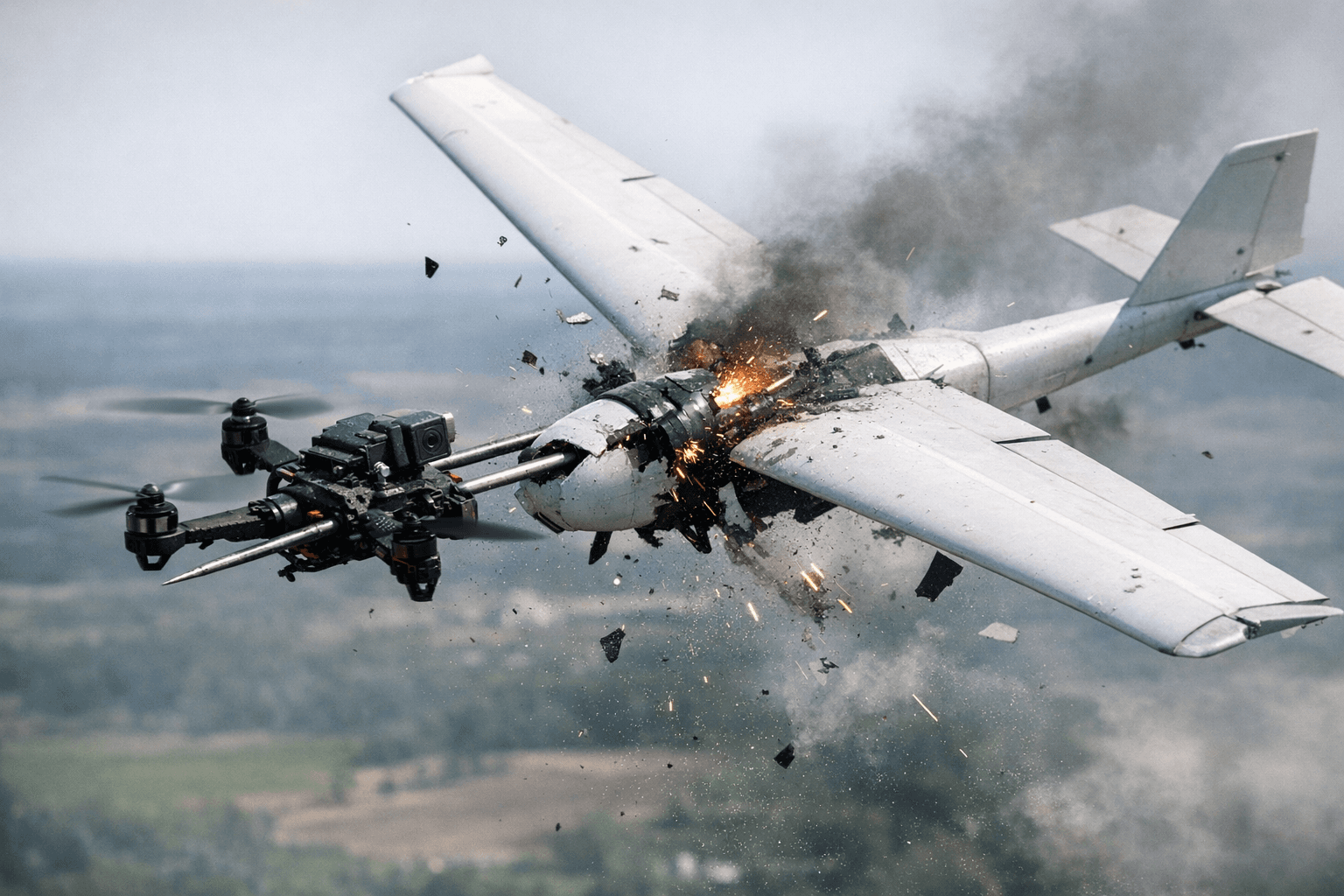
A Russian FPV interceptor descends, two metallic rods pierce a Ukrainian Darts-type loitering munition's lithium battery, and the target spirals to earth in flames while the interceptor, by appearances, stays structurally intact. The footage circulating since March 31 is already logging hits in drone engineering forums and regulatory briefings alike, and the design questions it raises reach well past the front line.
Autonomous systems expert David Kirichenko framed the clip not as an anomaly but as a milestone. "On the Russian side, interceptor drones equipped with rods designed to physically impale Ukrainian low-cost drones have become increasingly common over the past year," he said. The tactic is a design evolution from earlier ramming attempts, trading the certainty of mutual destruction for a higher-risk, higher-reward geometry: pierce the target's energy-dense battery, trigger a thermal runaway, and keep the interceptor aloft for another engagement.
Whether it works cleanly is a separate question. Prof. Justin Bronk of the Royal United Services Institute noted the gap between what the footage shows and what the method can reliably deliver. "In practice, most such hits would probably end up damaging the interceptor drone too," he said. "A direct impact like this one is also more difficult to reliably achieve than a proximity detonation with an explosive warhead." The video captures one successful engagement. It does not capture the typical outcome.
The design brief for a rod-equipped interceptor and the design brief for a race-class 5-inch quad share exactly one item: FPV link reliability. From there, the priorities fork hard. A competitive racing frame optimizes for resonance damping, motor-to-motor distance tuned for prop wash management, and battery placement relative to center of gravity for roll-rate consistency through gates. The interceptor optimizes for forward structural rigidity sufficient to transfer kinetic energy through the rods without shattering the airframe on contact. Weight savings that separate a podium finish from fourth place are structural liabilities when impact force is the objective. These are not adjacent engineering problems; they are competing ones.
The perception problem operates on no such distinction. Regulators and venue owners who govern where competitive FPV can fly do not typically parse the difference between a race quad and a battlefield interceptor. Viral footage of FPV hardware puncturing aircraft in active combat zones narrows the political window for competitive leagues, particularly at venues already facing remote ID compliance pressure and airspace access scrutiny. Sponsorship conversations that depend on brand-safe optics become more complicated every time a clip like this one moves through mainstream news cycles.
There is a slower-moving implication underneath the immediate perception hit. Battlefield improvisation has historically migrated into sport hardware within 18 to 24 months: composite materials, battery shielding designs, and redundant control link architectures all travel this pipeline. The engineers studying open-source footage for lessons about closing speeds, structural vulnerabilities, and flight envelopes at contact are often the same engineers whose preferences shape the next generation of league spec classes. Russia's current field testing over Ukraine is, in that sense, also a durability study no racing lab could replicate.
This article was produced by Prism’s automated news system from verified source data, official records, and press releases, then run through automated quality and moderation checks before publishing. The system is built and supervised by the people who set the standards it runs under. Read our full AI policy.
Did this article answer your question?