TEKNOFEST 2026 Expands Drone Racing With FPV and Autonomous Competition Categories
TEKNOFEST 2026 adds a GNSS-denied FPV autonomous tracking category and runs 52 competitions in Şanlıurfa, with 75 million TRY in prizes across drone disciplines.
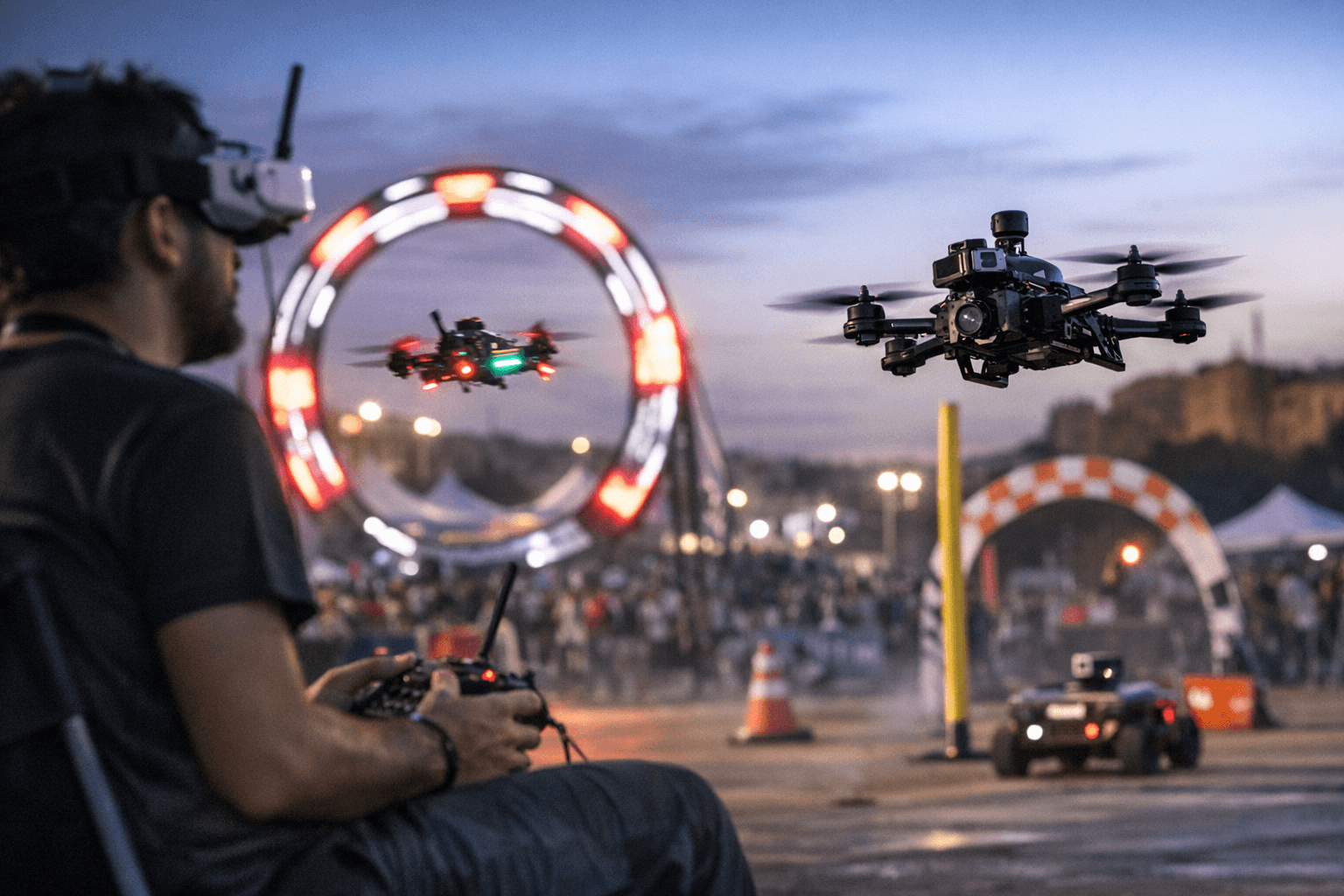
The FPV Drone Tracking Competition, one of four events making its debut at TEKNOFEST 2026, requires teams to autonomously chase a moving target drone using image processing and onboard control with no GPS assistance whatsoever. That design constraint is not incidental. The festival lands in Şanlıurfa, and the explicit ban on Global Navigation Satellite System data maps directly onto the contested electronic environment that defense engineers have been designing for since GPS jamming became standard doctrine. TEKNOFEST has formalized what the autonomy community already knows: GNSS-denied flight is not a niche edge case; it is the operational baseline worth scoring.
For pilots and engineering teams deciding whether to commit to the festival, the 2026 program is the most technically layered drone event in TEKNOFEST's nine-year run. Spanning 52 competition categories and 127 subcategories, the festival now fields five distinct UAV competition streams with separate hardware classes, eligibility rules, and prize structures.
Three categories did not exist in the 2025 lineup at all. The Electronic Warfare Competition, the Advanced Autonomous Systems Design and Operation Competition, and the FPV Drone Tracking Competition are all new for 2026. The Combat UAV Hunter Drone Competition returns with a defined payout structure: 200,000 TRY for first place, 175,000 TRY for second, and 150,000 TRY for third. The Fighter UAV Competition, which involves autonomous lock-on and kamikaze mission profiles against airborne adversaries, runs a steeper ladder: 600,000 TRY, 500,000 TRY, and 400,000 TRY across the top three finishers. Those are engineering prizes, not racing prizes, calibrated to mission completion against autonomous opponents.
The flagship TEKNOFEST Drone Championship, organized since 2017, runs on an individual-entry basis in 2026. The competition uses FPV cameras and UAVs tuned to designated frequencies, with craft dimensions fixed in the 180-to-250 mm range. Video transmitters may only be operated when instructed by event staff. The format runs through ranking rounds, with the highest-placed pilots advancing into elimination heats. That centralized RF clearance rule carries real operational weight at a multi-pilot festival where spectrum congestion can force mid-race disarms. It is a managed radio frequency plan in everything but name, and it is a more disciplined protocol than the honor-system approach still common at regional circuits.
The FPV Drone Tracking Competition is where the program makes its sharpest claim on the autonomy debate reshaping competitive drone development. The competition's primary aim is to evaluate image-based perception, decision-making, and dynamic target tracking capabilities in a realistic mission scenario, with teams developing systems that can autonomously follow a moving target drone without GNSS data. In operational terms, that requires a capable flight controller running onboard vision processing, a trained detection model, and tuned control loops that can pursue a maneuvering craft with no positional correction from satellites. First place in this category pays 300,000 TRY, second place 250,000 TRY, and third place 200,000 TRY.
The World Drone Cup runs concurrently on the sport side, inviting both amateur and professional pilots to compete for ranking in Şanlıurfa. It is the entry point for pilots who race rather than build, with no system integration requirement beyond meeting the event's technical compliance standards.
On eligibility, the autonomous competition categories follow a consistent model. High school and university students enrolled in Turkish institutions or abroad, as well as graduates, are eligible to apply. Teams may consist of a minimum of three and a maximum of fifteen members.
The financial structure behind TEKNOFEST's two-stage model is worth mapping before any team commits resources. Teams that pass the preliminary selection stage receive over 100 million TRY in financial support across the full competition program, while teams that place at the festival share in over 75 million TRY in direct prizes. The application window for 2026 competitions closed on February 20. Teams already in the pipeline are now in technical preparation and qualification review, not open enrollment.
For teams that did make the February 20 cut, the actionable horizon looks like this: the FPV Drone Championship demands 180-to-250 mm craft with FPV cameras on designated frequencies and transmitters that stay silent until cleared. The FPV Drone Tracking Competition demands GNSS-free autonomous tracking, with judging weighted on perception accuracy, decision latency, frame centering on a moving target, and reacquisition after target loss. The Combat UAV and Fighter UAV categories require autonomous mission execution in air-to-air scenarios, with teams expected to demonstrate autonomous takeoff, flight, lock-on, and landing sequences.
The RF management protocols TEKNOFEST enforces at large multi-track events are also drawing attention from race promoters outside Turkey. A centralized transmitter clearance system designed for a festival running dozens of simultaneous pilots addresses a problem that has dogged large-scale arena FPV events globally. The template is replicable, and the 2026 Şanlıurfa edition, with its simultaneous FPV sport, autonomous tracking, and electronic warfare programming, is the most demanding test that template has faced.
TEKNOFEST's drift away from pure sport toward applied autonomy is not a sideline feature in 2026; it is the organizing logic of the entire drone program. The GNSS-denied tracking category, the EW competition, and the autonomous combat brackets collectively signal where the festival's technical ambitions are pointed. Pilots and engineers mapping their 2026 competition calendar are effectively choosing which side of that line they want to compete on.
This article was produced by Prism’s automated news system from verified source data, official records, and press releases, then run through automated quality and moderation checks before publishing. The system is built and supervised by the people who set the standards it runs under. Read our full AI policy.
Did this article answer your question?