Foil surfing evolves from big-wave breakthrough to open-ocean revolution
Foil surfing grew from big-wave hardware into a broader open-ocean craft as new foil shapes lowered the speed needed to fly. Each breakthrough widened the conditions, riders, and session lengths that were possible.
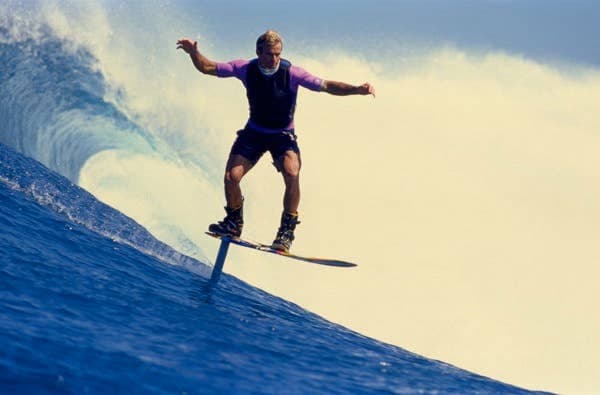
Laird Hamilton’s early foil setup at the turn of the century used a razor-sharp aluminum foil and snowboard boots for giant surf, where ordinary boards would bog down. From there, the sport spread into open-ocean glides, longer downwind runs, and marginal surf that once looked unrideable.
From big-wave experiment to proof of concept
The board used a razor-sharp aluminum foil and snowboard boots, a setup that looked improvised only until you understood the conditions it was meant to solve. On truly giant waves, Hamilton argued, standard planing boards run into a drag wall, and that is where foils matter most: they preserve speed instead of surrendering it to resistance.
Big-wave surfing rewards control, line choice, and momentum above almost everything else, and foiling was born as a way to keep all three alive when the wave face gets enormous.
Hamilton’s view established foiling as a way to turn a wave into a cleaner, longer-running source of glide, not just get above the water. That insight later moved beyond tow surfing and into conditions that had never seemed central to surfing at all.
Kai Lenny shifts the center of gravity
The next turning point came when Kai Lenny took foiling out of the big-wave lane and into the open ocean. His stand-up paddle hydrofoil video in 2016 earned the label “breaking the internet”: he was gliding above wind chop at about 20 mph using downwind energy alone. That was a different kind of revelation from Hamilton’s. It showed that a foil could work without a monster wave and without a tow rope.
Lenny’s breakthrough changed the sport’s geometry. Instead of waiting for a perfect face to appear, he could connect the energy already moving through the ocean and turn it into forward motion. That made foil surfing feel less like a specialized stunt and more like a repeatable method for covering water, reading texture, and staying aloft in conditions that would be useless on a normal board.
He also reframed what an elite rider could do. The open-ocean foil was not simply a larger version of wave riding. It was a test of efficiency, balance, and energy management, with very little wave power available to rescue mistakes. That is why Lenny became such a visible milestone: he showed that foiling could be powered by small, distributed energy rather than only the biggest swells on the planet.
The gear breakthrough that made the sport usable
If Hamilton supplied the ambition and Lenny supplied the spectacle, Alex Aguera supplied the hardware that made foil surfing practical for more people. Many riders first knew foils through thin kite, tow, or air-chair designs. The problem was not that those foils did not work. It was that they were not well suited to the slower speeds and softer energy that define a lot of surfable water.
The missing piece was thickness. Thicker foil sections generated more lift at slower speeds, and that changed the whole operating window of the board. Suddenly a foil did not need to be pushed as hard before it rose free of the drag that had trapped ordinary surfboards.
A pivotal development came in 2016 on Maui’s Kanaha Beach, where Aguera built a foil board that did not depend on external power sources. Instead, it used the rider’s paddle stroke and the energy already moving through the ocean. Once a foil could be self-started and sustained through rider input and water movement, the sport gained its own equipment language, its own learning curve, and a path that did not require a tow rig or huge surf.
Why sessions got longer and conditions got wider
Each technical step changed who could participate and where the sport could happen. The big-wave phase demanded access to rare conditions and a high degree of confidence in heavy water. The open-ocean phase made it possible to ride long distances on downwind energy and wind chop. The thicker, lower-speed foil sections widened the entry point again by making lift more accessible at slower paddling speeds.
The board no longer needs to be pinned to steep, plunging waves to deliver a ride. It can begin in softer surf, continue across open water, and reward riders who understand how to conserve energy and connect bumps. Sessions grew longer because the board stayed efficient longer, and riders could keep linking motion instead of resetting after every glide.
A foil surfer has to think about water differently, reading wind texture, swell direction, and speed with the same seriousness that traditional surfers reserve for face shape and takeoff angle. That has created a progression path built around feel and efficiency, not just wave size.
What foil surfing is now
Foil surfing still carries the tension that defined it from the beginning: speed, efficiency, and wave energy remain the core currency. Small surf, wind chop, and downwind routes are no longer dead ends. They are the raw material.
Hamilton now describes foiling as another point in surfing’s evolution, not a separate world.
This article was produced by Prism’s automated news system from verified source data, official records, and press releases, then run through automated quality and moderation checks before publishing. The system is built and supervised by the people who set the standards it runs under. Read our full AI policy.
Did this article answer your question?