KT Nomad foil review praises tailored design and early lift
KT's Nomad stands apart from the mid-aspect pack with early lift, tight tuning, and a 155-tail setup that rewards riders who want more character than neutrality.
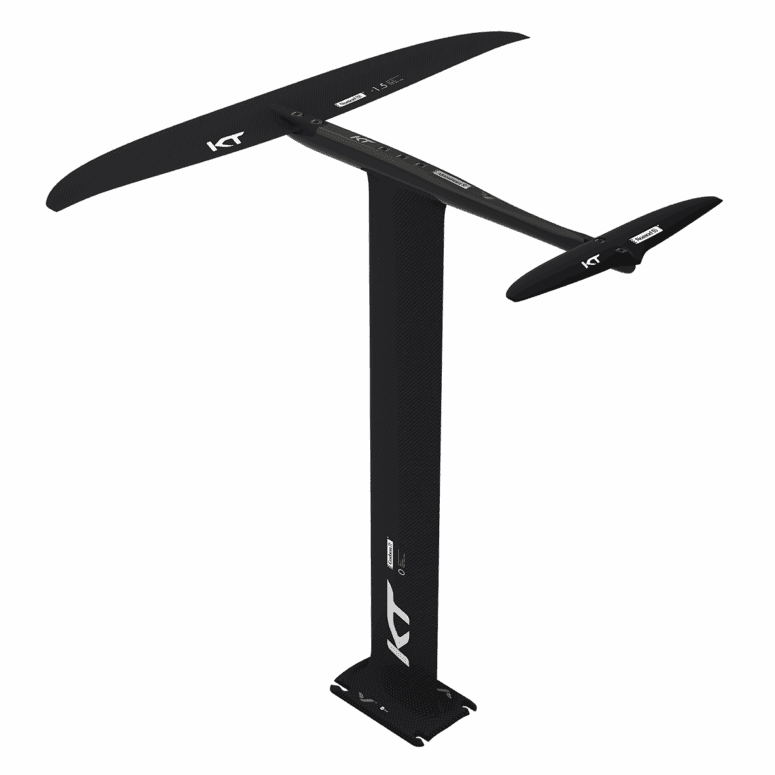
KT puts the Nomad in its “carve centric versatility” category, built for a cleaner, faster, more controlled ride when the wave gets messy. It feels more tailored, more alive, and more willing to trade some generic sameness for control and response through turns.
A foil with a point of view
It is not the glide-first Atlas line, and it is not the beginner-to-intermediate Instinct family. This is the foil for riders who want control and response to come through the turns, not just a stable platform that disappears underneath them.
KT’s foil collection is now largely shaped by Kane de Wilde, a name that has carried real weight in foil circles since the early G10 tail-wing days. The Nomad feels like the cleanest expression of that approach so far: a system built on “well thought out concepts” and meant to ride differently, not merely look updated.
Why the sizing matters
KT does not treat the Nomad as one wing shape simply stretched across a range. The smaller wings carry more sweep, while the aspect ratios extend as the sizes get larger. That gives the line a more tailored feel than the usual mid-aspect all-rounder, where every size often seems to wear the same personality in a different scale.
The stock front-wing sizes are 700, 830, 980, and 1160 cm², with rear wings at 155, 190, and 250 cm². KT says the Nomad’s high-camber profile, early lift, and stall resistance mean riders should size down 10% to 20% compared with other foils on the market. The Nomad is built to give you more lift and usability than its area number suggests, so chasing your usual size can leave you on more foil than you actually need.
The 830 is the heartbeat size
The 830 is the size that makes the case most clearly. It lands in the sweet spot for everyday wave use, and it is the one that best shows the Nomad’s mix of lift, agility, and drive. It feels lifty, skatey, and agile.
That character is what makes the Nomad stand out from the middle-of-the-road surf foils flooding the market. The 830 does not feel neutral in the way a lot of modern surf foils do. It wants to roll, recover, and re-engage quickly when the wave is lumpy, inconsistent, or only half-formed.
Rear-wing choice changes the whole ride
KT offers 155, 190, and 250 cm² tails, and the setup guidance is precise enough to tell you a lot about the platform’s intent. KT warns that front wings larger than 1000 cm² are not recommended with the smallest 155 tail if you want a pitch-stable, smooth, and predictable ride.
The 155 tail is the one that unlocked the best all-round feel in the 830 test, giving enough agility to make turns feel lively without blowing up the balance. The result is a foil that can stay composed while still feeling quick off the rail.
The 190 and 250 tails give you more room to tune for control, but the 155 is where the Nomad’s livelier side comes through. If you want the foil to feel more responsive and less damped, that small rear wing is a major part of the story.
Setup is part of the product, not an afterthought
KT’s published fuselage options are 56 cm and 63 cm aluminum fuselages, and the longer 63 cm setup worked better than the shorter 56 cm version. The 63 cm fuselage improved pitch stability and made it easier to find the right pumping cadence.
The hardware gets the same kind of treatment. The 15.5mm high-modulus mast is stiff and dense, and the torx labeling plus socket-style connections give the foil a clean, confident assembly. Tolerances were tight enough that the assembled foil felt like one solid unit.
KT’s setup documents also stress that the rear wing shim is important for performance.
Who it is for, and who it is not for
KT describes the Nomad as suitable for prone, wing, downwind, SUP, wake, tow, kite, and surf foiling. It keeps enough early lift and control to move across different disciplines without losing its distinct feel.
The Nomad makes sense for riders who want a surf foil that carries speed, handles technical sections, and still has enough ease to stretch a session into more than one type of wave. It is less compelling if you want the most anonymous, middle-ground option possible. KT has built a foil that asks for a specific taste: you need to like response, you need to like tuning, and you need to value the sensation of a board and foil working together as a system.
This article was produced by Prism’s automated news system from verified source data, official records, and press releases, then run through automated quality and moderation checks before publishing. The system is built and supervised by the people who set the standards it runs under. Read our full AI policy.
Did this article answer your question?