Agencies Weighing Duda Replacements Get Practical Guide to Key Platform Features
Lindo.ai's agency-focused guide cuts through platform noise to tackle the five features that actually matter when replacing Duda.
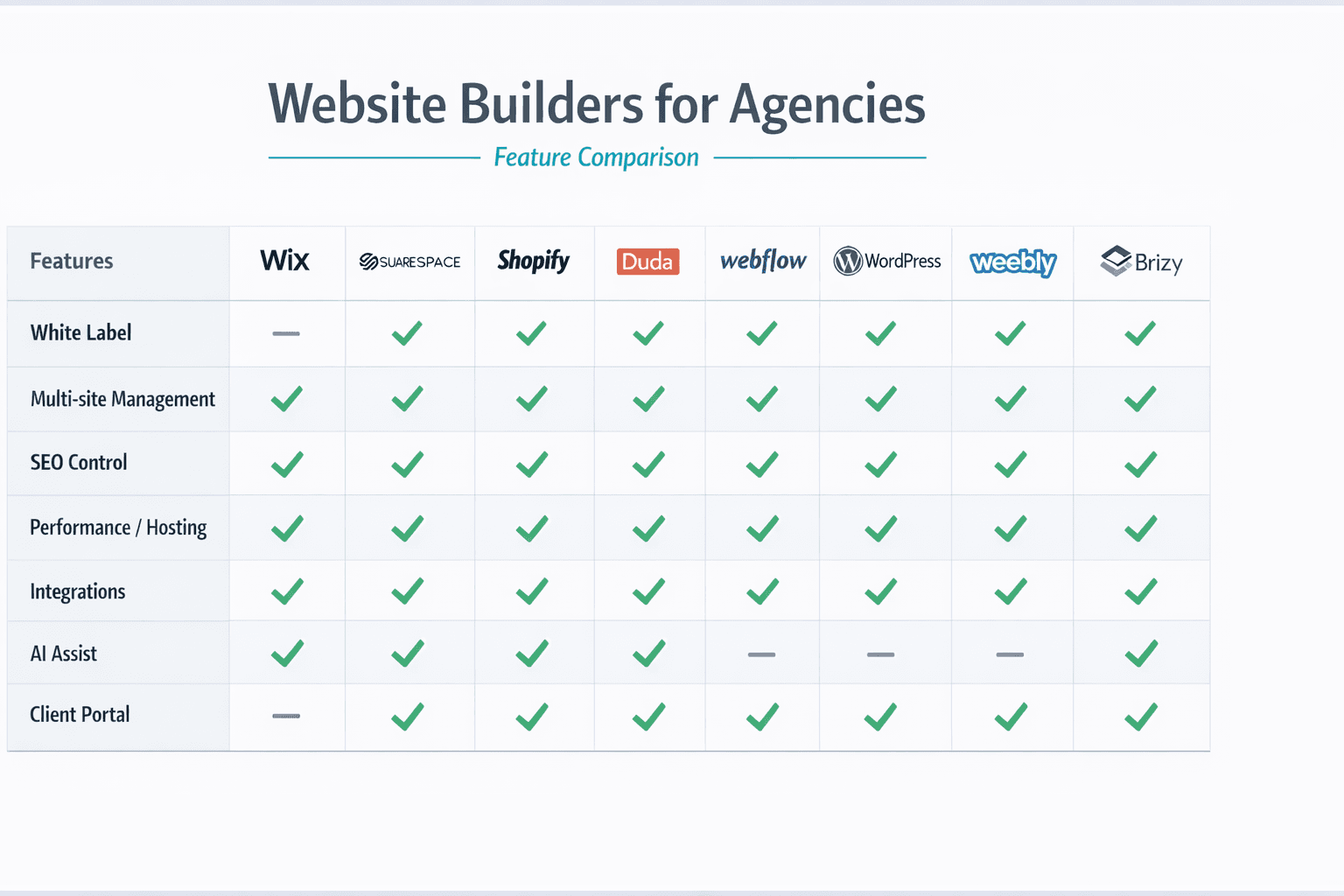
If your agency is on Duda and starting to feel the friction, you're not alone. The question most teams get stuck on isn't whether to switch; it's what to actually evaluate when comparing alternatives. Lindo.ai published a practical guide targeting exactly this problem, and the framing is refreshingly specific: stop comparing homepage builders and start auditing the infrastructure features that determine whether a platform can scale with agency operations.
The guide zeroes in on five functional areas that separate platforms built for individual site owners from those built for agencies managing dozens or hundreds of client sites. These aren't abstract categories. They're the operational pressure points that break workflows at scale: white-label depth, multi-site governance, SEO control, role-based access, and productized service delivery. Each one deserves a hard look before you commit to a migration.
White-label depth: more than a logo swap
Surface-level white-labeling, slapping your agency's name on a dashboard, is table stakes. The Lindo.ai guide pushes past that to examine how completely a platform lets you erase the underlying vendor from the client experience. That means custom domains for client portals, branded email notifications, and no "powered by" footers bleeding through into client-facing interfaces.
For agencies selling website management as a packaged service, this matters more than most people admit. If a client can see the underlying platform, it undercuts the perception that your agency built and owns the product. The depth of white-labeling available directly affects how credibly you can present your service as proprietary.
Multi-site governance at scale
Single-site website builders aren't designed for someone juggling 80 client accounts. The governance layer, meaning how a platform lets you push updates, manage templates, enforce brand standards, and monitor performance across a portfolio, is where most Duda alternatives fall short.
The guide frames this in practical terms: when a security patch needs to go out, or when a client's brand updates require a component swap across 30 sites, you need propagation controls that don't require touching every site manually. Platforms that lack centralized multi-site management turn routine agency work into labor-intensive chaos. This is one of the areas where Duda has historically had an edge, which means any serious replacement needs a comparable or superior answer.
SEO control that goes beyond the basics
Agencies managing SEO as part of a retainer or productized offer need granular control, not just a meta description field. The Lindo.ai guide specifically flags SEO control as a critical evaluation point, which signals that many alternative platforms still treat it as an afterthought.
What granular SEO control actually looks like in practice:
- Schema markup implementation at the page or component level
- Canonical tag management without requiring code injection workarounds
- Redirect management with bulk editing capability
- Sitemap customization and automatic regeneration
- Page speed controls tied to asset delivery and rendering settings
If a platform's SEO tools require you to hand off to a developer for anything beyond title tags and meta descriptions, it's not built for agencies selling SEO as a service.

Role-based workflows and client access
Agencies don't operate as a single user. You have account managers, designers, developers, copywriters, and clients who all need different levels of access to different parts of a project. A platform without meaningful role-based permissions creates two bad outcomes: either everyone has too much access (a support liability) or you're constantly working around restrictions that were designed for solo users.
The guide identifies role-based workflows as a distinct requirement, separating it from general "collaboration" features. The distinction matters. Collaboration features are often about commenting or version history. Role-based access is about who can publish, who can edit copy, who can see billing, and whether a client can accidentally break a page during a review session. These are structural controls that agencies need baked into the platform, not bolted on through workarounds.
Productized service delivery
This is the angle that separates agencies thinking about scaling from those still trading hours for dollars on every project. Productized services, pre-scoped deliverables at fixed prices, require platforms that let you build repeatable systems. That means templated starting points clients can't deviate from without triggering a scope change, onboarding flows that are consistent across new clients, and site structures that can be duplicated and customized without starting from scratch.
The Lindo.ai guide treats productized delivery as a first-class evaluation criterion, not an edge case. For agencies that have already structured their offers around fixed-price packages, the platform's ability to support that model operationally is non-negotiable. A platform that requires bespoke setup work for every new client destroys the economics of productized services before you even finish onboarding.
How to use this framework in practice
When you're running platform demos or free trials, these five areas give you a concrete scorecard. Don't let a vendor walk you through features they want to show you. Build your own test scenarios:
1. Set up a white-labeled client portal and send yourself a test invite. Does anything reveal the underlying platform?
2. Create a template and push a design change to three cloned sites simultaneously. How many steps does it take?
3. Implement schema markup on a service page without touching the source code editor. Is it possible?
4. Create three user roles with genuinely different permissions and confirm the restrictions hold under real use.
5. Clone your best-performing site structure for a new client and get it to a ready-to-customize state. Time it.
Those five tests will tell you more than any feature comparison matrix.
The Lindo.ai guide is ultimately making the case that platform evaluation for agencies is a different exercise than platform evaluation for freelancers or in-house teams. The features that matter most are operational and systemic, not cosmetic. Any platform can build a decent-looking site. Fewer can support the infrastructure of an agency selling websites as a managed, scalable service.
This article was produced by Prism’s automated news system from verified source data, official records, and press releases, then run through automated quality and moderation checks before publishing. The system is built and supervised by the people who set the standards it runs under. Read our full AI policy.
Did this article answer your question?