AI search exposes fragmented marketing, demands broader brand visibility
AI search is forcing agencies to prove a brand is credible everywhere, not just on its own site. Thin content and siloed channels now show up fast in performance.

AI search is exposing the weak links
AI search is turning fragmented marketing into a liability. For years, teams could get away with a tidy split between SEO, content, paid, social, and PR, but AI-driven search now pulls from broader signals and exposes when those parts do not fit together. That is the agency accountability angle here: if the brand looks incoherent across the web, the website alone will not rescue it.
Brick Marketing’s Search Engine Land piece gets to the heart of the shift. Traditional search could sometimes hide a messy marketing operation behind a decent keyword strategy. AI search is much less forgiving because it behaves more like a synthesis engine, checking whether the brand appears consistently across press releases, directories, brand mentions, social platforms, and other public signals. If the supporting ecosystem is thin, the gap shows up immediately.
Why the old SEO playbook is losing leverage
The old model was built around predictability. SEO, content marketing, social media, paid advertising, and email all had familiar lanes, and many organizations settled into routines that felt efficient even when they were stale. That comfort is now dangerous, because AI search does not just reward page-level tuning. It looks for a broader pattern of credibility, presence, and consistency.
That means agencies need to stop treating AI SEO like a quick tactic bolted onto an existing plan. The better framing is cross-channel visibility: does the client show up in the places AI systems are likely to consult, and do those signals agree with each other? A strong homepage with weak public presence, sloppy citations, and disconnected messaging is no longer a harmless imbalance. It is a visibility problem.
Google has made the shift impossible to ignore
Google’s own rollout tells you how quickly this space has expanded. AI Overviews were brought to everyone in the United States in May 2024, then expanded to more than 100 countries and multiple languages by October 2024. By May 2025, Google said AI Overviews were available in more than 200 countries and territories and more than 40 languages, and Google I/O 2025 put the feature at 1.5 billion monthly users.
Google Search Central’s guidance reinforces the direction of travel. Google says AI features in Search can help users find websites, and its Search Essentials still emphasize helpful, reliable, people-first content. Google also describes AI Mode as using a query fan-out technique, which means it breaks a search into multiple related searches across subtopics and data sources. In practice, that is a big clue: the system is not just reading one page, it is assembling a picture from many signals.
What the data says about brand visibility
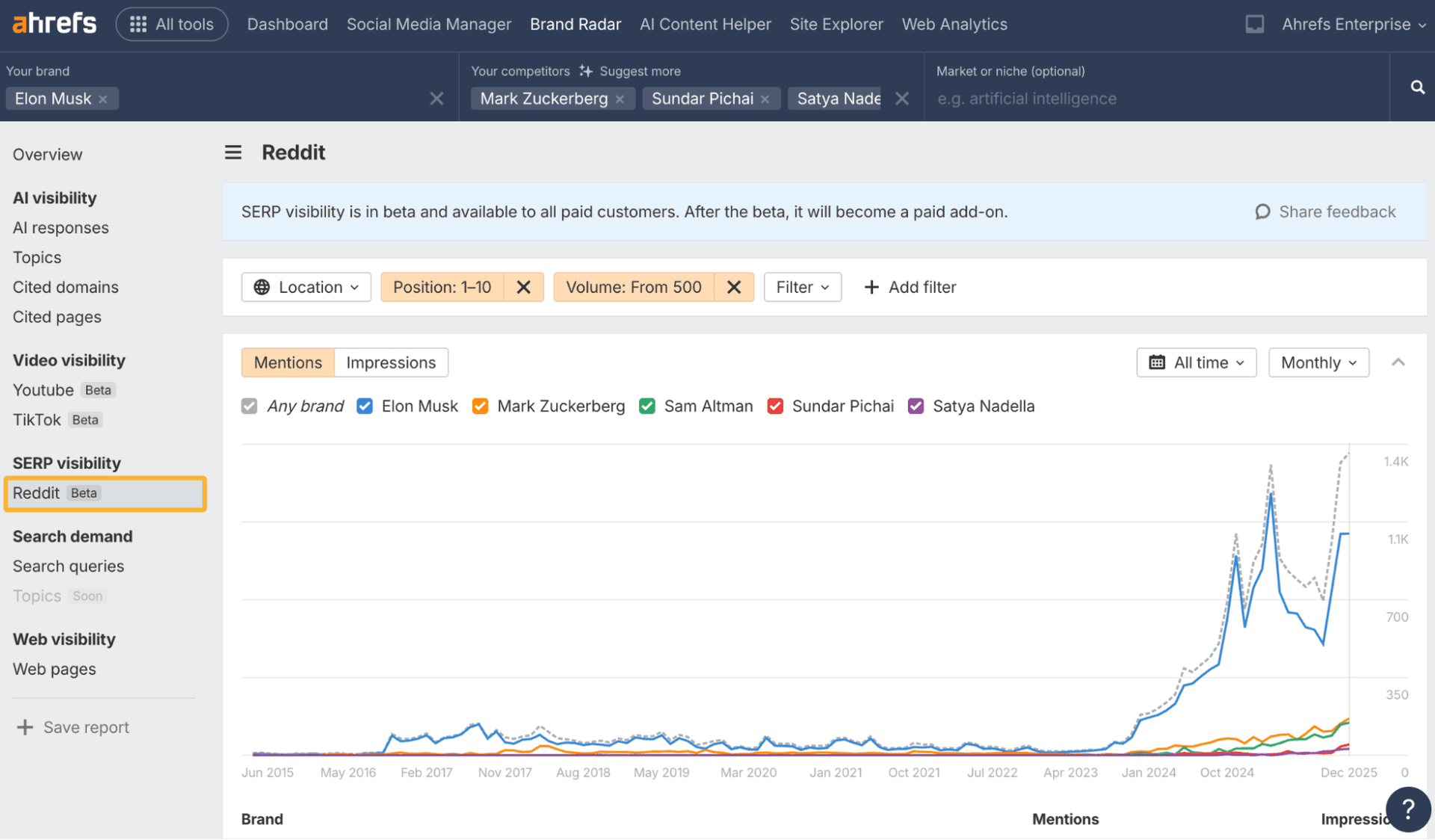
The third-party research lines up with Google’s direction. Ahrefs analyzed 75,000 brands and found that brand web mentions had the strongest correlation with AI Overview brand visibility at 0.664, while backlinks were much weaker at 0.218. That does not mean links stopped mattering, but it does mean the old obsession with link quantity looks incomplete when AI systems are trying to recognize a brand across the web.
Ahrefs also reported that 76% of AI Overview citations come from pages already in Google’s top 10, and 86% come from pages in the top 100. That is an important reality check: AI visibility is still anchored to strong underlying search performance, so a brand cannot skip the fundamentals and expect AI summaries to do the work. Good off-site signals help, but they work best when the page itself already has authority.
Semrush’s 2025 AI Overviews research shows how fast the surface area can change. AI Overviews appeared in 6.49% of keywords in January 2025, climbed to nearly 25% in July, and then settled at 15.69% in November 2025. Semrush also found that navigational queries triggering AI Overviews rose from 0.74% in January to 10.33% in October 2025. The point for agencies is simple: this is not a fixed interface, and the brands that adapt fastest will not be the ones chasing one-off optimizations.
How agencies should adjust the client brief
The practical response is not to abandon SEO. It is to widen the brief. If AI search rewards a coherent public footprint, then agencies need to coordinate content, PR, social, citations, and distribution with far more discipline than they used to. The brand has to look credible everywhere, not merely optimized on-page.
A stronger operating model usually includes:
- Content that answers real customer questions clearly, with enough depth for AI systems to trust it.
- PR and brand mentions that reinforce the same positioning the site is trying to own.
- Consistent citations and directory data so the company details are not drifting from place to place.
- Social and distribution strategies that keep the brand visible beyond owned media.
- Technical SEO that still does the basic work of making strong pages easy to crawl, rank, and cite.
That is where agencies can add real value. Instead of selling AI SEO as another isolated service, the smarter move is to use it as the reason to break down silos. If paid media is driving one message, the website says another, and PR points somewhere else entirely, AI search will highlight the disconnect. Integrated strategy is no longer a brand luxury. It is a survival requirement.
The new standard is coherence
The real lesson here is not that AI search has made SEO harder. It has made weak marketing easier to spot. Brands with thin content, patchy mentions, and inconsistent positioning will struggle because AI systems are now better at assembling the whole picture, not just reading a page title and a few links.
That is good news for agencies willing to do the harder work. The winners will be the ones that treat search as a reputation and distribution problem, not just a technical one. In an AI-first results page, the brands that surface are the ones that look established, consistent, and trustworthy everywhere the system goes looking.
This article was produced by Prism’s automated news system from verified source data, official records, and press releases, then run through automated quality and moderation checks before publishing. The system is built and supervised by the people who set the standards it runs under. Read our full AI policy.
Did this article answer your question?