AI search reshapes local visibility for multi-location brands
AI search is no longer a side feature. For multi-location brands, local visibility now depends on clean data, stronger reviews, and location pages that AI can trust.
AI search is now part of the local funnel
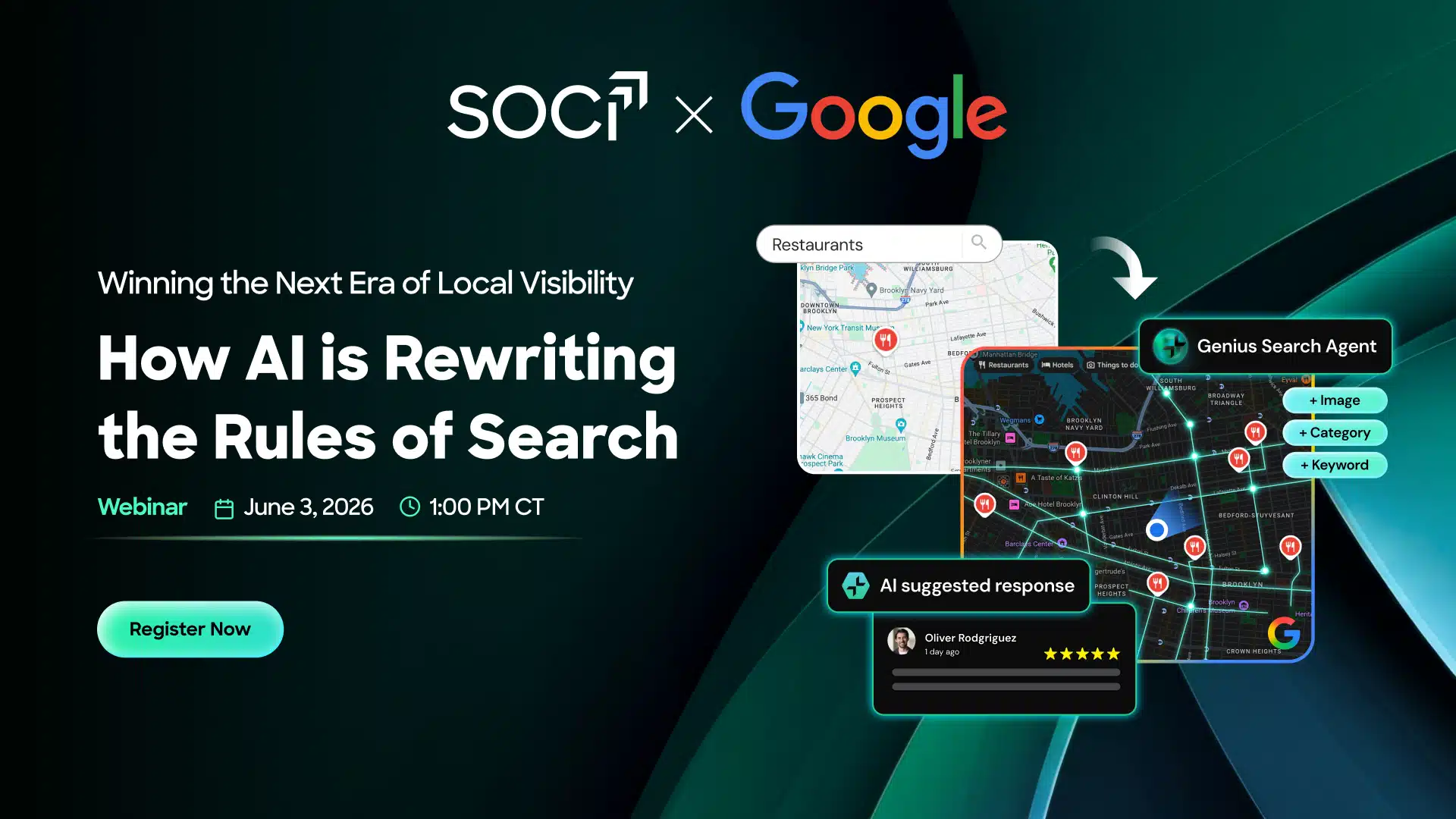
The biggest mistake agencies can make right now is treating AI search like a separate channel. Google has folded AI Overviews into Search, Gemini into search experiences, and Ask Maps into Google Maps, which means discovery now happens inside the tools people already use to find nearby businesses. Google says AI Overviews are used by more than a billion people, and Ask Maps can answer complex location questions and offer recommendations inside Maps itself.
That changes the job for any agency managing a multi-location brand. Traditional rankings still matter, but they are no longer the whole story. When Google is deciding what to show, it is also evaluating whether a business looks current, consistent, and worth recommending in an AI-generated answer.
Why the old local playbook is too narrow
Google’s guidance on local results still starts with the familiar three signals: relevance, distance, and prominence. Complete and accurate Google Business Profile information also helps businesses appear in local search results, which is a reminder that fundamentals still carry real weight. The difference now is that those same inputs are feeding more surfaces than the blue links in Search.
Google’s local listings help pages say local listings may include AI summaries compiled from multiple sources, including place summaries and review summaries. That matters because AI does not just read a listing like a static record. It is trying to synthesize evidence, which means weak profile data, stale hours, inconsistent categories, or thin review activity can all drag down the quality of the answer.
What SOCi’s local visibility data says agencies should notice
SOCi’s 2026 Local Visibility Index frames the market in a way that agency leaders should take seriously: local visibility now spans search, reputation, social, and AI discovery. The index analyzed more than 2,700 brands and 350,000 locations, which gives the findings more weight than a narrow point-in-time audit. Its headline warning is blunt: AI visibility can be three to 30 times harder to win than traditional Google local rankings.
The other number is even more revealing. SOCi says fewer than half of the brands that lead in Google local visibility also show up among the most visible brands in AI results. That overlap gap tells you this is not just a ranking tweak. It is a sign that AI systems are rewarding a broader mix of signals, and the brands that win in AI answers are not always the ones sitting on top of local pack results.
The data you need to clean up first
If you manage a franchise, healthcare network, home services group, or retail chain, start with the parts of the stack that machines read before humans do. The first pass should focus on accuracy, consistency, and completeness across every location.
- Business names, addresses, phone numbers, and hours must match everywhere the brand appears.
- Categories, service areas, and attributes should be standardized so every location is described the same way.
- Photos need to be current and location-specific, not recycled from a national brand library.
- Reviews should be monitored as a live signal, not treated as a reputation task that sits outside SEO.
- Store pages and location pages need to reflect what is true on the ground now, not what was true last quarter.
This is not busywork. Google’s systems lean on prominence and completeness, and its AI summaries can pull from multiple sources. If one location is messy, it does not just lose a ranking position. It can become less likely to be included in the answer at all.
Location pages need more depth than most brands give them
Multi-location brands often stop at a template page with a map embed, a phone number, and a few thin paragraphs of copy. That used to be enough to satisfy a basic local SEO checklist. It is not enough now, especially when AI is looking for evidence that a location deserves to be recommended in context.
Build location pages around the questions real customers ask. Hours, services, appointment rules, parking, accessibility, neighborhood landmarks, and staff expertise all help create a page that feels local rather than cloned. Ask Maps and AI Overviews are built to surface useful answers, so pages that actually answer those questions are more likely to be quoted, summarized, or used as supporting evidence.
What to standardize over the next quarter
This is the quarter to turn local SEO into a governed system instead of a collection of one-off fixes. Agencies should standardize the inputs that influence both classic local ranking and AI discovery, then report the changes in a way clients can act on.
1. Audit every Google Business Profile for completeness and consistency.
2. Compare listing data against the website, location pages, and third-party listings.
3. Review categories, hours, service areas, photos, and attributes location by location.
4. Map review volume and review freshness across the footprint, not just at the brand level.
5. Rework the weakest location pages so they include local proof, not generic brand copy.
6. Track whether the brand is visible in Google Search, Google Maps, Gemini, and AI-driven discovery surfaces like ChatGPT and Perplexity.
That last point matters because SOCi’s broader framing says local visibility now stretches across multiple platforms, not just Google Search. If your reporting still ends at organic rankings, you are missing where the market is moving.
What to report back to clients
Client reporting should shift from vanity metrics to operational ones. Instead of only showing average rank or top-three wins, show how many locations have complete profiles, how many have fresh reviews, how often core data changes are corrected, and which pages are built to answer local intent. That gives clients something they can actually manage, fund, and improve.
You should also show where AI exposure is breaking from traditional local performance. If a location ranks well but is weak in AI-driven discovery, that is a signal to tighten profile data, deepen the page content, and strengthen the review ecosystem. If a location has solid reviews and good local content but still underperforms, the issue may be consistency, prominence, or weak entity signals across the broader footprint.
The practical takeaway for agencies
Google is embedding AI directly into Search and Maps, not keeping it in a separate experimental lane. That means the local visibility game is expanding, not replacing old signals but layering new ones on top of them. For multi-location brands, the winners will be the ones that treat data governance, reputation, and location content as one operating system.
The agencies that adapt fastest will not just chase rankings. They will build cleaner listings, stronger review patterns, and better location pages, then measure how those inputs travel across Search, Maps, Gemini, and AI-generated answers. That is where local visibility is heading, and the brands that keep their house in order will be the ones AI keeps putting in front of customers.
This article was produced by Prism’s automated news system from verified source data, official records, and press releases, then run through automated quality and moderation checks before publishing. The system is built and supervised by the people who set the standards it runs under. Read our full AI policy.
Did this article answer your question?