AI search visibility depends more on intent than exact prompts
Intent beats keyword tinkering in AI search. Agencies that map buyer jobs, not prompt variants, will measure cleaner, win more often, and waste less time.
AI search visibility is drifting away from exact prompt matching and toward the bigger question underneath the prompt: what does the user actually need? That shift matters because it changes how you build briefs, how you map content, and how you judge success in GEO and AI visibility programs. If you keep obsessing over tiny wording variants, you end up measuring noise instead of demand.
What the prompt-tracking data really shows
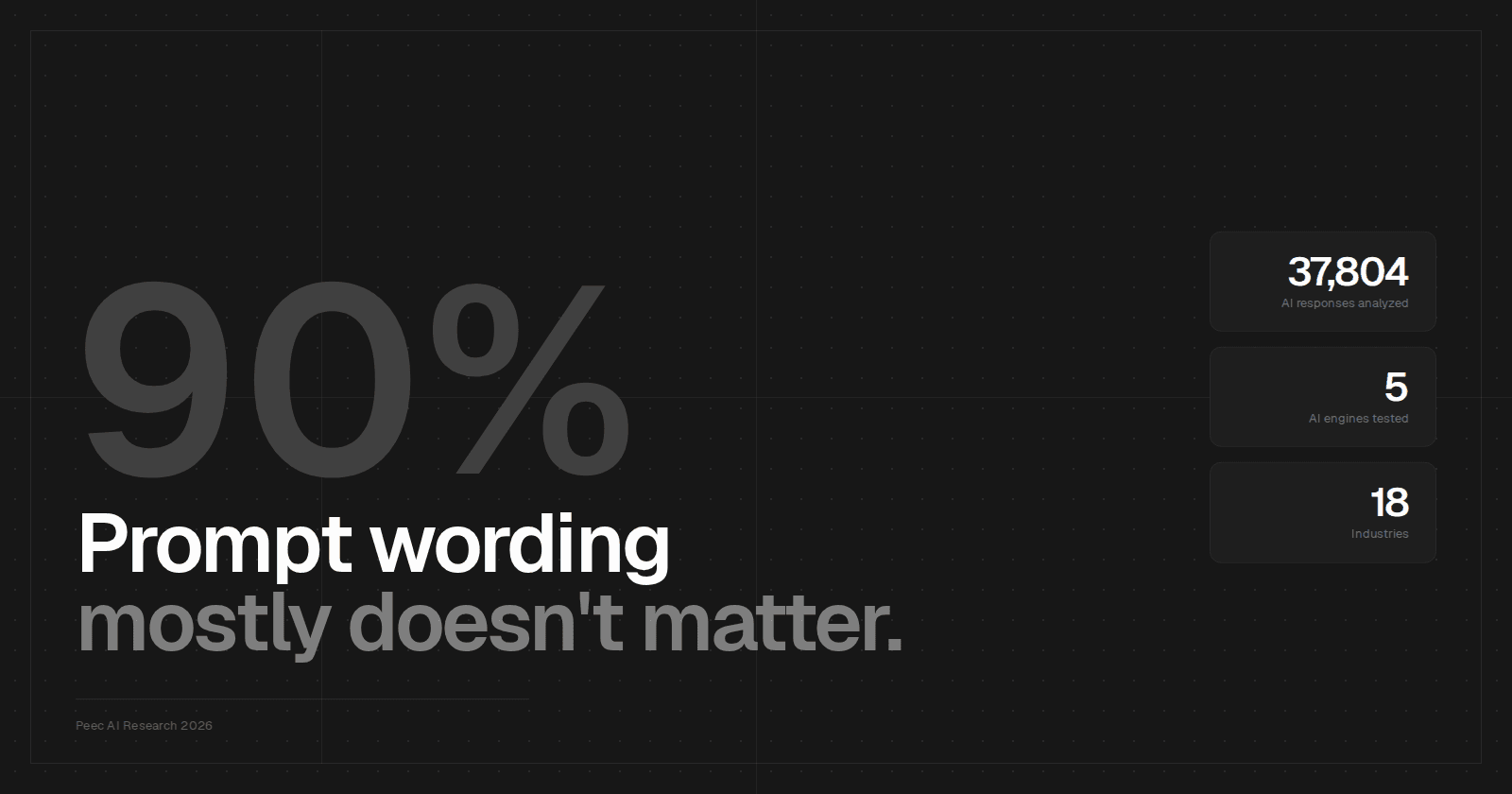
A Peec AI analysis of 37,804 AI responses across five LLM engines found that prompt wording matters less than many marketers assume. The practical takeaway is simple: if two prompts are asking for the same job to be done, the system is often responding to the shared intent, not to whether the query used one keyword variant or another. That does not make keywords irrelevant, but it does put them in their proper place.
The more useful lens is category intent. A prompt about comparing products, solving a problem, or deciding between options is not just a string of terms to match. It is a signal about the answer shape the model should favor, which is why clarity, entity coverage, and decision support matter so much in the pages that win visibility.
Why agencies need to stop treating prompt lists like keyword lists
For agency operators, this changes the job in two places at once. First, content creation has to start with the problems and jobs-to-be-done buyers actually express, not with a spreadsheet of keyword permutations. Second, prompt tracking has to focus on representative questions and decision situations instead of trying to map every possible phrasal variation that might be typed into ChatGPT, Gemini, or Perplexity.
That approach does more than save time. It keeps measurement tied to the real commercial moments that matter, especially in GEO campaigns where the point is not to catch every possible wording but to understand whether your brand appears when a buyer is trying to choose, compare, or solve. In practice, the winning pages are usually the ones that answer the underlying intent cleanly enough that the model can trust them.
Build briefs around intent, not just terms
This is where content architecture becomes the main event. If a prompt is fundamentally about a category comparison, a how-to task, or a buying decision, your brief needs to cover the entities, proof points, and decision criteria that fit that intent. That means mapping pages to questions like: what is the buyer trying to accomplish, what alternatives are in play, and what evidence would make the answer feel complete?
- one page for the primary problem or decision state
- supporting pages for comparison, use cases, and objections
- clear entity references so the model understands who and what you mean
- enough detail to answer both short, search-like prompts and richer, context-heavy ones
The result is a cleaner editorial system:
That structure is more durable than chasing wording variants because it aligns with how AI systems seem to interpret user need. It also forces a better internal discipline: every page has to earn its place by contributing something specific to the intent map.
Use real prompt behavior as your testing baseline
The user side of the story backs this up. Search Engine Land’s coverage of Stella Rising survey data found that two-thirds of respondents wrote AI prompts of 15 words or fewer. About 60% framed queries as questions, and only 9% used direct commands. At the same time, users are increasingly adding context like budget, location, profession, age, health concerns, and preferences.
That combination matters. It tells you users are not abandoning the habits of search, but they are enriching those habits with personal context. So your testing methodology should reflect both patterns: short, query-like prompts and longer prompts with modifiers that change the answer. If your content only handles one of those forms, you are leaving visibility on the table.
Treat prompt tracking like measurement, not magic
There is also a hard technical reason to be careful. Kevin Indig has argued that prompt tracking is noisy because LLMs are probabilistic systems. Identical prompts can produce different answers, and one study he cited found within-LLM variance of 10% to 34% on identical prompts. In a collaboration he referenced, running the same prompt three times in ChatGPT left only 2.2% of citations remaining.
That means agency reporting needs stronger methods than a single prompt run and a screenshot. Repeated runs, fixed sampling rules, and confidence intervals make the work more defensible. More importantly, they push you toward canonical intents instead of fetishizing every wording permutation. If the same buyer need keeps surfacing through slightly different phrasing, that is one intent cluster, not 20 separate tracking opportunities.
Visibility is only half the battle
Another piece of the puzzle is trust. Burson’s Credibility Paradox analysis modeled more than 55,000 scores across seven AI platforms and 85 companies, and it found AI responses were modeled as 10% more credible for business audiences than for others. That suggests the next layer of competition is not simply whether your brand is mentioned, but whether the answer feels believable enough to matter.
For content strategy, that pushes you beyond keyword coverage and into evidence. You need proof, specificity, and entity credibility. If a model is deciding which source best supports an answer, generic copy will not compete with content that clearly shows expertise, product details, comparison points, and decision support.
Why all of this matters for agency growth
The commercial-query data makes the opportunity harder to ignore. In Peec AI’s broader sample of 500,000 prompts, Google AI Overviews appeared in about 87% of queries. Decision-stage prompts showed AI Overviews 88.5% of the time, two-word queries returned an AI Overview 64.6% of the time, and prompts of 11 to 15 words peaked near 89%. The pattern also varied by region, with 76% in the European Union and 90.3% outside it, while France came in at 0% because Google had not launched AI Overviews or AI Mode there.
That is a strong signal that funnel stage matters as much as wording. If AI Overviews are showing up most often in decision-heavy moments, agencies need to report on coverage by intent stage, not just by keyword set. The visibility win is no longer “we rank for this phrase.” It is “we appear when a buyer is ready to decide.”
The new agency playbook
The cleanest operating model is not complicated: 1. Define the intent clusters that actually drive buying behavior. 2. Map content to those clusters with clear entity coverage and decision support. 3. Test with representative prompts, multiple runs, and a noise-aware reporting method.
That is the practical shift hiding inside all the prompt-tracking data. Search visibility in AI systems is not about repeating the exact phrase someone typed. It is about how well your content aligns with the need behind the phrase, and how consistently that alignment survives across models, prompts, and decision contexts.
Pew Research Center’s analysis underscores why the stakes are high. In a panel of 900 U.S. adults covering 68,879 unique Google searches, 58% conducted at least one search in March 2025 that produced an AI-generated summary, and users were less likely to click links when that summary appeared. In other words, being part of the answer is becoming more valuable than simply sitting below it. Agencies that build around intent will be better positioned for that reality than agencies still trying to win by keyword friction alone.
This article was produced by Prism’s automated news system from verified source data, official records, and press releases, then run through automated quality and moderation checks before publishing. The system is built and supervised by the people who set the standards it runs under. Read our full AI policy.
Know something we missed? Have a correction or additional information?
Submit a Tip