Digital Applied argues topic clusters are now an architecture decision
Topic clusters are now an architecture decision, not a blog-count tactic. That shift changes site structure, internal linking, briefs, retainers, and what agencies should measure.
Topic clusters are a site map, not a post quota
Topic clusters only look like a content plan until you try to scale them across a real site. Digital Applied’s guide makes the sharper case: clustering is an information-architecture decision, one that changes how pages are grouped, how they link, and how a brand earns authority across a subject instead of chasing isolated keywords.

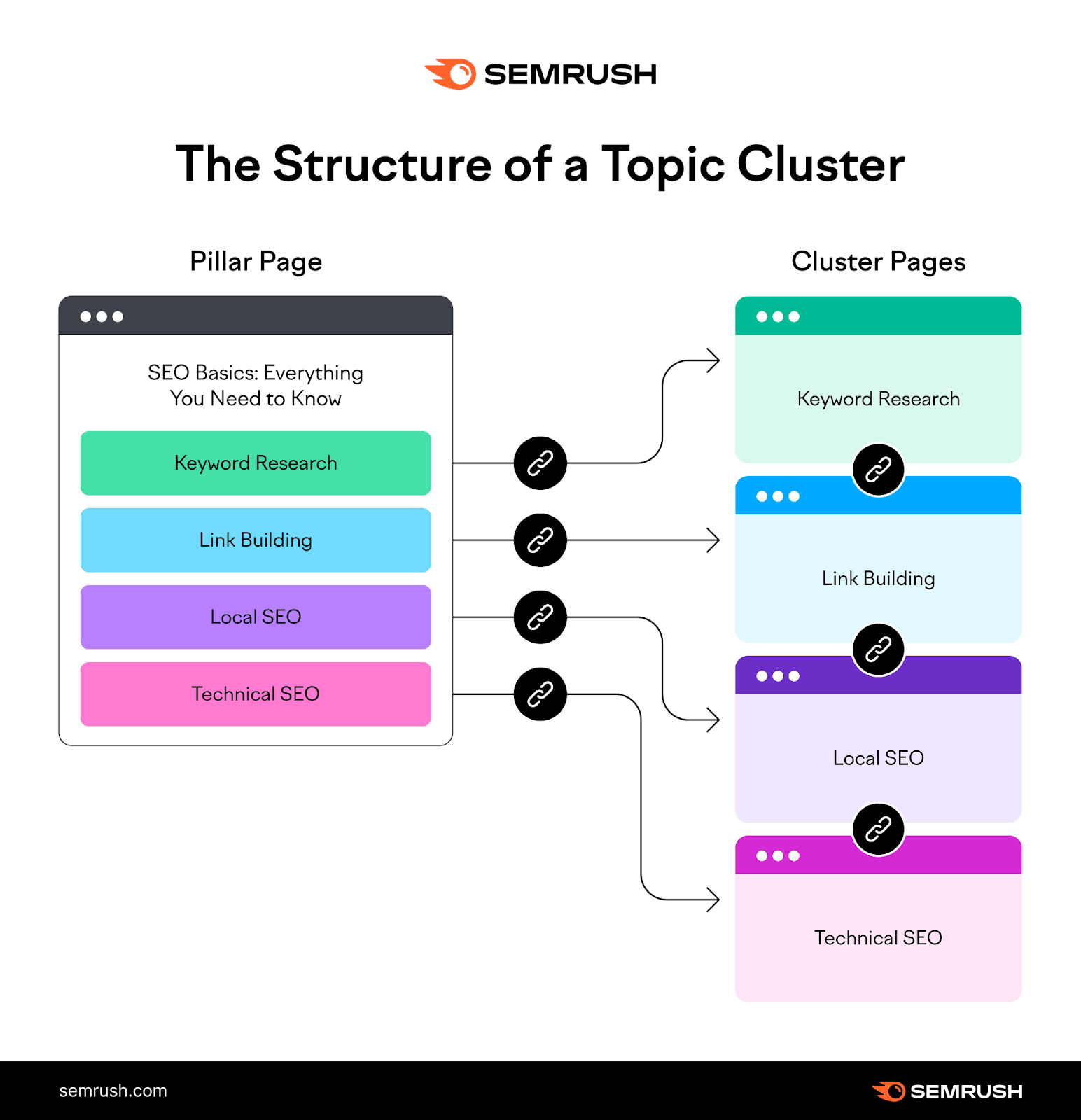
That matters because the old habit of “publish more blogs” is giving way to a more exacting standard. A single pillar page now carries the broad subject, cluster articles dig into the subtopics, and internal links do the heavy lifting that lets Google, and increasingly AI-generated answers, read the site as one coherent body of work.
The structure behind the strategy
At its simplest, the pillar-and-cluster model is built around one central page and a set of supporting articles. The pillar page covers the category-level topic, while each cluster article handles a narrower question, use case, or subtopic in depth. The point is not just coverage, but connected coverage, with links binding the pages together so the search engine can see the topical relationship instead of a pile of disconnected posts.
That is where the operational shift shows up. Topic selection affects site structure. Site structure affects internal linking. Internal linking affects the way content briefs are written, because each brief has to support a role in the cluster, not just hit a keyword target. Once you start thinking this way, a cluster stops being a batch of articles and becomes a system.
Why architecture beats keyword volume
Digital Applied’s argument is that modern search rewards entity-based topical coverage more than raw keyword output. The practical takeaway is simple: a site with deep, interconnected coverage of one subject is in a better position than a site that sprays out loosely related articles and hopes volume carries the day.
The guide leans on the 2024 Google API leak to reinforce that point, citing two signals, siteFocusScore and siteRadius, as evidence that concentrated topical coverage can help while off-topic sprawl can dilute authority. Whether you are planning a service-page hub, a product education section, or a knowledge base, the logic is the same: breadth without coherence is a liability.
That lines up with Google Search Central guidance as well. Google says to create a logical site structure, link important pages from relevant pages, and use concise, relevant anchor text so people and Google can make sense of the site more easily. Google also says its ranking systems are designed to prioritize helpful, reliable, people-first content over content built to manipulate rankings. In other words, the mechanics of clustering are not a trick. They are the cleanest way to present useful coverage.
What this means for agencies
For agencies, the biggest change is not editorial, it is commercial. If topic clusters are treated as architecture, then retainers need to account for planning, mapping, and consolidation work before anyone starts drafting headlines. A client that wants durable organic growth may need a topic architecture redesign before it needs another wave of copywriting.
That pushes agencies toward a different workflow. Strategists have to scope the topic, editors have to define the pillar and the supporting leaves, SEOs have to plan internal links and anchor text, and writers have to produce content that fits a larger map. The old model, where success was counted in article volume, starts to look thin fast.
A better retainer usually includes:
- A pillar scoping session that defines the main topic and the coverage boundary.
- Cluster mapping that shows which questions deserve their own pages and which belong inside the pillar.
- Internal linking planning, so each article points to the right pages with relevant anchor text.
- Consolidation decisions for overlapping posts, which is often where the real value sits.
- Ongoing refresh work, because architecture only matters if the site keeps its structure as it grows.
Use the right measurement, not just more output
Once the architecture is in place, raw content count becomes a weak metric. A site can publish a dozen articles and still fail if the pages do not reinforce one another or if the coverage drifts too far from the core topic. The better question is whether the site is becoming easier for search systems to interpret as a focused authority.
That means measuring the things architecture actually changes: whether the pillar holds the cluster together, whether important pages are linked from relevant pages, whether the anchor text is clear, and whether the content stack is broad enough to show real subject depth without wandering into off-topic sprawl. For agencies, this is where reporting gets more honest. A smaller number of well-connected pages can outperform a larger pile of disconnected posts.
The guide’s pillar scoping scorecard and consolidate-versus-split matrix are useful because they force that decision before writing starts. If a topic is already covered in another page, the right move may be to merge. If a subtopic is distinct enough to stand alone, it earns a cluster page. That is architecture work, not publishing for its own sake.
The Google and AI search overlap
The cluster model is also being reframed as a bridge between SEO and GEO. The reason is obvious enough: the same structure that helps Google understand a topic can also help AI systems surface a site inside generated answers. Google’s own guidance on AI experiences says AI Overviews display links in a range of ways and surface a wider range of sources, which makes a clearly organized topic hub even more useful.
The timeline matters here. Google introduced expanded AI Overviews at Google I/O on May 14, 2024, then said in October 2024 that AI Overviews were expanding to more than 100 countries and territories and reaching more than 1 billion monthly users. By May 2025, Google said AI Overviews were available in over 200 countries and territories and more than 40 languages. In May 2026, Google published Search Central guidance saying SEO best practices still matter for generative AI features because those features are rooted in Google’s core ranking and quality systems.
That is the key takeaway for anyone building content now. Topic clusters are not a decorative editorial format. They are a way to organize a site for classic search, for AI-powered search, and for the kind of authority that survives beyond one algorithm update. The agencies that adapt will stop selling blog volume and start selling structure, which is where the real leverage lives.
This article was produced by Prism’s automated news system from verified source data, official records, and press releases, then run through automated quality and moderation checks before publishing. The system is built and supervised by the people who set the standards it runs under. Read our full AI policy.
Know something we missed? Have a correction or additional information?
Submit a Tip