Google Expands Universal Commerce Protocol Into Search Product Listings
Google is pushing Universal Commerce Protocol into main search product listings, turning the SERP into a checkout surface and forcing agencies to optimize for feed quality, not just clicks.
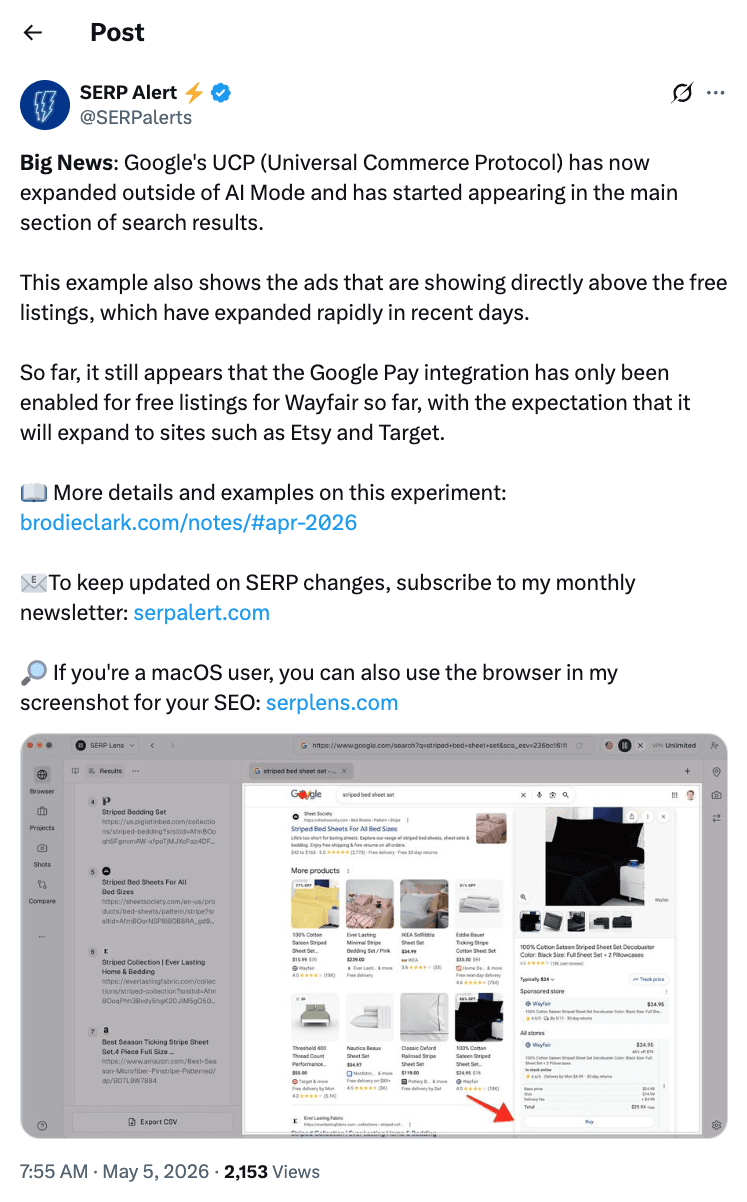
Google’s Universal Commerce Protocol is moving out of its early checkout lane and into product listings on the main search results page, with Wayfair appearing to be first in line. That matters because the SERP is no longer just a place to win visibility. It is becoming a transaction surface, where product data, inventory signals and checkout readiness can decide whether a shopper buys without ever reaching a retailer’s site.
Google launched UCP on Jan. 11, 2026 as an open standard for agentic commerce, built with Shopify, Etsy, Wayfair, Target and Walmart, and backed by more than 20 other companies across retail and payments, including Adyen, American Express, Best Buy, Flipkart, Macy’s Inc., Mastercard, Stripe, The Home Depot, Visa and Zalando. Google designed the protocol to cover the full shopping journey, from discovery to buying to post-purchase support, and its developer documentation says UCP already powers agentic actions in AI Mode on Google Search and Gemini, starting with direct buying.
The company has also been careful to keep merchants in control. Under UCP, merchants remain the merchant of record and keep customer data and relationships, while shoppers can buy with Google Pay using payment methods and shipping information already saved in Google Wallet, with PayPal support planned. Wayfair said on Jan. 12, 2026 that it is a foundational partner in the protocol and that shoppers can check out directly from Wayfair without leaving Google, while Wayfair remains the merchant of record and keeps pricing, fulfillment and support consistent.
Google widened the system again in March 2026, adding Cart support, real-time Catalog access for pricing and inventory, and Identity Linking for loyalty or member benefits. Google also said it is simplifying UCP onboarding in Merchant Center, which is the part agencies should care about most. If more retailers can plug into these flows faster, then the competitive game shifts from just ranking a product page to maintaining clean feeds, accurate availability, strong identity matching and frictionless checkout logic that can survive inside Google’s own commerce experience.
That shift fits the broader retail pitch Google has been making. At NRF 2026, Sundar Pichai said Google has worked with retailers for more than two decades, and noted that Google Search has provided real-time Shopping Graph data since 2021, with more than 50 billion product listings now in the graph. For SEO agencies serving retailers, the message is blunt: product visibility, transaction readiness and marketplace-style competition are converging. The firms that keep treating ecommerce SEO as a traffic-only exercise will miss where the conversion is moving.
This article was produced by Prism’s automated news system from verified source data, official records, and press releases, then run through automated quality and moderation checks before publishing. The system is built and supervised by the people who set the standards it runs under. Read our full AI policy.
Did this article answer your question?


