Top White Label Website Development Agencies for Scaling in 2026
Hiring a developer costs $104K+ annually once overhead is counted; white-label web development partners offer team-based capacity at a fraction of that, and here's how to choose them.
The scale inflection most agency owners hit isn't gradual. It arrives when a third client signs in five weeks and the dev queue is already full. The choice that follows, hire or outsource, looks very different depending on which numbers you're actually running.
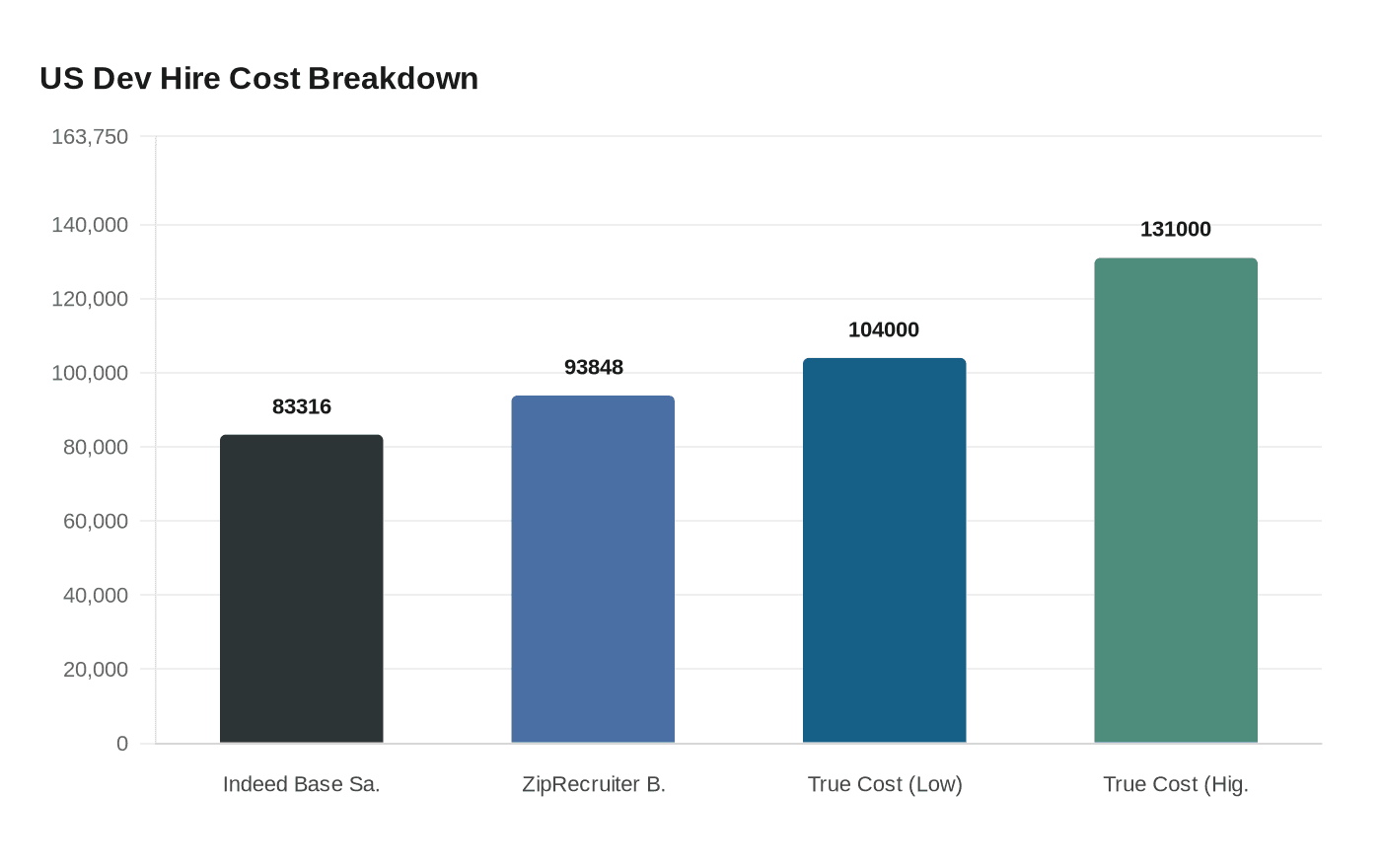
A mid-level web developer in the United States commands an average base salary of $83,316 per year according to Indeed's March 2026 benchmark, drawn from 1,400+ active job postings, with ZipRecruiter placing the figure at $93,848. Apply the standard employer overhead multiplier of 25 to 40 percent, covering benefits, payroll taxes, equipment, and onboarding time, and the true annualized cost of a single developer lands between $104,000 and $131,000. That number is what white-label fulfillment competes against, not just the line item on a vendor invoice.
The demand backdrop makes this a structural question, not a temporary one. According to Business Research Insights and Mordor Intelligence, the global web development market is valued at $82.4 to $87.75 billion in 2026 and is projected to reach $134 to $165 billion by 2031 to 2035 at CAGRs between 8.03% and 8.87%. North America holds 39.4% of current market revenue. Progressive Web Apps are among the fastest-growing sub-segments at a 13.45% CAGR. Asia-Pacific is the fastest-growing regional market at 17.05%, a dynamic that makes offshore-staffed white-label vendors increasingly competitive on both cost and quality. Digital agencies have averaged 12% annual growth over five years, according to Promethean Research's 2025 Digital Agency Industry Report, outpacing the broader U.S. market. That compounding growth creates a capacity gap white-label partners are positioned to fill systematically.
Prince Kapoor's 2026 white-label web development guide published on ViralChilly evaluates providers across a consistent scorecard: platform coverage (WordPress, Shopify, headless), QA documentation, team-based delivery capacity, NDA and brand-masking practices, pricing transparency, and SLA clarity on turnaround and code handoff. Those same criteria are the vetting checklist every agency should apply before signing a white-label development agreement. Here are the agencies worth serious consideration.
1. ViralChilly
ViralChilly operates both as a practitioner-focused agency-operations publisher and as an active white-label web development provider, giving them an unusually direct view of where delivery models break. Their engagement model centers on capacity multiplication: outsourcing a build frees the agency's internal schedule to absorb concurrent projects, and it's the unlocked revenue from that second engagement that makes the ROI math compelling, not just the margin on the first.
2. Seahawk Media
Seahawk Media is a WordPress-specialist white-label partner covering custom web design, development, site migration, and hacked site repair. Client reviews across multiple independent sources consistently cite smooth handoffs, clear communication, and dependable delivery timelines; those three attributes matter more than headline pricing when your agency's SLA to the end client is on the line.
3. Uplers
Uplers has served agencies and businesses across industries for more than 12 years with white-label coverage spanning web development and design, software development, quality assurance, and mobile app development. Their breadth makes them a practical single-vendor solution for agencies that want to avoid managing separate relationships for every discipline type in their project mix.
4. PixelCrayons

PixelCrayons publishes specific delivery metrics that most white-label vendors don't: 40% faster project delivery and a 98% QA pass rate, supported by agile sprints, CI/CD pipelines, and automated testing protocols. For agencies that need to demonstrate documented QA processes to enterprise clients or back their own SLAs with verifiable methodology, that transparency is operationally significant.
5. E2M Solutions
E2M Solutions has maintained a consistent reputation in the white-label web design space across multiple years and industry rankings. Their longevity as an agency-facing partner is a useful proxy for process maturity: vendors who have absorbed and corrected delivery failures across hundreds of projects represent lower risk than newer entrants running comparable fee structures.
6. OuterBox
OuterBox builds white-label websites with explicit emphasis on usability, speed, and conversion performance, with deep eCommerce experience informing their approach to site structure, navigation, and checkout flow. Critically, their site architecture is built with SEO considerations embedded from the outset rather than retrofitted, which directly addresses the dev-to-SEO handoff gap that causes technical SEO regressions on agency-delivered sites.
7. GetDevDone
GetDevDone brings two decades in the market to an on-demand delivery model that suits agencies with variable monthly project volumes rather than predictable retainer workloads. Their verified client satisfaction record across a meaningful review base reflects a process maturity that comes only from having handled the failure modes of complex builds repeatedly, long before your projects arrive.
8. Wildnet Technologies
Wildnet Technologies leads with an AI-first delivery model and multi-channel white-label capabilities spanning web development, SEO, PPC, and broader digital marketing execution. For agencies whose client service mix is expanding beyond pure web builds, Wildnet's integrated stack reduces the coordination overhead that multiplies when you're managing three or four separate white-label vendors simultaneously.
9. Pronto Marketing
Pronto Marketing focuses on hands-free digital delivery with particular strength serving IT managed service providers and small B2B consultancies through white-label web development and SEO programs. Its plug-and-play onboarding and reputation for low-friction collaboration suit agencies that want a reliable execution partner without heavy ongoing management overhead on their side of the relationship.
The Vendor-Vetting Checklist
Before committing to any white-label web development partner, ViralChilly's guide identifies five contractual and operational requirements that separate low-risk partnerships from expensive ones.
1. QA Process Documentation: Demand written QA protocols, not verbal assurances.
Cross-browser and device testing, automated checks, and defined pass/fail thresholds protect your SLA and give you evidence to show clients when quality disputes arise.
2. Dev-to-SEO Handoff Standards: Require staging-server access and a defined handoff checklist covering meta structure, schema markup, site speed targets, and crawlability before any build goes live.
This is the step most white-label arrangements skip, and where technical SEO regressions originate.
3. Revision Policy in Writing: Confirm the number of included revision rounds, what specifically triggers a change order, and what the turnaround SLA is on each round.
Ambiguity here becomes margin erosion.
4. Code Ownership and Portability: The agency must own the code.
Require version control access through GitHub or equivalent, and confirm you can migrate the codebase to any hosting environment without vendor permission or supplemental fees.
5. Brand Masking and NDA: All deliverables carry your branding exclusively.
Require an NDA prohibiting the vendor from contacting your clients directly or using your clients in their own case studies and marketing without written consent.
6. Pilot Project Policy: Run one project before committing to a retainer or multi-project agreement.
A vendor who resists a paid pilot is signaling something about their confidence in their own process.
The margin math across all of this resolves cleanly: a white-label partner on per-project or retainer pricing delivers team-based, redundant capacity at a fraction of the $104,000 to $131,000 true annual cost of one in-house developer. The global digital marketing outsourcing market is growing from $25.4 billion in 2024 toward $74.76 billion by 2034 at an 11.4% CAGR, per Market.us research, with the U.S. segment alone expanding from $8.8 billion to an estimated $23.5 billion in the same window. Agencies that build the right white-label partnerships now, with proper contracts and clear delivery standards, are constructing delivery infrastructure that scales with their revenue rather than against it.
This article was produced by Prism’s automated news system from verified source data, official records, and press releases, then run through automated quality and moderation checks before publishing. The system is built and supervised by the people who set the standards it runs under. Read our full AI policy.
Did this article answer your question?