Ahrefs Says AI Visibility Improves With Clear, Answer-First Writing
Ahrefs argues AI visibility starts with writing that humans can skim and machines can quote. The fix is simple: lead with the answer, name specifics, and stop burying the payoff.
The real shift is editorial, not just technical
Ahrefs’ point is blunt: if you want AI systems to cite your page, make the page easier to skim. The same habits that help a reader find the answer fast, clean structure, concrete terms, clear framing, also help answer engines pull the right passage without guessing.

That overlap matters because AI systems and humans both lean on shortcuts. Both scan for fast cues, both reward pages that surface meaning quickly, and both struggle when the answer is buried under throat-clearing. In practice, that means AI visibility is less about gaming a system and more about writing like the source deserves to be quoted.
Start with BLUF and put the bottom line first
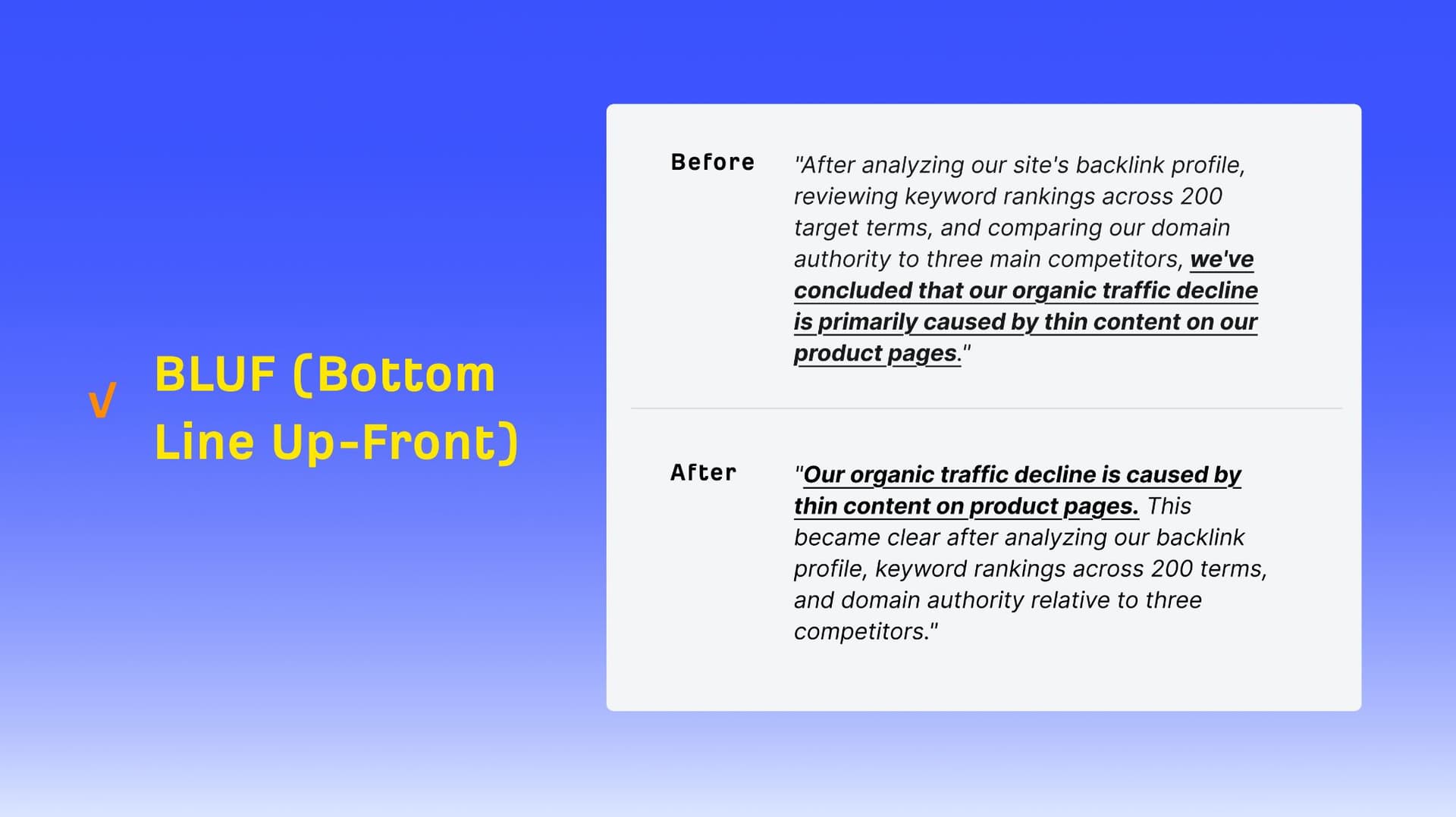
The strongest framework in the Ahrefs piece is BLUF, short for Bottom Line Up Front. Princeton University Press describes it as a U.S. military communication style that puts the bottom line first, and Animalz has made the same point in plain language: busy readers want the takeaway immediately.
That format translates cleanly to modern search and AI answers. State the conclusion at the top of the section, then spend the rest of the paragraph proving it. If the answer is “clear, answer-first writing improves AI visibility,” say that immediately, then unpack the mechanics with the supporting evidence underneath.
A simple BLUF pattern that works
- Lead with the conclusion in the first sentence.
- Name the entity, product, or concept right away.
- Follow with one or two sentences of proof or context.
- Save nuance for the lines that come after the answer.
That sequence is not decorative. It gives both readers and models a clean path from claim to support, which is exactly what extractive systems need when they decide what to cite.
Specificity beats vague polish
Ahrefs also highlights a writing style that is rich in concrete entities, question-and-answer structures, and confident claims. That is a useful reminder for anyone tempted to write in soft, brand-safe abstractions. AI systems are far more useful when the page says exactly what it means, names the thing being discussed, and answers the obvious question before moving on.
This is where a lot of content still fails. Pages that pad the opening with generalities force the reader to hunt for the answer, and they give the model less to latch onto. A tighter structure, with named tools, specific terms, and explicit conclusions, makes the page easier to retrieve and easier to cite accurately.
Why the first screen matters so much
Ahrefs notes a research-backed pattern that shows up in citation behavior: a large share of citations come from the first 30% of content. CXL’s 2026 study makes that even more concrete, reporting that 55% of Google AI Overview citations came from the first 30% of content, while only 21% came from the bottom 40%.
That is the part many writers still miss. The answer is not simply to write a better article. It is to place the useful answer where the system is most likely to encounter it, which usually means the top of the page, the top of the section, and the first sentence after the heading.
What AI visibility looks like in Google now
Google has already made AI Overviews part of the core search experience. The company said the feature began rolling out to everyone in the United States in May 2024, and by May 2025 it said AI Overviews were available in more than 200 countries and territories and more than 40 languages.
Google Search Central’s message is just as important: the same SEO best practices still matter for AI features like AI Overviews and AI Mode. That means AEO is not replacing search fundamentals. It is layering answer extraction on top of them, which makes structure, clarity, and topical relevance even more valuable than before.
Clicks are under pressure, so being cited matters more
Pew Research Center’s numbers show why this is more than a writing style debate. In March 2025, about 18% of Google searches produced an AI summary, and users were less likely to click links when one appeared. Pew also found that 88% of those summaries cited three or more sources, which means being in the citation set is becoming the visibility goal, not just ranking high on the page.
That changes the editorial target. If a summary is going to absorb attention before the click, then the page has to be written so the model can confidently lift the right lines. In that environment, the best source is the one that answers cleanly, names things precisely, and gives the system no reason to look elsewhere for the core fact.
AEO is becoming a reporting discipline, not just a search tactic
The market is starting to treat AI visibility as its own measurement layer. Conductor’s 2026 AEO and GEO benchmarks report frames AI as a critical brand visibility channel, which is a useful way to think about the problem if you are responsible for both discovery and attribution. Microsoft Advertising has also launched an AI performance dashboard that can show which pages are being used as citations in AI answers.
That kind of reporting matters because it turns writing choices into measurable outcomes. If a page is getting cited, the structure is working. If the model keeps skipping it, the answer may be there, but the page is not making it easy enough to find.
The practical playbook for writing that gets cited
The useful takeaway from Ahrefs is not that writers should chase another trick. It is that clear prose is now a search advantage. The pages most likely to surface in AI answers are the ones that feel organized, direct, and easy to parse from the first line to the last.
A good working checklist looks like this:
- Put the answer in the opening sentence of the section.
- Use concrete entities instead of vague labels.
- Frame sections as direct answers to real questions.
- Keep the first paragraph loaded with the strongest point.
- Write supporting detail in a way that can be quoted without cleanup.
- Avoid hiding the conclusion in the final sentence.
That is the overlap Ahrefs is really pointing to: readability and extractability are converging. The writer who makes a page easier for humans to skim is often making it easier for AI systems to cite as well. In a search landscape shaped by AI Overviews, that is no longer a stylistic preference. It is the shortest path to being seen.
This article was produced by Prism’s automated news system from verified source data, official records, and press releases, then run through automated quality and moderation checks before publishing. The system is built and supervised by the people who set the standards it runs under. Read our full AI policy.
Did this article answer your question?