Microsoft rethinks search indexing for factual, confidence-based AI answers
Microsoft is recasting Bing around evidence, not rankings, and that changes what it takes for a brand to show up in AI answers.
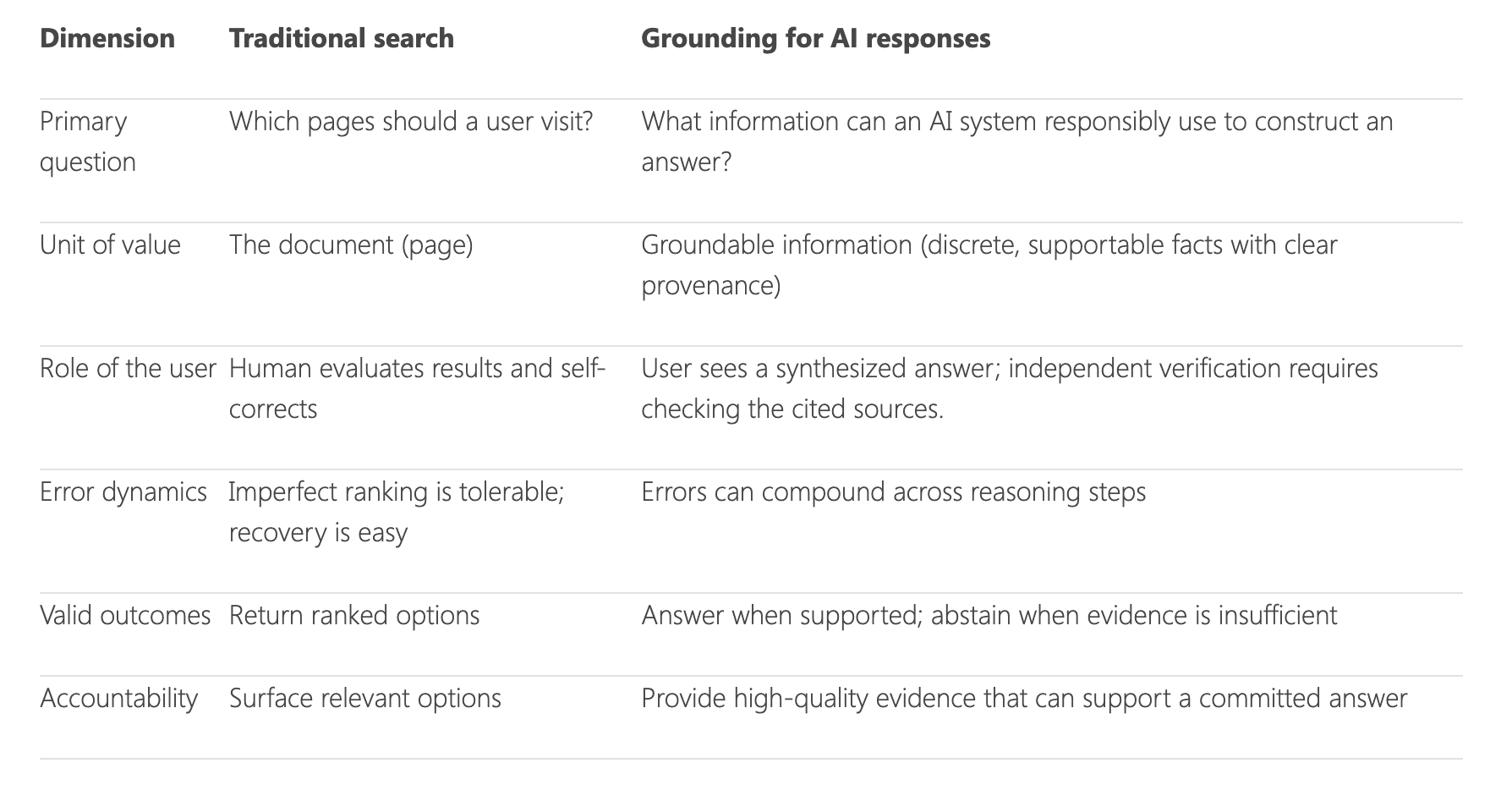
Search is moving from ranking pages to grounding answers
Microsoft is signaling a clean break with classic search indexing: AI answers cannot be built on a document-ranking system alone. In Bing’s new framing, the index has to help the system decide which specific facts can responsibly support an answer, not just which pages deserve a click. That is a subtle shift in language, but a major shift in infrastructure, because the unit of value is moving from documents to groundable information with clear provenance.

That matters most once an AI system commits to a response. Traditional search can recover from a weak result by ranking another page higher or lower; grounded AI systems have to make a judgment before they speak. Microsoft’s message is that the search stack now has to support factual, attributable, confidence-based answers at the entity, fact, and passage level if those answers are going to be surfaced reliably.
Why the old index creates new risks in AI search
The failure modes Microsoft is worried about are not abstract. Stale content is more dangerous in grounded AI because it can directly produce a wrong answer instead of merely slipping down a results page. Conflicting sources are another problem, since the system has to recognize disagreement before it tries to synthesize a response. In other words, the index is no longer only a retrieval layer; it is part of the answer-quality control system.
That also changes how retrieval itself works. Microsoft describes AI systems as repeatedly retrieving information, refining earlier results, combining evidence, and reassessing confidence before answering. That is a much more intricate loop than the old query-in, result-out pattern, and it raises the bar for content quality. If a page is fresh, easy to identify, easy to trust, and easy to ground, it becomes far more useful to the answer engine.
Microsoft has been staging this shift for years
The May 6, 2026 Bing Search Blog post, “Evolving role of the index: From ranking pages to supporting answers,” is not a sudden pivot so much as the latest step in a staged migration. Microsoft launched the first AI-powered Bing preview in February 2023, presenting it as an AI copilot for the web. On July 24, 2024, Bing introduced generative search for a small percentage of user queries while still keeping traditional search results visible.
That timeline is important because it shows how carefully Microsoft has been building the bridge from search to synthesis. Under the broader Bing leadership story associated with Satya Nadella, Yusuf Mehdi, and Jordi Ribas, the company has been moving from a world where users choose among ranked pages to one where the system itself assembles a response. The Redmond, Washington company is making clear that the index has to evolve with that new job.
Grounding is becoming a product, not just a concept
Microsoft has also turned grounding into an operational layer inside its AI stack. In January 2025, the company said Grounding with Bing Search was designed to bridge the temporal limitations of large language models and real-time web data. That is the practical problem underneath all the rhetoric: models know a lot, but they do not know what changed five minutes ago, and search has to supply that missing context.
The commercial details make the shift even more concrete. Microsoft’s Grounding with Bing Search and Grounding with Bing Custom Search are priced at $14 per 1,000 transactions. The service also carries a maximum of 150 transactions per second and 1 million transactions per day. Those limits show that grounding is not a side experiment. It is becoming a managed infrastructure layer that developers can actually build on through Azure AI Foundry or a Web Knowledge Source.
Microsoft says the final output includes the model result grounded with Bing data and citing pertinent publishers. That is the clearest signal yet that attribution is no longer an afterthought. The system is designed to bring source material into the answer path itself, which means provenance is part of the product, not just a reporting detail.
What publishers and brands need to optimize now
For publishers and brands, the takeaway is less about chasing keywords and more about making content legible to answer systems. Freshness now matters because stale pages can mislead a grounded model. Attribution matters because the system needs to know where a fact came from. Evidentiary clarity matters because the model has to determine whether a passage is sufficient to support an answer, not merely relevant to a topic.
That is why Bing’s new visibility tools matter. In February 2026, Bing Webmaster Tools introduced AI Performance in public preview. The dashboard shows when a site is cited in AI-generated answers across Microsoft Copilot, Bing summaries, and select partner integrations. It also provides total citations and identifies which URLs are referenced, which gives publishers a new way to track visibility beyond blue links.
That shift should change how content teams think about structure. Pages that are organized around clear entities, explicit facts, and quotable passages are easier for grounding systems to reuse. Content that buries key details, leaves dates ambiguous, or blends multiple claims without clear sourcing is harder for an answer engine to trust. The goal is no longer just to be retrievable; it is to be supportable.
The broader signal for search and AI visibility
Microsoft’s February 2026 grounding post adds a wider frame: grounding powers nearly every major AI assistant in the market. That makes Bing’s index strategy more than a Microsoft product story. It is a preview of how search infrastructure itself is being judged, not only by ranking quality, but by whether it can support reliable machine-generated answers.
That is the real platform shift hidden inside the index update. Search is becoming an evidence system for AI, and evidence has stricter rules than ranking ever did. The publishers and brands that adapt fastest will be the ones whose content can be understood at the level of the fact, the passage, and the source. In the next phase of search visibility, being findable will matter less than being groundable.
This article was produced by Prism’s automated news system from verified source data, official records, and press releases, then run through automated quality and moderation checks before publishing. The system is built and supervised by the people who set the standards it runs under. Read our full AI policy.
Did this article answer your question?