Uberall report finds 83% of restaurants invisible in AI search
Most restaurants still show up on Google, but 83% disappear from AI answers. Uberall says that gap is now a customer-acquisition problem, not just a listings problem.
A restaurant can still be visible on Google and still be missing when a diner asks an AI assistant where to eat. Uberall says 83% of restaurant locations were invisible in AI-generated recommendations, and only 17% appeared in the sample ChatGPT pizza query, even though 86% of restaurants still maintained some presence on Google.
That gap is the point. Uberall’s benchmark treats AI discovery as a new layer of local search, one where multi-location and quick-service brands have to be present in the answer itself, not just in a map result or a business profile. The company says its study used proprietary GEO Studio data and aggregated performance metrics from its global QSR customer base, covering more than 300 top QSR brands across eight cuisine categories in the U.S., U.K., France and Germany. It tested hundreds of thousands of consumer prompts across ChatGPT, Gemini, Perplexity, Copilot and Google AI Overviews.

The operational problem is bigger than rankings. If a restaurant’s address, hours, menu, ratings and location details are inconsistent, AI systems have less reason to surface it in a recommendation. Uberall’s numbers show that the brands winning attention are the ones with cleaner local data and stronger signals across channels. The report says the top three brands in each cuisine category captured 53.4% of total share of voice, and in burgers the leader alone drew 10 times the share of voice of the average brand.
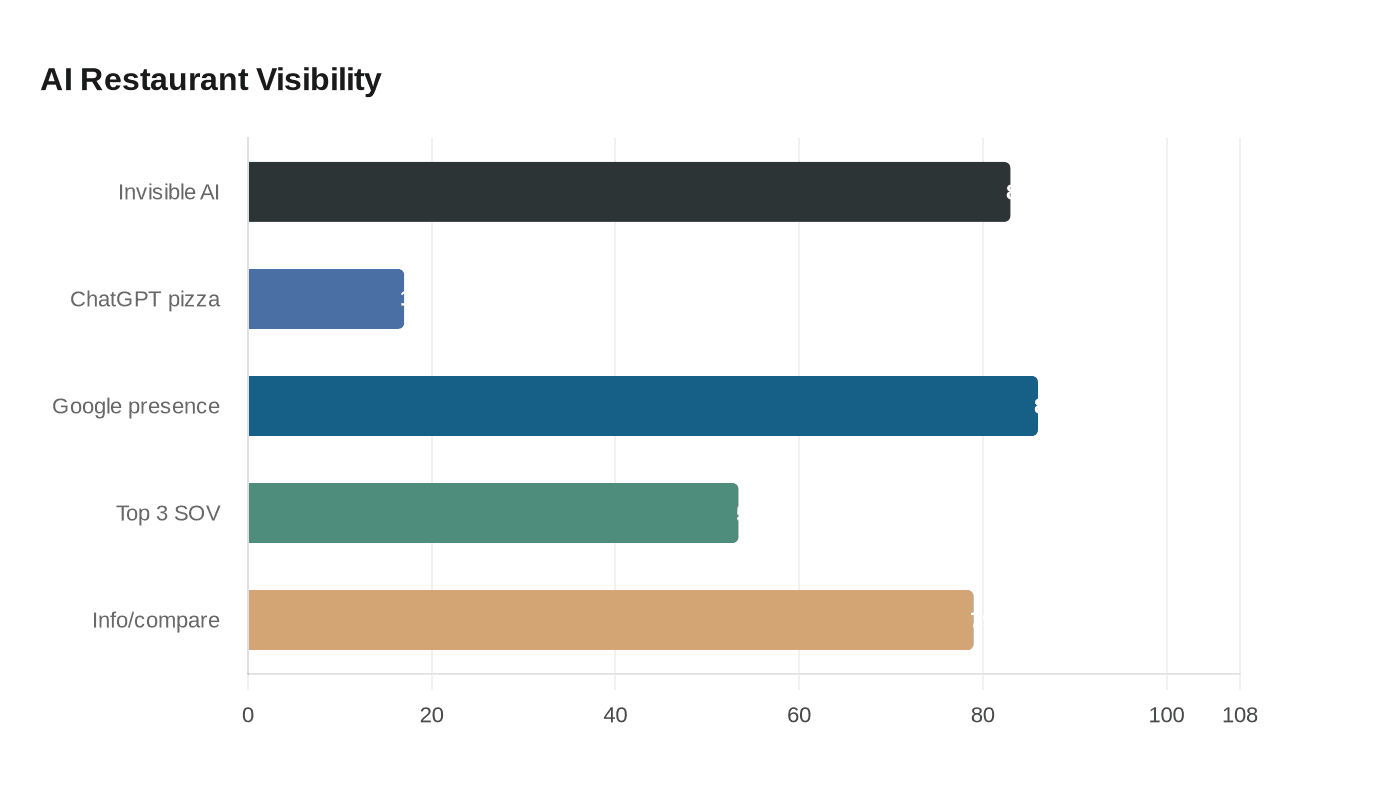
The prompt behavior matters too. Uberall says informational and comparative queries made up nearly 79% of AI-generated restaurant responses, which means discovery is happening earlier in the journey, before a diner ever opens a reservations page. The company also says the rating thresholds are unforgiving: ChatGPT primarily recommends businesses averaging 4.3 stars or higher, Perplexity 4.1 or higher, and Gemini 3.9 or higher. That puts review quality, review volume and consistency squarely into the visibility equation.
Google has already pushed this shift into its own search product. In May 2024, it said AI Overviews would roll out broadly in the U.S., and by December 2024 it had expanded AI-organized results to dining recommendations. OpenTable later said it partnered with Perplexity so diners could see restaurants and available reservation times inside the AI interface, then reserve from there. Search is no longer only a results page; it is becoming a recommendation engine.
The timing is brutal for restaurants. The National Restaurant Association projects $1.55 trillion in restaurant and foodservice sales in 2026, says 61% of adults consider dining out essential to their lifestyle, and reports that 42% of operators said their restaurants were not profitable in 2025. Against that backdrop, AI visibility is turning into a hard revenue issue for chains that depend on local demand, repeat visits and accurate listings. Brands that treat local data, reputation and structured presence as core operations will be the ones AI can actually find.
This article was produced by Prism’s automated news system from verified source data, official records, and press releases, then run through automated quality and moderation checks before publishing. The system is built and supervised by the people who set the standards it runs under. Read our full AI policy.
Did this article answer your question?