Similarweb separates AI mentions from citations, reshaping visibility strategy
Similarweb’s new split between mentions and citations shows why being named by AI is not the same as being credited by it. That gap is where reporting, budget, and strategy go wrong.
The measurement mistake behind the AI visibility hype
The easiest AI visibility win is the one teams are counting wrong. A brand name inside a ChatGPT answer feels like progress, but Similarweb’s latest framing makes the harder point: being named is not the same as being sourced, and those two outcomes do very different jobs for a business.

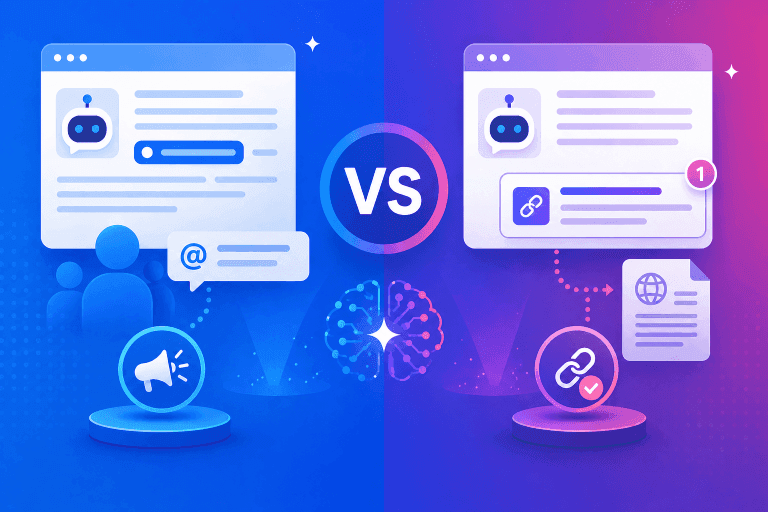
That distinction matters because teams keep treating mentions as if they were proof of attributable visibility. In reality, a mention can build category association and familiarity, while a citation is what creates a traceable path back to the page or domain that informed the answer. If you are reporting on influence, budgeting content work, or deciding where to focus GEO effort, collapsing those signals into one number hides the real story.
What Similarweb means by mentions and citations
Similarweb defines an AI mention as an LLM naming your brand in a generated answer without linking to your content or crediting your page as the source. That is a visibility signal, but it is not attribution. The model may know the brand belongs in the category because it has seen the name repeatedly across public web content, but the user still has no source to click, audit, or compare.
A citation is different. It is an explicit source reference that points the user back to the page or domain that informed the answer. Similarweb’s Citation Analysis tool is built around that logic: it shows which domains and URLs shape answers, how often they appear, and whether your brand is actually being cited. That is why the company calls citations the currency of authority in Gen AI search.
Why the business value is not interchangeable
A mention can help with awareness, but a citation is where the measurable upside starts to look like business value. Similarweb’s guidance ties citations to referral potential, credibility, and traceability, while warning that generative AI chatbots can drive 95% to 96% less referral traffic than traditional search results. In a zero-click environment, being present is not enough if the system never sends the user outward.
That is also why the reporting mistake is expensive. If a dashboard celebrates mentions alone, it can make a brand look healthier than it is, especially when the model is name-dropping it without sourcing it. A brand can be frequently named in AI answers and still lose the source credit to third-party pages, news coverage, forums, or review sites that the model trusts more for the specific query.
Why the same brand can be visible and still under-attributed
Similarweb’s framing makes a subtle but important point: mentions are driven more by training data density and broad association, while citations are tied more closely to retrieval and source selection. That means the same brand can be well known to the model, show up in the answer, and still fail to earn the citation that would improve authority measurement and referral opportunity.
The practical example is easy to picture. Similarweb’s own article describes a case where ChatGPT might say that platforms like Similarweb, [Tool B], or [Tool C] estimate traffic using large-scale data panels. All three names are visible, but none of them necessarily gets the source credit. That is the difference between being part of the conversation and being the source behind it.
How the data changes the playbook
Similarweb says related citation work has analyzed 24,000 conversations and 65,000 responses across ChatGPT, Perplexity, and Google, and that only selected sources get foregrounded. In another benchmark, only 11% of domains overlapped between ChatGPT and Perplexity, which reinforces a bigger truth: citation behavior is platform-specific, not universal. The same brand or URL can be surfaced and credited very differently across systems.
That fragmentation changes how GEO teams should work. Princeton University’s GEO paper introduced Generative Engine Optimization as a new paradigm for improving visibility in generative engine responses, and its controlled experiments showed visibility gains of up to 40%. But those gains only matter if you know whether you are optimizing for mention share, citation share, or both.
Track separate KPIs, not one blended score
Similarweb’s own product framing points to a practical structure: the Brand Overview tab shows top-level mention rates by topic, the Citation Analysis tab shows Domain Influence Score and the split between brand-mentioned and non-brand responses, and the Prompt Tracking tab shows which queries produce mentions versus citations. That is the reporting discipline teams need if they want to understand whether visibility is awareness, attribution, or both.
Optimize for the source layer, not just the name layer
If the goal is mentions, the work leans toward brand association: earned media, community presence, review platforms, and other sources that train the model to recognize the name. If the goal is citations, the work becomes more surgical: identify the domains and URLs Gen AI engines trust, study the prompts where they appear, and build content and partnerships that make your pages more likely to be selected. Similarweb’s citation tools point directly to Reddit threads, Quora discussions, news outlets, and publisher pages because those sources often shape what gets credited.
That is why budget decisions should follow the metric. Mentions justify brand-building and category presence. Citations justify content strategy, digital PR, source relationships, and page-level optimization, because they are the signal most closely tied to attribution and potential traffic in a click-scarce environment.
The reporting shift that actually matters
The real lesson is not that mentions are useless. They are useful, but only for the question they answer. Citations answer a different question, and in AI search that question is increasingly the one that decides whether visibility can be audited, defended, and converted into value.
Similarweb’s separation of the two metrics is more than a semantic cleanup. It is a correction to how AI visibility should be measured, because the brands that win the next phase of discovery will be the ones that know the difference between being named and being credited, and act on it with two different strategies.
This article was produced by Prism’s automated news system from verified source data, official records, and press releases, then run through automated quality and moderation checks before publishing. The system is built and supervised by the people who set the standards it runs under. Read our full AI policy.
Did this article answer your question?