Baby shower traditions around the world reveal global rituals
Baby showers are not one party but five different rituals, from Hindu godh bharai to Afghanistan’s sixth night, each centering support in a different way.
Baby showers look familiar in pastel-leaning Western form, but the deeper idea is much older and much broader: a community marking the arrival of a child with protection, gifts, blessing, food, or all of the above. The biggest mistake is assuming the event only means a registry and a stack of onesies. Across cultures, the same gathering can be a prayer ceremony, a postpartum welcome, a public feast, or a family milestone that says as much about the parents’ community as it does about the baby.
A ritual older than the modern party
Baby shower customs reach back to ancient Egypt and Greece, where rituals were held to ensure a safe birth. That origin matters because it puts the event in the same category as other birth rites: a practical attempt to reduce risk, wrapped in symbolism. The modern U.S. baby shower took shape much later, in the baby-boom era during WWII, when material gifts were given to expectant mothers to help them prepare.
That shift explains why the American version often feels split between utility and celebration. One line of baby-shower history says the tradition changed from practical to personal, and that is exactly what you see in today’s mixed-format events. Shower planning now can mean registry management, meal coordination, and guest-list politics, but it can also mean choosing whether the occasion is meant to bless, support, or simply gather people around a new life.
Five customs that change the purpose of the shower
Huggies pulls together five named customs that make the point clearly: Hindu godh bharai, the Afghani sixth night, a Dominican evening fiesta, the South African stork party, and Tibetan pang-sai. The useful comparison is not décor, it is timing and intent. Some of these celebrations happen before birth, others after delivery, and that single difference changes the whole structure of the event.
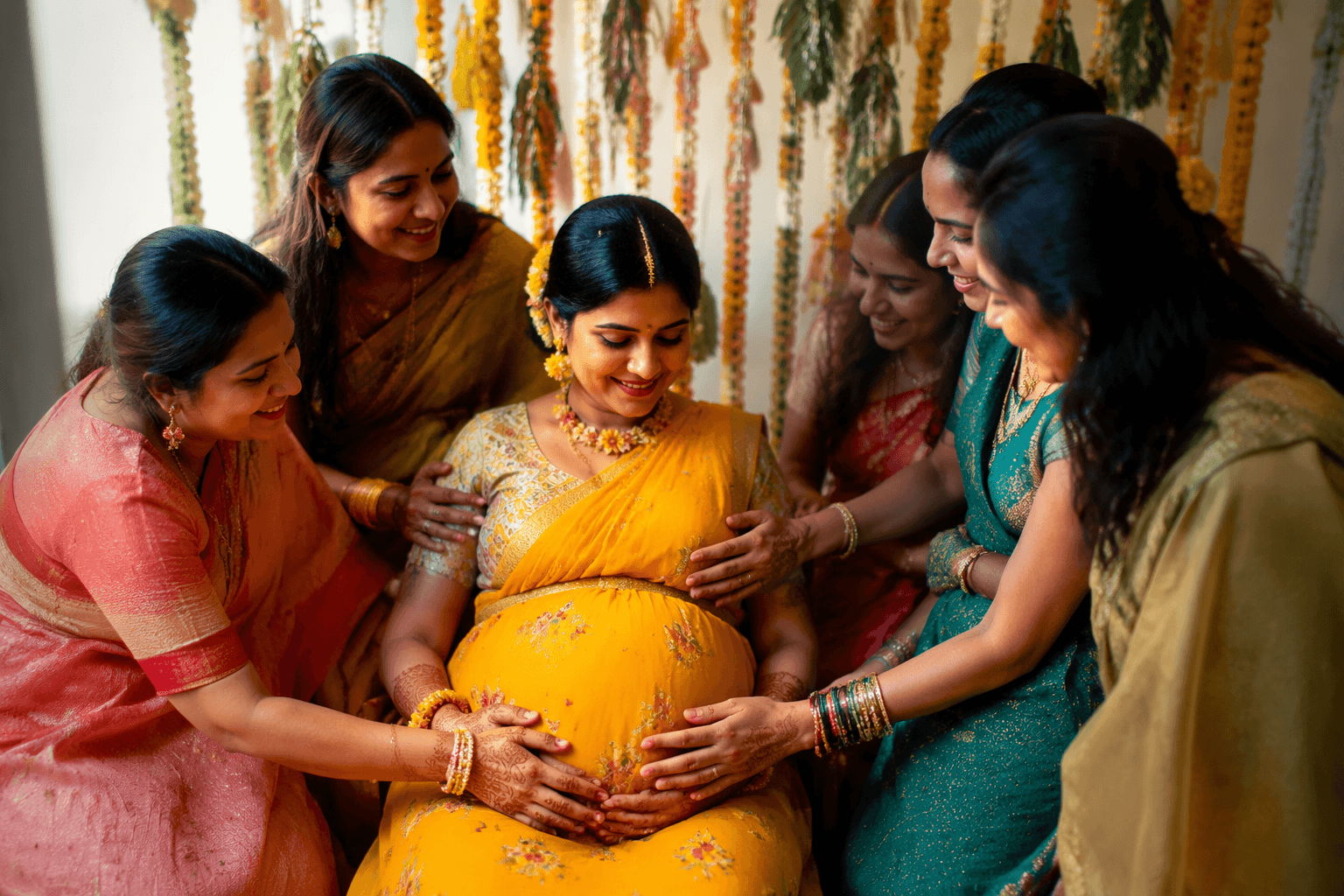
Hindu godh bharai is a blessing ceremony first and a gift event second. The emphasis is on prayer, good wishes, and a formal show of support for the mother-to-be, which is a reminder that baby-related gatherings are not always built around presents. In practice, that means the tone can be quieter and more ritualized than a typical registry shower, with the family treating the occasion as a moment of protection and welcome.
The Afghani sixth night points in a different direction entirely. A sixth-night celebration is tied to a specific day after birth, so the child is already here and the gathering becomes a postpartum welcome. Afghanistan has distinct cultural traditions for welcoming a baby, and that timing makes the event feel less like anticipation and more like arrival, when the family and community can gather around the newborn directly.
The Dominican evening fiesta leans public, social, and celebratory. Even the name signals a different atmosphere, with evening timing that naturally changes the menu, guest flow, and energy level. Instead of a quiet domestic shower, the event reads more like a communal party, which broadens the idea of what a baby celebration can be.
South African stork parties are another useful example because they show how one event can carry a familiar symbol while still functioning as its own custom. South African baby-shower traditions are also described as stork parties, and that makes the symbolism plain: the baby is being announced, welcomed, and folded into a wider circle. In a multicultural setting, that kind of tradition can be especially resonant because the symbol is simple enough to understand but specific enough to retain cultural identity.
Tibetan pang-sai rounds out the picture by showing that baby celebrations do not have to look like the standard gift-opening shower at all. The name itself signals a distinct tradition, and its place alongside the other customs makes one thing obvious: there is no single global script for welcoming a child. Once you see pang-sai beside godh bharai and the sixth night, the modern shower starts to look like just one local expression of a much larger human habit.
What culture changes, beyond the decorations
The real difference across these traditions is not just whether there are flowers, sweets, or favors. Culture changes the purpose of the event. In some places, the main job is blessing the parent. In others, it is building community around the newborn. In still others, it is giving practical support at the exact moment the family needs it most.
That lens also helps explain why baby showers have changed so much in Western settings. A HuffPost reflection on baby showers then and now notes that the tradition has changed over the years, and another account of its evolution says the practice shifted from practical to personal. Those two ideas line up neatly with the modern co-ed shower, the themed shower, and the increasingly custom-built guest list. One description of a mixed baby shower even notes that it is not just for women anymore, with ethnic dishes and a midwife as emcee, which tells you how much the format has opened up.
For multicultural families, the most useful move is not to flatten everything into one generic party. It is to decide what the event is for, then build around that purpose. A blessing-centered shower can borrow the cadence of godh bharai. A postpartum welcome can follow the logic of the Afghani sixth night. A community meal can echo the spirit of a Dominican evening fiesta or a South African stork party. A family that wants a quieter, more ritual-driven gathering can still make room for utility without losing meaning.
Why the history still matters
The changes in childbirth care help explain why these celebrations evolved at all. OHSU’s history of midwifery in America notes that in the early 19th century, midwifery was the most customary practice for pregnancy care and childbirth in the United States. By 1980, midwives attended only 1.1% of births, and in the later comparison period they attended almost 12% of U.S. births. That swing tells you how quickly birth culture can change, and why the social ritual around birth changes with it.
When midwifery, family structure, and community support shift, the baby shower shifts too. The event becomes less about one fixed custom and more about the local answer to a recurring need: how to welcome a child, care for a parent, and signal that a family is not doing this alone. That is why the same celebration can look like prayer in India, a sixth-night welcome in Afghanistan, a fiesta in the Dominican Republic, a stork party in South Africa, or pang-sai in Tibet, while still serving the same human purpose.
This article was produced by Prism’s automated news system from verified source data, official records, and press releases, then run through automated quality and moderation checks before publishing. The system is built and supervised by the people who set the standards it runs under. Read our full AI policy.
Did this article answer your question?