Barcelona gyms compete on day passes as nomads drive demand
Barcelona's gym scene is splitting between members and drop-ins, with Eixample, Gràcia and the centre winning the transient crowd. Day passes now matter as much as dumbbells.
Barcelona's gym market has moved past the old monthly-membership logic. The real competition now is over how fast a tourist, digital nomad, or new expat can buy a day pass, get through the door, and lock away a bag without friction. In this city, access design is not an administrative detail anymore. It is part of the product.
Who Barcelona's day-pass market really serves
Vagabod's guide frames Barcelona as a mix of Spanish chains, international boutique concepts, and a strong independent scene, and the practical takeaway is blunt: independent gyms are usually the best bet for day-pass access. Chains more often require membership or tack on higher day-pass surcharges, so the first battle is not equipment quality but entry policy. For a short-stay user, the value is in a clean drop-in process, posted opening hours, and staff who can keep check-in from becoming a language test.
That makes the market especially relevant to three groups: tourists trying to hold on to routine, digital nomads staying a month, and expats avoiding long contracts. They are not shopping like local members who already know the system. They are buying convenience, and Barcelona's gyms that understand that are the ones that make the first visit feel effortless rather than conditional.
Where the useful gyms cluster
The most practical options are concentrated in Eixample, Gràcia, and the city centre, which fits Barcelona's neighborhood-by-neighborhood fitness map. The center has advantages, but it also tends to bring higher pricing or tighter access rules, so the closer you get to the core, the more likely you are to pay for it in cash or inconvenience. In Barcelona, convenience is not abstract. It is often the difference between training and skipping.
Eixample shows that dynamic more clearly than anywhere else. A 2026 neighborhood guide puts it at about 262,000 inhabitants and more than 40 gyms, making it Barcelona's most populous district and one of the city's densest fitness corridors. That kind of concentration matters because it gives short-stay users real choice within a small area, which is exactly what you want when you are not building a life around one club.
What short-stay users should check before paying
The right gym for a transient stay usually wins on a handful of practical details, not on branding. The best test is simple: can you move from phone to workout in one smooth chain, or does every step create friction? If a club is missing that flow, it is probably built for long-term members, not drop-ins.
- Neighborhood density: choose a gym you can reach quickly from your apartment, hotel, or coworking space.
- App-based booking: look for a reserve-and-go system instead of phone calls or front-desk negotiation.
- Language friction: if onboarding is only easy in Spanish, it will feel heavier after a long travel day or a late arrival.
- Price per visit: judge the real cost after surcharges, not just the headline day-pass rate.
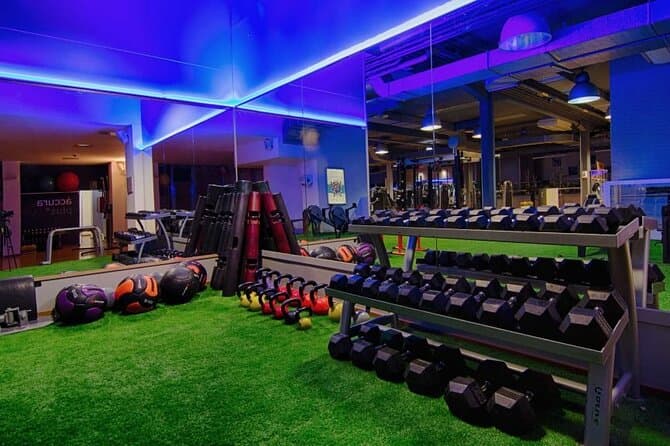
- Shower and locker convenience: a short-stay gym should make changing, storing a bag, and getting back out fast and clean.
Those are the details that separate gyms built for transient training from gyms built for people who already know the routine.
How operators are packaging flexibility
Barcelona's operators are not ignoring the trend. DiR says it runs 20 clubs in Barcelona and Sant Cugat, with wellness, pools, classes, and newer formats such as HYROX and Reformer Pilates. That is a broad offer, and it tells you the chain sees value in serving more than just the standard membership crowd. It also shows how much the city's gym floor has widened beyond plain weight rooms.
The more direct short-stay play is even clearer. Anytime Fitness's Poblenou club advertises temporary passes of 1 day, 3 days, 1 week, 2 weeks, or 1 month, and it stays open 24 hours a day. BCN Fitness goes straight at the traveler market, advertising a day pass from €6.95 for people in holiday mode or simply spending a day in Barcelona. Those are not random pricing choices. They are segmentation decisions aimed at tourists, business travelers, and temporary residents who want immediate access without a contract.
The public baseline beneath the private market
Barcelona's public sports system sets a low-cost floor under all of this. The city government says municipal sports facilities are a basic service for residents, and the Barcelona Sports Institute says those centres offer 200 different tariff options. The same institute runs the Barcelona Sports and Physical Activity Observatory, which exists to monitor and evaluate the city's sports system continuously. That tells you exercise access is treated as part of the city's civic infrastructure, not a niche amenity.
The city council's seasonal examples back that up. The Bernat Picornell pools on Montjuïc attract thousands of people in summer, and the city also highlights municipal sports centres and public spaces as part of the broader offer. In a city where swimming, training, and recreation already sit inside everyday urban life, private gyms have to compete on speed, clarity, and convenience as much as on machines or classes.
Why the demand keeps widening
The customer base for this market keeps expanding because Barcelona has become a major destination for remote workers and internationals, with strong foreign-resident communities in Eixample, Gràcia, and Poblenou. One recent guide describes the city as a leading digital-nomad destination, and another calls it a "coworking-friendly city" with a concentrated mix of digital nomads and international stakeholders. That overlap matters because the same short-stay audience that fills workspaces also wants a place to train without getting trapped in a contract.
The broader European fitness market is helping too. EuropeActive and Deloitte's 2024 European Health & Fitness Market Report points to strong growth in memberships and revenues in 2023, and Health Club Management summarized the figures as revenues up 14 percent, memberships up 8 percent, and clubs up 1 percent. Barcelona sits inside that recovery, but its twist is local: in a dense, fragmented city, flexible access is not a side feature. It is part of the value proposition.
Barcelona's day-pass market rewards gyms that feel local fast. In Eixample, Gràcia, the city centre, and Poblenou, the winners are the clubs that combine straightforward booking, clear language support, sensible price-per-visit, and showers and lockers that do not waste time. The gyms that get that mix right are built for transient training. The ones that do not are built for someone else.
This article was produced by Prism’s automated news system from verified source data, official records, and press releases, then run through automated quality and moderation checks before publishing. The system is built and supervised by the people who set the standards it runs under. Read our full AI policy.
Did this article answer your question?