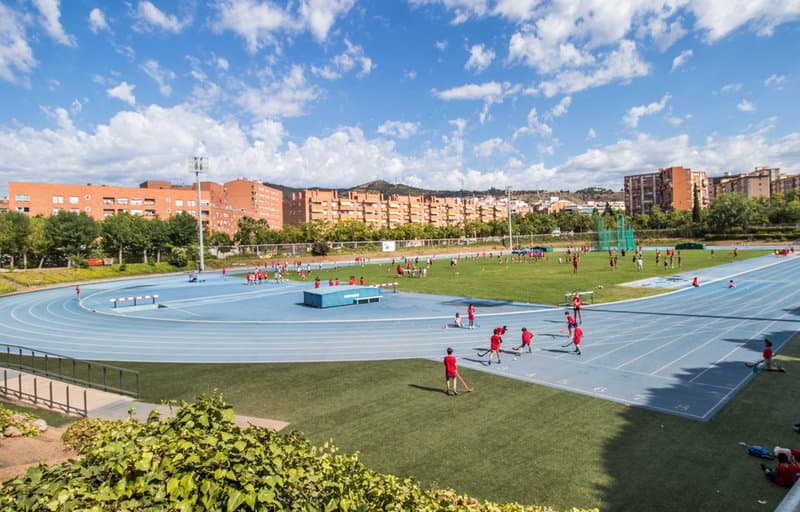
Barcelona residents outpace Europe in regular sport participation
Barcelona’s edge is habit, not hype: two-thirds of adults do sport, supported by open public circuits, municipal facilities, and policies that widen access.

In Barcelona, 66.7% of residents aged 17 and over do sport, 17.4 percentage points above the European average of 49%. Regular exercise is woven into daily life through public space, municipal infrastructure, and habits that reach far beyond a premium club crowd.
The participation base is the product
The 2022 adult sports-habits survey gives Barcelona a much broader profile than the usual gym story. It was built from 1,500 interviews across Barcelona’s 10 districts, with fixed quotas of 150 interviews in each district and stratification by district, sex, age, and nationality, plus marginal quotas for unemployed residents. That makes the result useful as a citywide snapshot, not a narrow club-member sample. Barcelona’s sports profile is young, educated, health-conscious, and more female than before.
That broader base also changes how you read demand. When two-thirds of adults are active, the market is not just selling inspiration, it is supporting routine. Barcelona’s fitness economy is therefore less dependent on the kind of short-lived rush that can inflate one premium format or one branded studio concept. The city has a steady population of habitual exercisers who walk, train outdoors, use municipal facilities, and keep moving because the city makes that easy to do.
Why the city keeps producing active residents
Barcelona’s sports system is designed to lower friction. The city promotes running circuits, gymnastics circuits, and other public-space options that do not require complex equipment or a large upfront commitment. Its running circuits are urban public spaces in parks, avenues, and other outdoor areas, built to make sport easy to fit into ordinary life. Its gymnastics circuits are free, open-access outdoor apparatus installations designed for exercise and calisthenics.
That public layer gives Barcelona a fitness entry point that does not depend on subscription culture. If the weather is decent, a resident can step into a park, use a circuit, or train in an open area without navigating a boutique booking system or a high monthly fee. For operators, the competitive benchmark is not only the neighboring gym, but the city itself and the convenience it has already engineered into the streetscape.
Barcelona’s network of infrastructures helps make sport and physical activity accessible to residents and supports its image as a sports city. Barcelona’s Sports Institute places that network at the center of the system. It keeps participation broad by spreading access across neighborhoods rather than concentrating it in a few commercial destinations.

The survey is part of a longer measurement system
The 2022 adult survey is not a one-off victory lap. It is part of a series carried out in 1989, 1995, 1999, 2006, 2013, 2017, and 2022, which gives Barcelona a long-running view of how participation changes over time. The Barcelona Sport and Physical Activity Observatory exists to analyze and collate data so the city can continually monitor and evaluate its sports system.
Older editions are not fully comparable because the study population changed over time. In 2017 and 2022, the survey focused on residents aged 17 and over, so the latest results are best treated as the current adult baseline rather than a perfectly seamless trend line.
Women, access, and pricing are part of the story
Barcelona’s participation numbers are not just about volume. They also reflect policy choices around inclusion. In Barcelona, 64.2% of women practice sport regularly, making women’s participation a central part of the city’s fitness picture rather than a side note. In the Women and Sport policy, the Gender Equality Office promotes women’s participation in sport and in decision-making bodies, while also working to ensure equal opportunities in sport.
That same access-first logic shows up in pricing. Discounted municipal sports-centre tariffs are intended to help more residents practice physical activity habitually and improve equal access. Barcelona is not treating facilities as luxury add-ons. It is treating them as part of the public health and civic fabric, which helps participation stay high across a broad slice of residents.
This is where Barcelona differs from cities whose fitness scenes are dominated by a few expensive brands or a churn of viral classes. Here, the system is held together by municipal design: open circuits, affordable access, and a steady effort to remove barriers for women and other underrepresented users.
This article was produced by Prism’s automated news system from verified source data, official records, and press releases, then run through automated quality and moderation checks before publishing. The system is built and supervised by the people who set the standards it runs under. Read our full AI policy.
Did this article answer your question?