Barcelona turns parks and neighborhoods into free public fitness network
Barcelona has turned parks, beaches, and neighborhood health programs into a free exercise grid that reaches far beyond the gym.
Barcelona’s most useful fitness amenity is not a club membership but the city itself. Barcelona City Council has stitched together parks, streets, beaches, and neighborhood health programs into a public exercise network that is free, local, and built for repeat use. The system is strongest where it looks least glamorous: in low-barrier classes, walking routes, and open-air circuits that let residents show up, move, and leave without buying into a private gym model.
A civic fitness network, not a lifestyle perk
The backbone of the system is public administration, not a boutique operator. Barcelona City Council runs the offer with the Barcelona Sports Institute, the Barcelona Public Health Agency, and the Neighbourhood Plan, which is why the city’s exercise map reads more like service delivery than entertainment. The clearest example is Let’s Move, a programme aimed especially at people over 40, with a special focus on senior citizens affected by sedentary lifestyles and people who already pass through primary care centres.
That matters because the programme is built to meet people where they already are. The city’s materials say Let’s Move uses low-barrier activities such as walks, tai chi, and Nordic walking to support physical, psychological, and social health. It also runs district-level sessions in places like Gòtic, Raval, Barceloneta, Roquetes, and Ciutat Meridiana, which tells you how Barcelona thinks about access: not as one flagship site, but as a neighborhood service tied to local health and community structures.
How Activa’t turns parks into a weekly habit
If Let’s Move is the outreach arm, Activa’t, or Get Active in the Parks, is the repeatable routine. Launched in 2008, the programme turns parks and gardens into a year-round exercise space except in August and on public holidays. Barcelona says it is free, especially suitable for people over 40, and organized so each district has a park where classes run two days a week.
The structure is simple and that is the point. Each park hosts one tai chi or chi kung session and one motricity-and-memory session every week, with each class lasting one hour. The city also adds a monthly Nordic-walking practice, which gives the programme a broader movement mix without pushing participants into a formal training load. The 2021-2022 programme evaluation from the Barcelona Public Health Agency says the design is intended to promote wellbeing in people over 40 and offers two weekly sessions in urban green spaces, which is exactly the kind of low-friction format public fitness needs if it wants to become habitual rather than aspirational.
Where the neighbourhood model works best
Barcelona’s neighborhood logic is what makes the network feel usable rather than abstract. Let’s Move places sessions in district-level settings, while Activa’t distributes classes through parks in each district. That combination matters in a city where access can change block by block. A resident in the Gòtic is not being asked to cross town for a wellness concept, and someone in Ciutat Meridiana is not treated as an afterthought when the schedule is designed.
The public-health framing is just as important as the geography. The city says Let’s Move is supported by primary care health teams and community working groups within Barcelona Salut als Barris, which links exercise to neighborhood health outreach instead of leaving it as a leisure option for the already-motivated. That is the real difference between Barcelona’s model and a standard municipal recreation page: the city is using parks as an extension of prevention, not just as space for recreation.
Beyond classes: the rest of the outdoor system
The city does not stop at guided sessions. Barcelona’s running circuits are public routes in parks, avenues, and other outdoor spaces, signposted with practical tips for people who want to exercise without complex equipment. The logic is straightforward: if you can walk, jog, or do intervals in public space, you do not need to buy a machine to stay active. Barcelona also promotes walking programmes such as Barnatresc, which reinforces the same idea from a different angle, turning movement into a citywide habit rather than a one-off event.
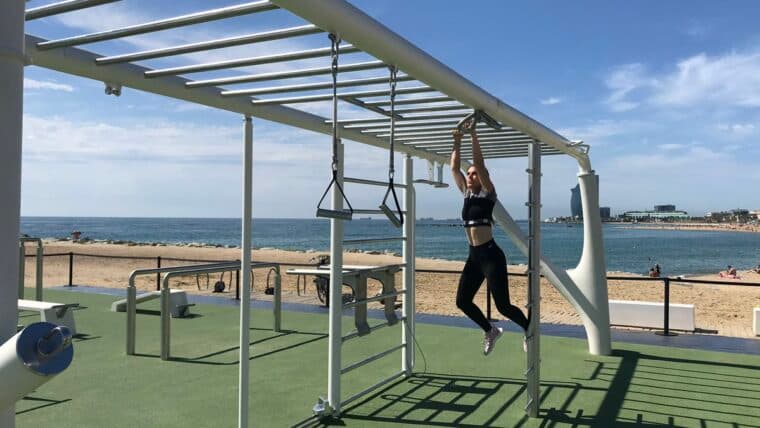
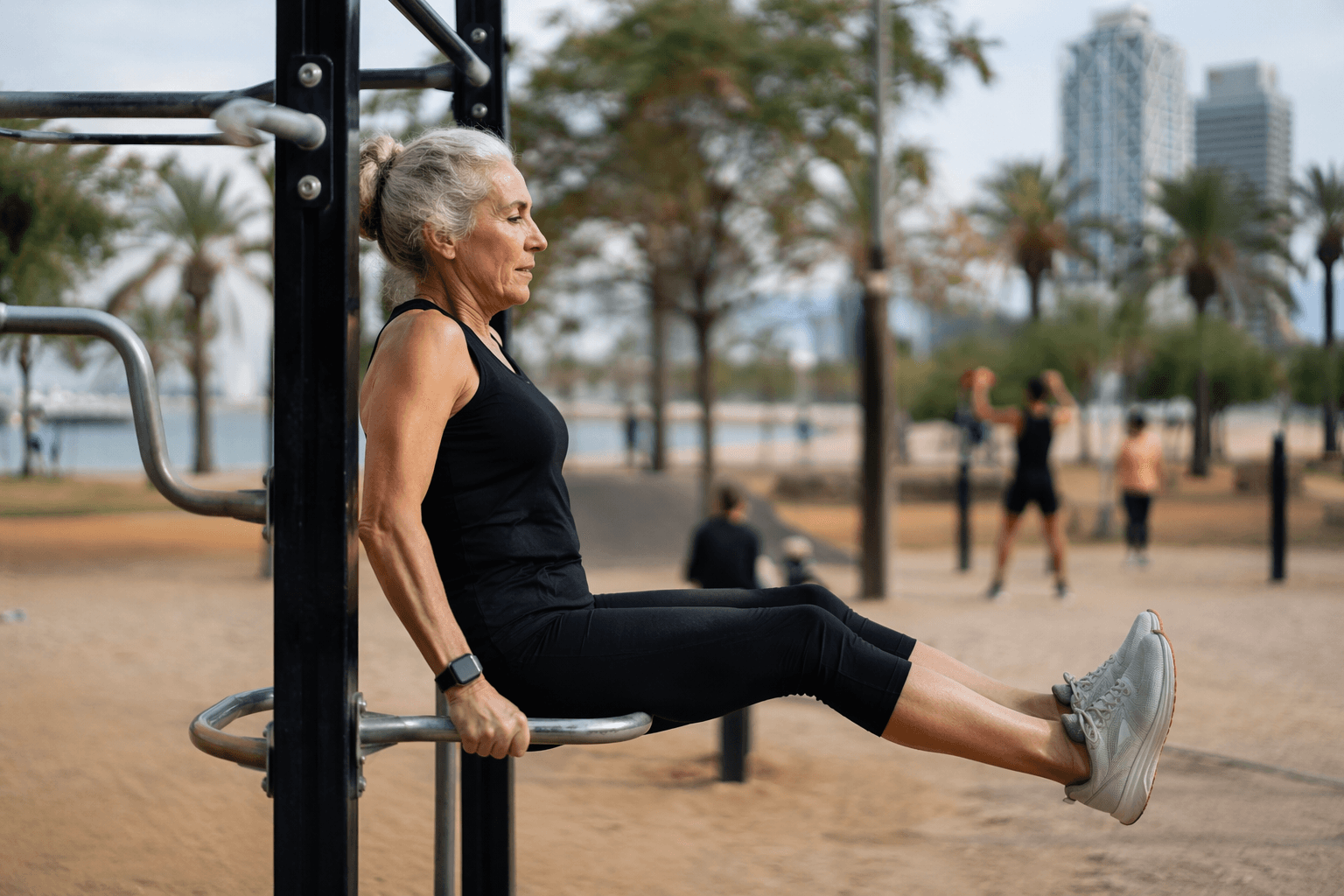
Then there are the gymnastics circuits, with outdoor apparatus designed for calisthenics and free open-access exercise. Barcelona says it already has five urban sports parks for action-sport users, which broadens the picture beyond low-impact mobility work. The network spans the full range, from senior-friendly tai chi to more intense urban training, and the public offer extends all the way to the waterfront, where beach sport includes sailing, kayaking, yoga, toning, and volleyball.
The institutions behind the system
None of this works without the city’s sports machinery. The Barcelona Sports Institute became an autonomous local body on 1 January 2009, after new statutes were approved on 31 October 2008, which gave the city a dedicated institutional structure for sports policy. That matters because the public fitness offer is not a one-off campaign. It is administered through a standing institution with enough continuity to run parks, routes, equipment, and neighborhood programming over time.
Barcelona’s governance layer also includes the Barcelona Sport and Physical Activity Observatory, whose job is to continually monitor and evaluate the city’s sports system, and the Barcelona Municipal Sports Council, the sectoral consultative and participatory body for sports stakeholders. Those two pieces explain why the city’s public sports model feels unusually integrated: the observatory tracks how the system performs, while the council gives stakeholders a formal place in the conversation. The result is a network that looks less like a collection of classes and more like an urban utility.
Where it succeeds, and where it has limits
Barcelona succeeds most when it keeps the offer simple. A one-hour tai chi session in a neighborhood park, a weekly motricity-and-memory class, a running circuit with signs, or a free open-access gymnastics setup is easier to use than a polished wellness brand, and the city has built enough repetition into the calendar for people to come back. The 2025 annual Activa’t festival at Parc del Clot drew more than 500 participants, which shows the programmes can scale beyond routine sessions when the city gives them a public moment.
The limits are real, though they are practical rather than ideological. Activa’t pauses in August and on public holidays, so the network is not uninterrupted. The offer is also distributed by park and district, which makes it accessible, but not universal in the sense of appearing on every block. Still, Barcelona’s own sports pages make the city’s philosophy clear: sport should be within reach of any resident, and the public realm, not the private club, is where that promise gets built.
This article was produced by Prism’s automated news system from verified source data, official records, and press releases, then run through automated quality and moderation checks before publishing. The system is built and supervised by the people who set the standards it runs under. Read our full AI policy.
Know something we missed? Have a correction or additional information?
Submit a Tip