Financing gap, not chemistry, is slowing SAF scale-up
SAF is stalling at the financing seam, where lenders want 18 to 24 months of FOAK operating data before funding the next plant. Policy is setting demand, but capital structures still decide the pace.
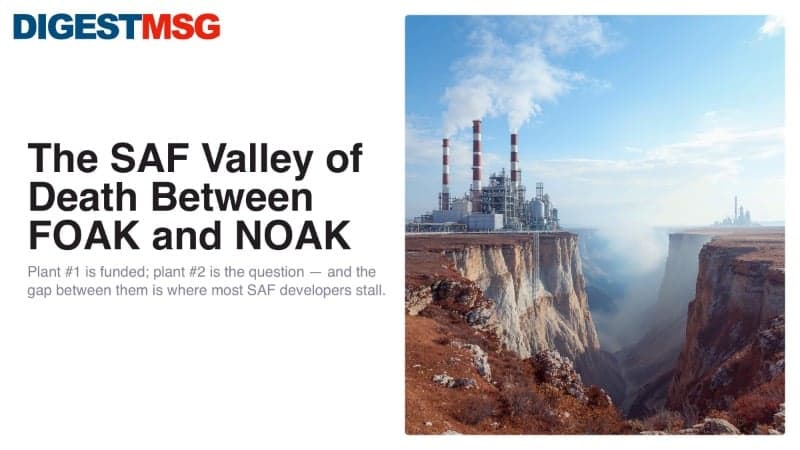
Lenders still want 18 to 24 months of FOAK operating data before backing the next SAF plant, even after ICAO’s 2023 SAF framework set a 5% 2030 emissions cut. That gap is slowing SAF scale-up more than chemistry or conversion yields. It leaves developers with a working first facility and no clear path to a second, lower-cost copy.
Why the FOAK-to-NOAK handoff is the bottleneck
The industry’s problem is sequencing. A first-of-a-kind plant can prove the process, but project finance usually waits for a long operating record before it prices the second facility as bankable. During that pause, engineering teams disperse, supplier relationships weaken, and construction slots can disappear, which pushes out the cost-down curve that SAF needs to move from demonstration economics to repeatable deployment.
That is why the most valuable work now sits above the reactor and the catalyst package. Developers need templates that can be copied, contracts that can be rolled forward, and capital structures that can be reused before the first plant has fully settled into commercial operation. Tax-credit insurance, whole-plant volume commitments, and similar capital-market tools are designed to narrow that gap by reducing perceived risk at the moment lenders are still comparing a live asset to a paper model.
Policy is creating demand, not solving the capital stack
ICAO’s global SAF framework is built on four pillars: policy and planning, regulatory frameworks, implementation support, and financing. Its aspirational goal is to cut international aviation CO2 emissions by 5% by 2030, and meeting the target requires 23 million tonnes of cleaner energies in international aviation by 2030. Financing is not a side issue in that structure, it is one of the four building blocks.
The IEA’s renewables outlook puts global SAF consumption at about 1 billion litres in 2024 and 9 billion litres in 2030 in its main case, enough to meet about 2% of total aviation fuel demand. Liquid-fuel dependence also makes sustainable fuels central for shipping and some industrial uses.
U.S. policy is trying to accelerate that market with credits and volume targets. The United States introduced SAF tax credits in 2022 worth up to $1.75 per gallon, while setting a path toward 3 billion gallons a year by 2030 and 35 billion gallons a year by 2050. Those targets create a revenue signal, but they do not eliminate the underwriting problem between one operating plant and a fleet of financed replicas.

What FOAK financing has already learned from other clean-energy sectors
The U.S. Department of Energy has already treated first-of-a-kind risk as a commercialization problem, not just an engineering one. Its FOAK case-study report drew on interviews with more than 30 executives across eight case-study companies that reached final investment decision in the last decade. The project proves it can run, then the market asks for a longer record before it will fund the second one.
DOE’s Office of Clean Energy Demonstrations has framed its role as helping to buy down real and perceived risk in FOAK and early-of-a-kind projects so follow-on private capital can come in later. That model lines up with the SAF financing problem almost exactly. The first project absorbs the learning curve, and public or quasi-public capital helps bridge the period before private lenders are comfortable treating the asset as repeatable rather than experimental.
The capital tools already moving into SAF
Brookfield Asset Management made a $1.1 billion commitment to Infinium. The World Economic Forum’s 2025 SAF financing report also highlights infrastructure-style capital, tolling models, green bonds, and private-equity participation as structures that can lower the cost of capital and support larger, repeatable plants.
Those structures work because they reframe the risk. A tolling model can separate feedstock exposure from conversion performance. A green bond can tap a broader buyer base if the project can present a credible offtake stack. Private equity can absorb more development risk early, then refinance into cheaper capital once the plant proves it can run to spec and sell product consistently.
Developers need to build for repeatability from the start, not after the commissioning punch list is closed. That means standardizing engineering packages, locking in offtake structures that can support the second plant, and lining up financing instruments that bridge the evidence gap lenders still demand.
This article was produced by Prism’s automated news system from verified source data, official records, and press releases, then run through automated quality and moderation checks before publishing. The system is built and supervised by the people who set the standards it runs under. Read our full AI policy.
Know something we missed? Have a correction or additional information?
Submit a Tip