Marine biofuel growth outpaces bunkering infrastructure at key ports
Marine biofuels are scaling faster than the tanks, barges and testing needed to deliver them, with Singapore setting the pace on bunkering rules.
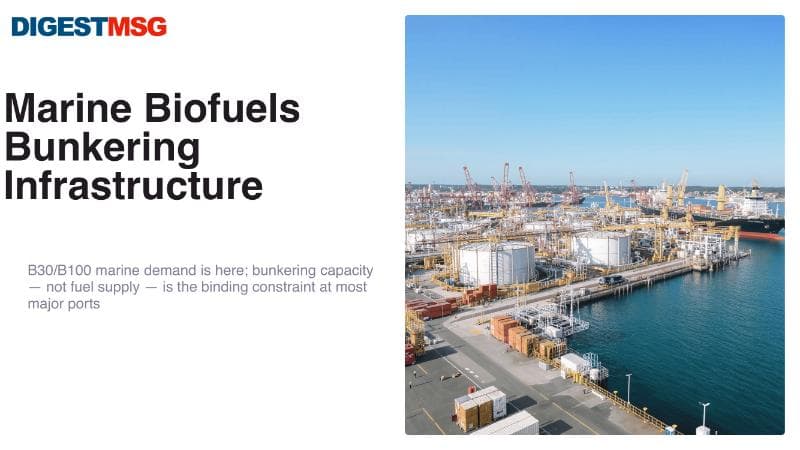
On March 7, 2025, licensed bunker tankers in Singapore were allowed to carry and deliver biofuels up to B30. Marine biofuel growth is outrunning the bunkering hardware needed to move it at scale. The tightest gaps are segregated tankage, specialized bunker barges and reliable blend-testing at hubs such as Singapore and Fujairah. The International Maritime Organization’s April 2025 Net-zero Framework, set for adoption in October 2025, adds mandatory emissions limits and GHG pricing that will push more ships toward compliant supply chains.
Infrastructure, not chemistry, is the bottleneck
The commercial problem is no longer whether marine biofuel can be made. The problem is whether it can be stored separately, blended cleanly, tested quickly and delivered on a timetable vessel operators trust. A fuel pathway can be technically mature and still stall at the port gate if the bunkering chain is not built for it — a last-mile constraint Biofuels Digest highlighted in a June 22, 2026 guide.
That bottleneck shows up most clearly at large hubs where turnaround time, product integrity and scheduling are non-negotiable. Singapore and Fujairah sit at the center of that discussion because both rely on repeatable operations, not one-off trial deliveries. If the port cannot protect product quality through segregated storage, dedicated barging and test capacity, shipowners are left with theoretical supply instead of a dependable stem.
Singapore has built the clearest rulebook
Singapore’s Maritime and Port Authority has already turned biofuel bunkering into an operational framework rather than an exception. Licensed bunker suppliers can supply biofuel within the Port of Singapore. All biofuels supplied there shall meet ISO 8217 standards. The authority also encourages International Sustainability and Carbon Certification-certified biofuel for trials and for permanent use.
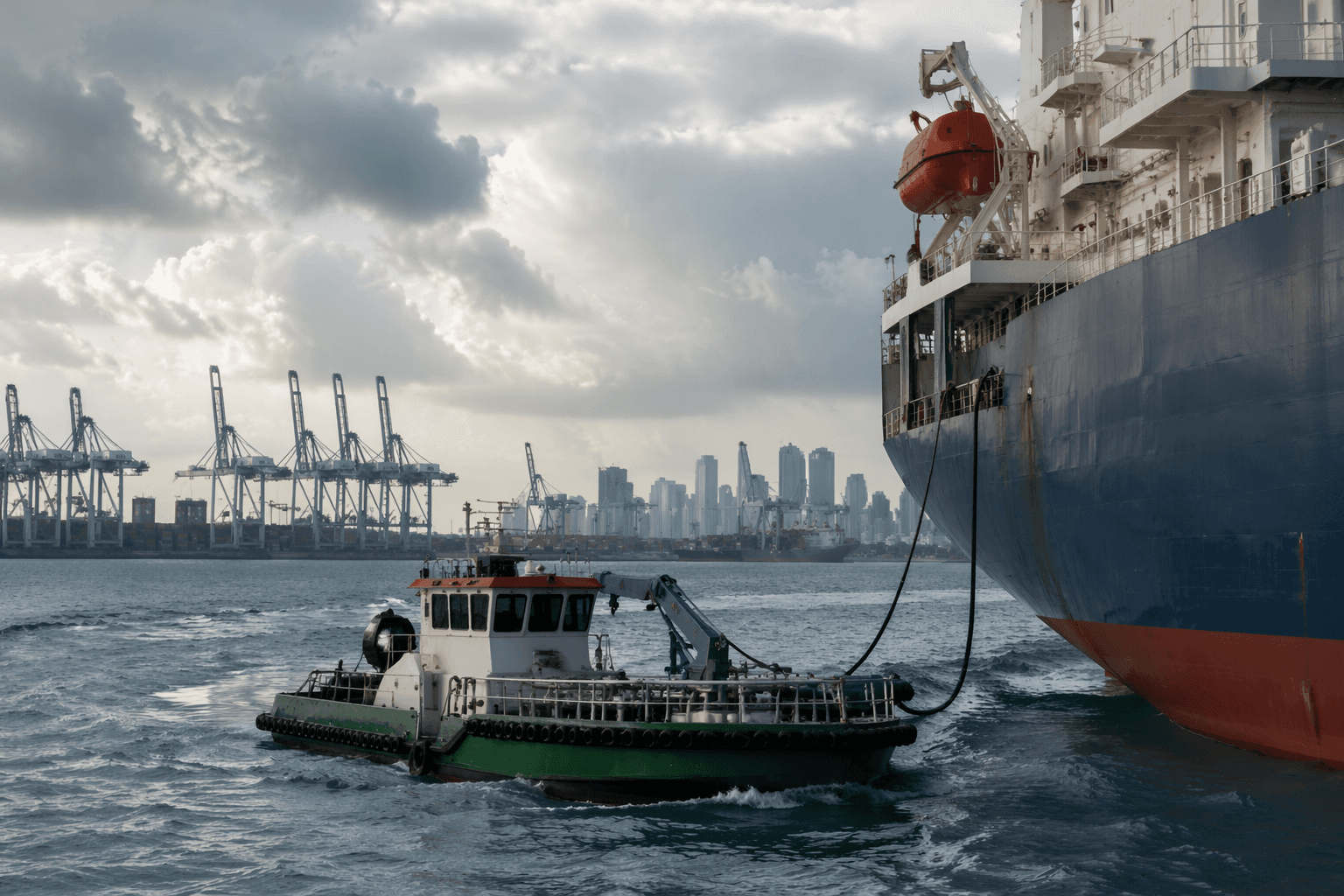
A March 6, 2025 circular accepted interim guidance on the carriage of biofuel blends and MARPOL Annex I cargoes for early implementation.
Singapore’s first biofuel supply circular, issued in 2022, was aimed at supporting trials of biofuel bunkering. Compliance is defined through standards, certification and handling rules, not just through the availability of molecule supply.
GCMD is treating assurance as part of the fuel
Biofuels adoption needs an assurance framework that covers quantity, quality, emissions abatement and traceability. That is a broader test than whether a ship can burn the fuel. It is a supply-chain test, and GCMD has pushed it through trials built to verify what actually reaches the vessel.
Project LOTUS, GCMD’s long-term biofuels study with NYK Line, NYK Shipmanagement Pte Ltd, ClassNK, VPS, Gard and OEM partners, ran from the first quarter of 2024 to the third quarter of 2025. Over that period, GCMD concluded four biofuels supply chain trials and examined the operational impact of continuous biofuel use on vessels.
GCMD’s technical approach includes tracer methods and chemical fingerprinting to verify biofuel claims. Those tools are designed to answer the questions shipowners and charterers care about most: what volume was delivered, what quality was in the stem, how much emissions abatement was achieved and whether the fuel can be traced through the chain. The same product may move through several hands before bunkering.
Ports are becoming decarbonisation assets
The IMO’s Net-zero Framework gives ports and bunker suppliers a clearer reason to invest in the physical chain. Mandatory emissions limits and GHG pricing will increase pressure on shipping lines to secure compliant fuel supply, and that turns storage, blending and certification into strategic assets. A terminal that can maintain separate product streams, preserve integrity and turn vessels around quickly can serve more of the market than one that only has access to supply on paper.
That is why the infrastructure discussion now reaches beyond Singapore. Fujairah is a major choke point because blending and testing capacity there will shape how quickly marine biofuels can move through the region.
The International Maritime Organization held its Technical Seminar on Marine Biofuels at IMO headquarters on February 12, 2026.
This article was produced by Prism’s automated news system from verified source data, official records, and press releases, then run through automated quality and moderation checks before publishing. The system is built and supervised by the people who set the standards it runs under. Read our full AI policy.
Know something we missed? Have a correction or additional information?
Submit a Tip