ETH Zurich turns dairy and tofu waste into carbon-capturing beads
Tofu whey and dairy waste became porous beads that pulled 97 milligrams of CO2 per gram, but scale, cost and durability will decide the real story.

ETH Zurich has turned two of food processing’s least glamorous leftovers, whey and by-products from tofu production, into porous protein beads that bind carbon dioxide. The pitch is smart circular economy logic: pull value out of low-value waste, load it with potassium hydroxide, and make a climate material that can capture CO2 from ambient air and give it back at room temperature.
The work, published in PNAS and led by materials scientist Raffaele Mezzenga, who heads ETH Zurich’s Laboratory of Food & Soft Materials and is a full professor at the Department of Health Sciences and Technology, starts with protein extracts that are assembled into amyloid fibrils before being shaped into beads. ETH Zurich says the chemistry inside the beads converts incoming CO2 into hydrogen carbonate, which is what makes the material act like a carbon sponge instead of just another protein pellet.
The headline number is strong: ETH Zurich researchers said the beads captured 97 milligrams of CO2 per gram of material. Additional reporting puts the result at 2.20 mmol of CO2 per gram under real-world humidity and temperature conditions, with beads roughly 0.5 to 1 centimeter across. One report says the material can be refreshed in about 10 to 12 minutes using dilute acid, which matters because direct air capture only becomes practical if the sorbent can cycle quickly without eating too much energy or chemical input.
That is where the real test begins. ETH Zurich frames direct air capture as still expensive and energy-intensive, and that remains the central bottleneck for any new sorbent, whether it is made from engineered polymers, mineral systems or food-derived protein. Climeworks, the ETH spin-off founded in 2009, is one of the first commercial direct air capture providers, and its existence is a reminder that the field has been trying to clear the same two hurdles for years: cost and scale.
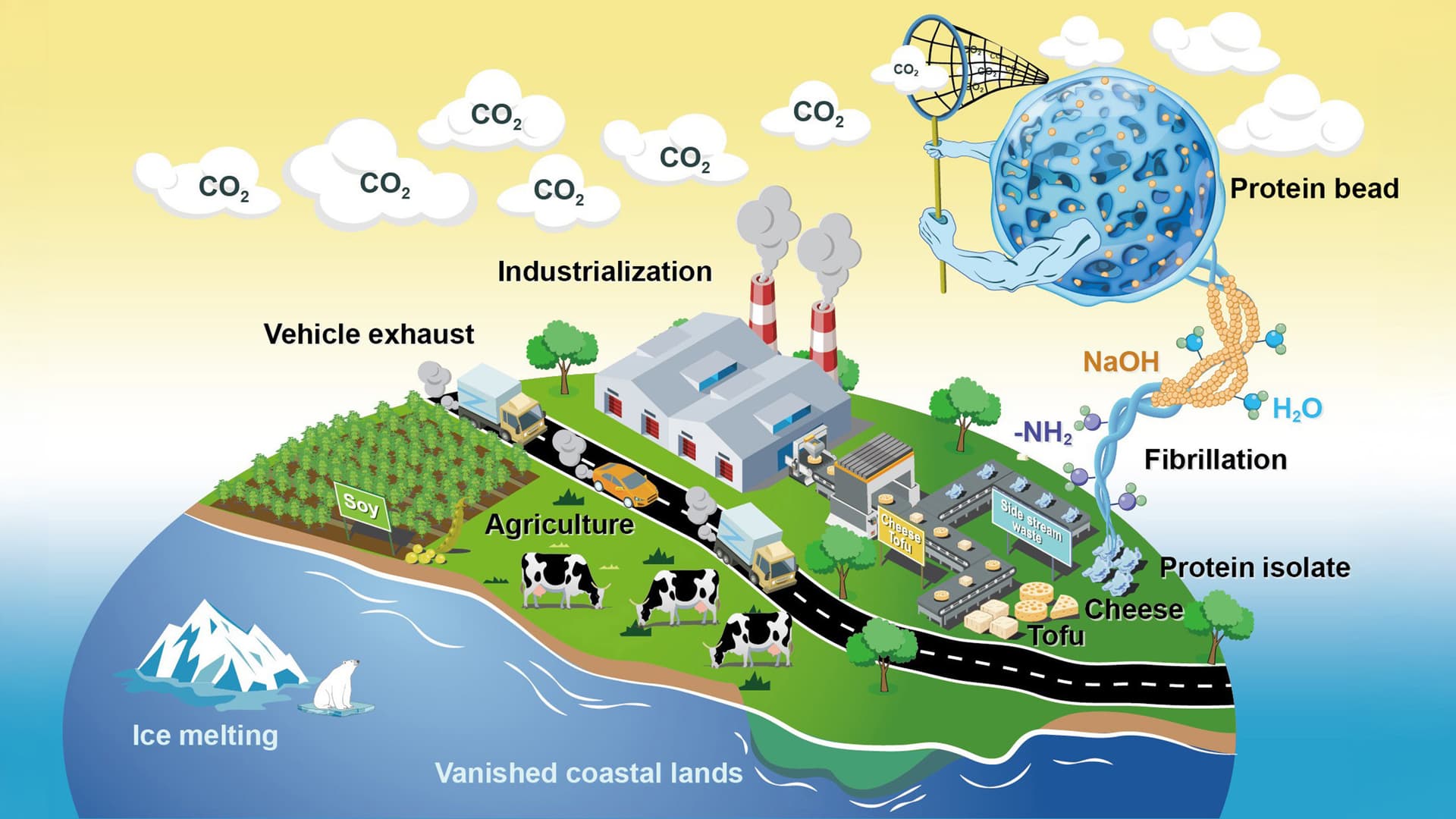
The broader climate case is obvious. ETH Zurich cites Intergovernmental Panel on Climate Change scenarios that call for technologies able to remove and store hundreds of billions of tons of CO2 if the world wants to stay below 1.5 C over the long term. The harder question is whether these protein beads can move beyond a clean lab result and into a durable industrial cycle. If they can, whey and tofu residue could become feedstock for carbon removal instead of disposal. If they cannot, they remain a clever demonstration of what food-waste chemistry can do in a flask, not a plant.
This article was produced by Prism’s automated news system from verified source data, official records, and press releases, then run through automated quality and moderation checks before publishing. The system is built and supervised by the people who set the standards it runs under. Read our full AI policy.
Did this article answer your question?