Experiment-guided AlphaFold3 improves dynamic protein structure predictions
AlphaFold3 is being steered by experimental data, and the payoff is bigger than accuracy: it can start tracing protein motion that static models miss.
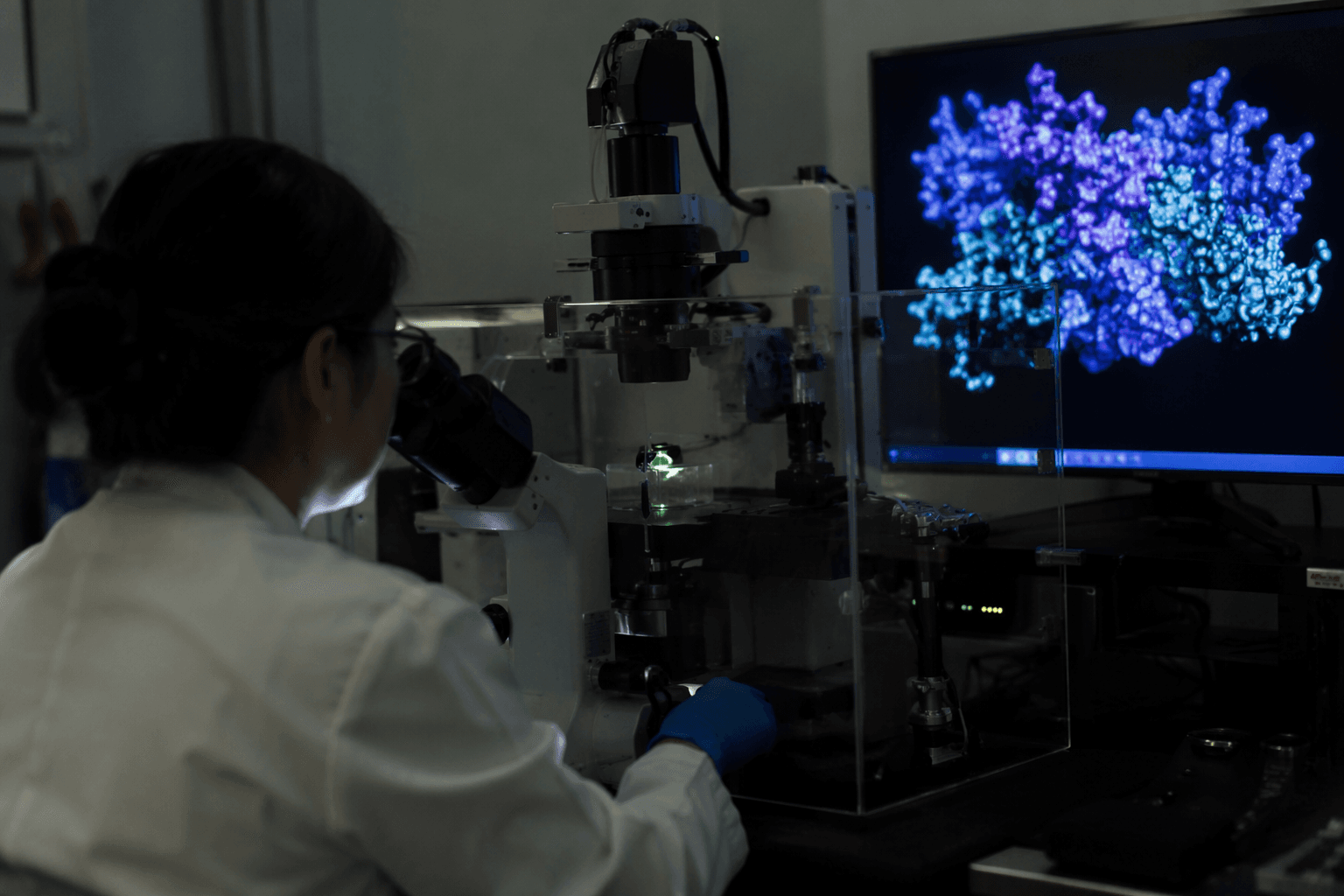
AlphaFold3 can now be steered with experimental measurements toward protein ensembles, not just one best-looking structure, which is the more useful target when a protein changes shape to work. A new Nature Biotechnology paper does that, creating a cleaner path from prediction to biology, especially for drug discovery targets that only make sense in motion.
Why the static snapshot is no longer enough
The core problem is easy to see if you have ever tried to interpret a protein that refuses to sit still. AlphaFold and related methods were trained largely on static crystal structures, and those structures still make up roughly 85% of the Protein Data Bank. That bias matters because many proteins are not rigid objects at all, but dynamic molecules that shift between multiple conformations, sometimes exposing a binding pocket and sometimes hiding it.
The researchers, led by Alex Bronstein and Paul Schanda at the Institute of Science and Technology Austria, with Ailie Marx at Tel-Hai University and MIGAL, and Sanketh Vedula, a postdoctoral researcher at Princeton University and the Broad Institute, frame the problem bluntly: AlphaFold-like models tend to collapse a heterogeneous protein into a single dominant conformation. For structural biology, that can be a good guess. For understanding function, allostery, or ligand binding, it can miss the point entirely.
What changed in the new AlphaFold3 workflow
The Nature Biotechnology paper is titled “Experiment-guided AlphaFold3 resolves measurement-consistent protein ensembles.” The method does not treat AlphaFold3 as the final answer. It uses AlphaFold3 as a prior, then infers protein conformational ensembles that stay consistent with measured experimental data.
The pipeline generates structures that agree with what the lab actually measures. The method can produce models in agreement with measurements even when AlphaFold3 mispredicts key structural features, which is exactly the kind of failure mode that has limited purely computational structure prediction for flexible proteins.
The experimental inputs that make the difference
Two techniques stand out here: NMR spectroscopy and cryo-electron microscopy. Both are valuable because they capture experimental signals that reflect ensembles and dynamics, not just an idealized fold. When those measurements are folded into AlphaFold3, the output can better reflect the protein’s real behavior under experimental conditions.
That matters for regions that prediction systems still handle poorly, especially flexible loops and alternate interfaces. These are the parts that often decide whether a target can bind a drug, switch state, or assemble into a larger complex. A static model can place the backbone, but it often misses the biological choreography.
The practical payoff is a model that can match measurements where a straight AlphaFold3 run would land on the wrong structural feature. For researchers working on proteins with heterogeneous states, that is the difference between a plausible picture and a usable one.
How this fits the earlier experiment-guided AlphaFold work
This paper did not appear out of nowhere. It follows earlier ICML 2025 work titled “Inverse problems with experiment-guided AlphaFold,” which included Maddipatla, Sellam, Bojan, Vedula, Schanda, Marx, and Bronstein. That earlier work established the methodological foundation, and the 2026 Nature Biotechnology paper extends it into a more direct protein-ensemble setting with AlphaFold3 at the center.
The new approach bakes experimental constraints into the inference step instead of treating them as an afterthought.
Why structural biology and drug discovery should care
Protein motion is not a niche problem. It is the reason a receptor opens, a loop flips, or a binding pocket becomes druggable. If a model only gives you one dominant form, you can miss the conformation that matters most for function or therapeutic design.
This is where the broader industry context comes in. AlphaFold’s earlier breakthroughs helped drive the 2024 Nobel Prize in Chemistry, and the field has spent the years since trying to extend that success from “what does this protein look like?” to “what does this protein do?”
For drug discovery, that opens a more realistic way to study targets with hidden pockets, alternate interfaces, or shape-shifting loops. Those are exactly the proteins where a rigid structure can mislead medicinal chemistry. If you can predict the ensemble, you can reason about which state a ligand stabilizes, which state is transient, and which state is actually worth chasing.
The practical takeaways for researchers
The clearest lesson here is that AlphaFold3 works better when it is treated as a powerful prior rather than an oracle. The experimental data are not a correction layer added at the end. They are the anchor that keeps the ensemble tied to biology.
A useful way to think about the method is this:
- Use AlphaFold3 to generate a strong structural prior.
- Constrain that prior with experimental observables from NMR or cryo-EM.
- Infer the ensemble that best fits the data, not just the most confident single pose.
- Pay special attention to flexible regions, because that is where static predictions most often fail.
That workflow is built for proteins where motion is part of the mechanism. In those cases, the model reconstructs a range of forms rather than a single structure.
This article was produced by Prism’s automated news system from verified source data, official records, and press releases, then run through automated quality and moderation checks before publishing. The system is built and supervised by the people who set the standards it runs under. Read our full AI policy.
Did this article answer your question?