IBM, Cleveland Clinic simulate 12,635-atom proteins with quantum hardware
IBM and Cleveland Clinic pushed quantum biology to 12,635 atoms, a 40-fold scale jump that could speed one of pharma’s hardest bottlenecks.
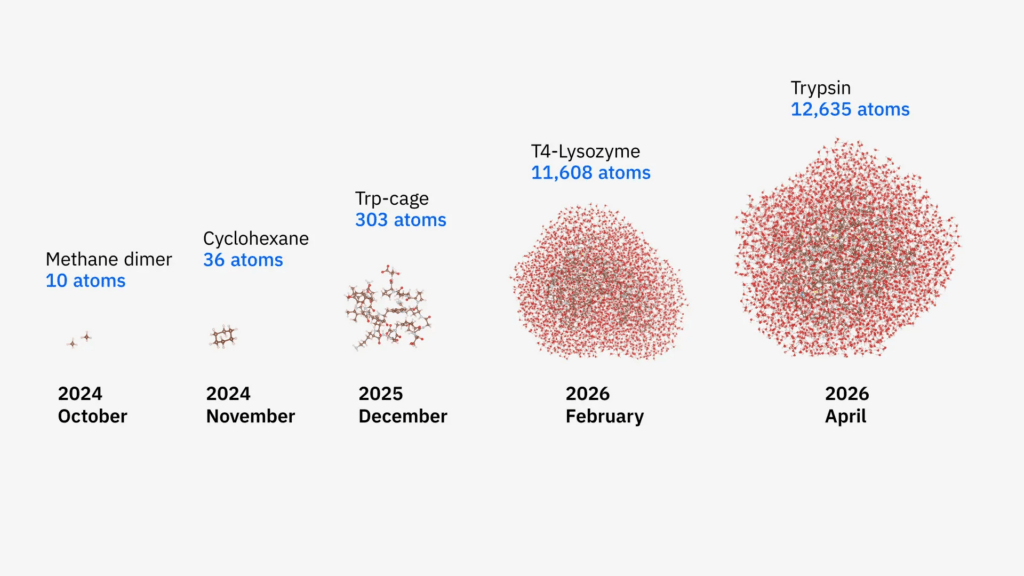
IBM, Cleveland Clinic and RIKEN have moved quantum hardware deeper into the drug-discovery pipeline with a simulation of protein chemistry at a scale that is still rare in the field. The team said on May 5, 2026, that it had modeled T4-Lysozyme and Trypsin in solution, with binding agents and water, reaching 12,635 atoms in the largest system and about 30,000 orbitals in total.
IBM said the work combined two IBM quantum computers with two of the world’s most powerful supercomputers, Fugaku and Miyabi-G at RIKEN. The quantum side used two IBM Quantum Heron r2 processors with up to 156 qubits each, while IBM’s quantum blog described the calculation as the largest heterogeneous quantum-classical electronic-structure calculation to date, using up to 94 qubits in the workflow.
The technical milestone matters because the central challenge in drug discovery is not just modeling proteins, but modeling how a drug candidate binds to a protein accurately enough to be useful. Cleveland Clinic said that problem is expensive and slow in life sciences, where developing a single medicine can take more than a decade and demand substantial investment before a candidate ever reaches the clinic.
IBM and Cleveland Clinic called the result the largest-known simulation of biologically meaningful molecules performed with quantum hardware. The group also said the scale was 40 times larger than what the same method could initially achieve six months earlier, and that a key workflow step improved in accuracy by up to 210 times over that same period. Just four months earlier, the partnership had modeled the 303-atom Trp-cage miniprotein, showing how quickly the hybrid approach has been advancing.
That speedup does not mean quantum computers are ready to replace conventional discovery tools. The work still depended on a hybrid quantum-classical setup, and the proteins were simulated in a tightly controlled research environment rather than in a full end-to-end pharmaceutical pipeline. Even so, the size increase from Trp-cage to T4-Lysozyme and Trypsin is a sign that the method is moving toward the kinds of molecular systems chemists actually study when they design and test drug candidates.
IBM Research Director Jay Gambetta said the systems simulated are the kind biologists and chemists work with in the real world, and that quantum computers are now producing results that matter to science. Cleveland Clinic added that the IBM Quantum System One on its main campus is the world’s first quantum computer fully dedicated to healthcare research, part of the 10-year Discovery Accelerator partnership announced in 2023. The latest run strengthens that push, but the commercial payoff will depend on whether these larger simulations can keep translating into faster, more reliable decisions in drug design.
This article was produced by Prism’s automated news system from verified source data, official records, and press releases, then run through automated quality and moderation checks before publishing. The system is built and supervised by the people who set the standards it runs under. Read our full AI policy.
Did this article answer your question?