MIT uses nanoparticle imaging to track cancer protein dimers in live cells
MIT researchers can now watch cancer-linked protein pairs form in living cells, revealing new EGFR and HER2 behaviors that could sharpen drug design.
A clearer live-cell view of a stubborn cancer target
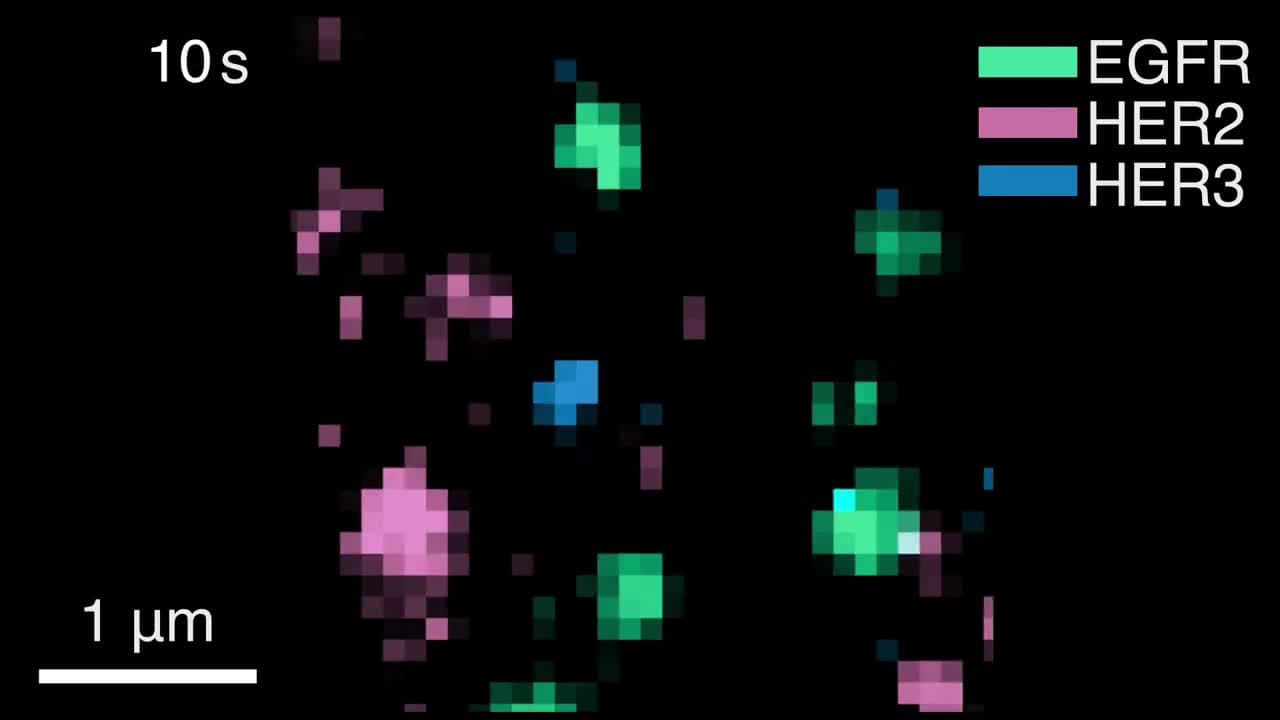
MIT researchers have turned a long-standing blind spot in cancer biology into something visible: the behavior of ErbB receptor pairs as they form and persist inside living cells. Using photostable upconverting nanoparticle probes, the team tracked individual EGFR, HER2, and HER3 molecules for more than 15 minutes, long enough to watch dimerization dynamics unfold instead of inferring them from snapshots.
That matters because ErbB-family signaling sits at the center of many oncology programs. These receptors are major anticancer targets, and current therapies already rely on tyrosine kinase inhibitors and monoclonal antibodies. What has been missing is a durable way to see how those receptors interact in real time, in the environment where drug resistance and altered signaling actually emerge.
Why this imaging advance is different
The core limitation has been familiar to anyone who works with fluorescence imaging: conventional probes bleach and blink, which makes long-duration single-molecule tracking difficult. The new method uses upconverting nanoparticles, or UCNPs, which remain stable and brightly illuminate individual molecules over long periods. That stability lets researchers follow receptor pairings at the single-particle level in living cells without losing the signal halfway through the story.
The Broad Institute described the work as providing a dynamic view of how cancer-related proteins interact in living cells. MIT Chemistry emphasized the same practical advantage: the platform can track individual proteins over extended periods, and it may be adaptable to other molecules and even drugs to see how they influence signaling inside the cell. For drug developers, that is the jump from indirect inference to direct observation.
What the team tracked, and why those receptors matter
The study focused on three members of the ErbB family: EGFR, HER2, and HER3. That family also includes HER4, and all four are transmembrane receptor tyrosine kinases tied to cancers such as breast and lung cancer when dysregulated. The paper’s title, *ErbB family receptor dimerization dynamics and dysregulation via long-term single-molecule imaging*, captures the key question: how do these receptors pair, and how do those pairings change when cancer mutations or ligands are in play?
A review in Cell has already laid out why this family is so central to oncology. ERBB receptors are established anticancer targets, and ligand binding to receptors such as EGFR, HER3, and HER4 can drive the formation of kinase-active hetero-oligomers. A 2019 Cell Biophysics study also notes the basic rule that dimerization is required for ErbB receptor activation. The new work builds on that foundation by showing the process directly in live cells over longer timescales than earlier approaches allowed.
The biggest surprise: HER2 and HER3 were not behaving as expected
Cell Press reports that the researchers found constitutive HER2 and HER3 homodimerization. That is a notable result because HER2 has long been treated as a receptor with distinctive activation logic, and HER3 has been viewed through the lens of partner-driven signaling. Seeing both receptors homodimerize constitutively in living cells pushes the field toward a revised model of how they can be activated and regulated.
The study also showed that oncogenic mutations and ligand stimulation alter ErbB dimerization dynamics. For EGFR, oncogenic mutations promoted stable, ligand-independent dimerization. That finding is especially useful for therapeutic strategy because it links mutant receptor behavior to a persistent paired state that may not respond the same way as ligand-driven signaling. In other words, the receptor is not simply turning on in a standard way; it is reorganizing its interaction pattern in a way that can change drug sensitivity.
What this means for EGFR-focused drug development
EGFR remains one of the most closely watched oncology targets in the field, especially in lung cancer. If mutant EGFR favors stable, ligand-independent dimerization, then a therapy that only accounts for ligand-triggered activation may miss part of the mechanism that keeps signaling going. Direct single-molecule tracking gives researchers a way to test how candidate inhibitors influence receptor pairing, not just downstream pathway output.
That makes the assay valuable in two practical ways:
- It can help distinguish whether a compound blocks receptor engagement itself or merely dampens later signaling.
- It can reveal whether a mutation changes the receptor’s baseline tendency to dimerize, which may matter for resistance.
- It can show how ligand exposure shifts receptor behavior over time, which is useful when comparing drugs under more realistic signaling conditions.
For teams working on EGFR inhibitors, those details could sharpen lead selection and help explain why one compound outperforms another in a mutation-specific setting.
Why HER2 and HER3 are especially important
HER2 and HER3 are central to breast cancer biology and to many combination-therapy strategies. The new observation of constitutive homodimerization means the receptors may have more intrinsic pairing behavior than expected, which could affect how clinicians and researchers think about pathway activation, bypass signaling, and resistance.
That is particularly relevant for HER2-targeted treatment design. If HER2 can homodimerize constitutively, then therapies aimed only at preventing one class of interaction may leave another route open. HER3 adds another layer, because its signaling role often depends on partner interactions. A more precise dimerization map could help explain why some tumors keep signaling even when one route is pharmacologically suppressed.
A tool for resistance monitoring, not just discovery
The most important shift here may be conceptual. This is not only a prettier image of receptor biology. It is a readout of how a cancer-linked protein system behaves under changing conditions, in real cells, over time. That opens the door to monitoring how receptor dimerization evolves in response to treatment, whether a mutation alters the pairing state, and whether ligand exposure reprograms the system in ways that foreshadow resistance.
Because the method is built on long-term, multicolor single-particle tracking, it also creates room for comparison across receptor types and conditions in the same experimental framework. That could help researchers ask whether a drug suppresses one receptor pairing while leaving another untouched, a question that often gets lost in endpoint assays.
What comes next
The final implication may be broader than ErbB biology alone. MIT Chemistry says the approach could be extended to other molecules and potentially to drugs themselves, giving researchers a way to see how treatments reshape signaling inside cells. That is a compelling direction for target validation, mechanism studies, and combination-therapy design.
For now, the immediate message is clear: the field can finally watch key cancer-related protein pairings unfold in living cells rather than reconstructing them from indirect measurements. For EGFR, HER2, HER3, and the broader ErbB network, that kind of visibility can change how targets are chosen, how drugs are compared, and how resistance is spotted before it becomes a clinical problem.
This article was produced by Prism’s automated news system from verified source data, official records, and press releases, then run through automated quality and moderation checks before publishing. The system is built and supervised by the people who set the standards it runs under. Read our full AI policy.
Did this article answer your question?