Nagoya team designs light-switch molecules to control cell signaling, genes
Blue light pulled AzoTag binders onto a synthetic switch in seconds, while violet light kicked them off, giving Nagoya researchers precise control over cell signaling and genes.
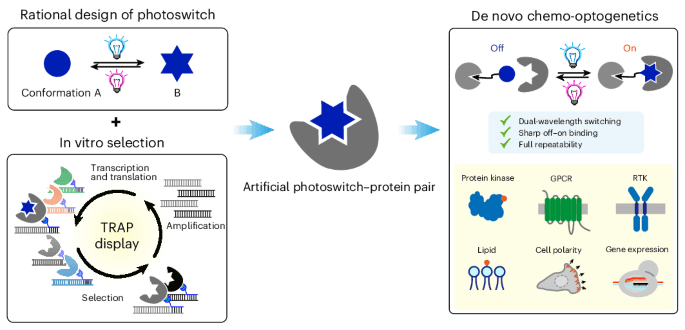
A blue flash brought the synthetic pair together; a violet pulse sent it apart. That light-driven back-and-forth is the core of AzoTag, a de novo chemo-optogenetic system designed by researchers at Nagoya Institute of Technology, Nagoya University and the University of Tokyo to control protein behavior with unusual precision in mammalian cells.
The team’s April 23, 2026 paper in Nature Chemistry, authored by 11 researchers including Tomoki Miyazaki, Tomoshige Fujino, Tatsuyuki Yoshii, Haruto Kosugi, Mamoru Funane, Naoya Murata, Kim Chung Nguyen, Satoru Nagatoishi, Kouhei Tsumoto, Gosuke Hayashi, Hiroshi Murakami and Shinya Tsukiji, lays out a bottom-up strategy. Instead of borrowing a natural photoreceptor, the group first designed a photoresponsive small molecule, then used mRNA display to find artificial protein binders that recognize one photoisomer-specific shape.
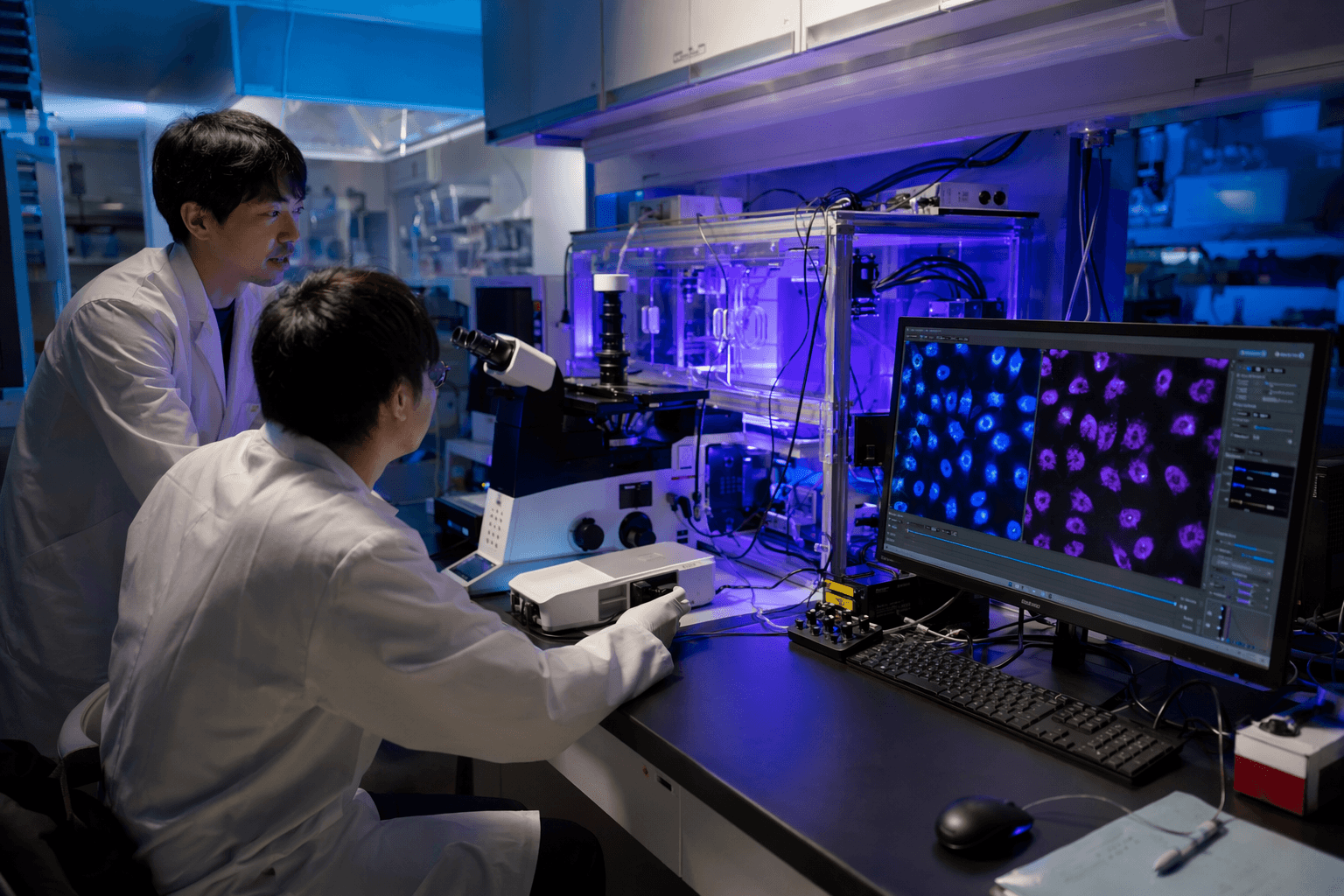
That photoswitch platform centers on ortho-tetrafluoroazobenzene, or FAzo, which the researchers tuned into Et-FAzo and Ca-FAzo variants. Using a TRAP display workflow and an Anticalin-based library of about 10^13 variants, the group isolated binders that preferred the cis form of FAzo. The resulting proteins, named AzoTag1 and AzoTag16, formed a synthetic pair that responded to light on a seconds timescale and stayed stable under repeated illumination.
In cells, blue light promoted binding to cis-FAzo, while violet light drove dissociation. That switchability let the researchers relocalize proteins and steer a wide range of biological functions in mammalian cells, including PI3K signaling, Raf/ERK signaling, GPCR activation, receptor tyrosine kinase activation, gene expression and cell differentiation. The system also supported localized membrane protrusion and cell movement, showing that the same molecular logic could be pushed into different signaling pathways and cellular behaviors.
The immediate appeal is not consumer technology or a near-term clinic. It is experimental control. Optogenetics has already shown how light can make cells photosensitive and precisely controllable in time and space, but many tools still depend on natural photoreceptors or natural ligand pairs. AzoTag pushes that idea into a fully synthetic, customizable framework, giving researchers a way to design the switch and the binding partner together from scratch.
The paper’s early visibility was strong, with 2,816 accesses and 54 Altmetric points shortly after publication. More importantly for cell biologists, AzoTag expands the toolkit for probing how signaling networks, gene programs and differentiation states can be turned on and off with light, one engineered interaction at a time.
This article was produced by Prism’s automated news system from verified source data, official records, and press releases, then run through automated quality and moderation checks before publishing. The system is built and supervised by the people who set the standards it runs under. Read our full AI policy.
Did this article answer your question?