Nature study maps the human proteome, revealing cancer drug targets
A 13,000-protein atlas shows where cancer rewires tissue biology, sharpening target selection, toxicity checks, and repurposing opportunities.
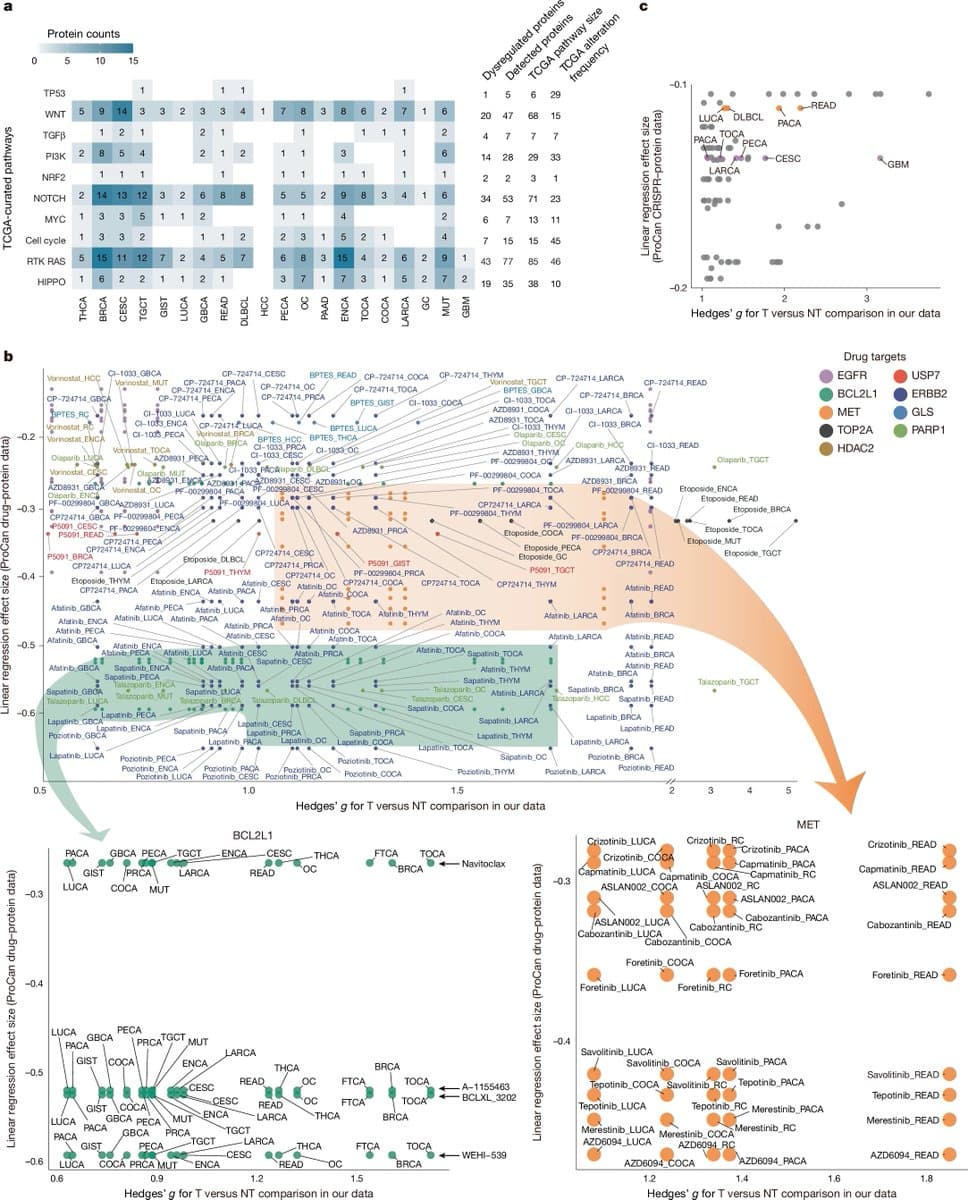
Built from 2,856 samples and more than 13,000 quantified proteins, a new spatial map of the human proteome shows not just which proteins exist, but where they show up across healthy tissue, fetal tissue, tumor tissue, and the tissue around a tumor. The atlas gives cancer research a much sharper way to separate promising targets from likely toxicity traps.
What the atlas actually covers
The resource spans 58 major tissue types, 251 specific tissue subtypes, and 25 carcinomas, making it broad enough to compare organ biology against cancer biology without reducing everything to a single disease slice. The team collected samples from 9 post-mortem adult donors, 8 healthy participants, 9 post-mortem fetal donors, and 1,015 patients with cancer, then profiled the material with data-independent acquisition mass spectrometry. DIA-MS is built for consistency across large cohorts, which suits a cross-tissue proteome map.
The spectral library covers more than 75% of human protein-coding genes, and the project characterizes 208 understudied proteins and 82 missing proteins, which pushes the map beyond the usual high-traffic targets and into the places where real discovery still lives. In practice, that means researchers are not just looking at the familiar kinases and receptors that dominate drug pipelines. They are also seeing proteins that have been hard to place in tissue context until now.
Why protein location changes the drug picture
Protein abundance alone has always been a blunt instrument. A protein can be present in two tissues and still behave very differently depending on the local microenvironment, developmental state, and disease context. This atlas maps proteome trajectories across fetal, healthy adult, adjacent non-tumor, and tumor tissue, turning a static expression table into a developmental-and-cancer continuum.
Quantitative comparisons across diverse tissue types and states can indicate organ-specific toxicity, identify repurposable anticancer drug candidates, and prioritize therapeutic targets. A target that looks attractive in a tumor but also lights up in an essential normal tissue becomes a safety concern, while a target that is tumor-enriched and tissue-restricted rises on the list fast.
The atlas also includes adjacent non-tumor tissue. Cancer does not only rewrite malignant cells, it also reshapes the surrounding tissue, and the atlas gives researchers a way to see that spillover in protein terms. A protein that looks “clean” in bulk tumor data can still be embedded in a broader tissue program that predicts side effects or weak efficacy.
What becomes newly possible for drug repurposing
Drug repurposing depends on context. An approved drug only becomes interesting for a new cancer indication if its target appears in the right place, at the right level, in the right disease state. This atlas gives drug teams a tissue-aware filter for exactly that kind of screening and a way to identify drug candidates that may be repurposed as antineoplastics.
Instead of starting from scratch with a brand-new molecule, teams can begin with existing compounds and ask a cleaner question: does the target sit in a cancer-relevant proteomic state while staying relatively quiet in the organs that would make the drug unsafe? The atlas is not a repurposing answer key, but it changes the first pass from guesswork to a map with tissue, cancer, and developmental context built in.
Most proteomics programs still struggle with the gap between what is measurable and what is actionable, especially in underexplored proteins. Because this atlas characterizes understudied and missing proteins alongside the better-known ones, it can pull overlooked candidates into the repurposing conversation sooner.
Why precision medicine gains a better map
Precision medicine needs more than mutation calls and transcript counts. It needs a read on what the tumor is actually doing in tissue, and this atlas gives that read in protein space, where many drug decisions are ultimately made. The resource provides wide-ranging insights in developmental biology and oncology and could aid the identification of therapeutic targets and the development of treatments for cancer.
A map like this becomes useful when it can be queried against a specific tumor type, tissue subtype, or protein family. The project is a quantitative resource for navigating the proteome in the human body and in common cancers. That makes it the kind of dataset that can feed target review, biomarker triage, and patient stratification work rather than sitting as a one-off atlas on a shelf.
This article was produced by Prism’s automated news system from verified source data, official records, and press releases, then run through automated quality and moderation checks before publishing. The system is built and supervised by the people who set the standards it runs under. Read our full AI policy.
Know something we missed? Have a correction or additional information?
Submit a Tip