Pumpkinseed raises $20 million to advance reference-free protein sequencing chip
Pumpkinseed closed a $20 million Series A to push a Raman-based chip from peptide reads to full-length protein sequencing, aiming at a new foundation for proteomics.

Pumpkinseed is betting that protein analysis can move beyond reference databases and into a new read layer for biology. The Stanford spinout said its deSIPHR chip can sequence proteins directly, without labels or a reference database, and now has $20 million to push that platform from peptide-length reads toward full-length protein sequencing.
The Series A was co-led by NfX and Future Ventures, with participation from Base4, ADVentures, and Stanford University. Pumpkinseed said the financing will support scale-up of deSIPHR, expansion of biopharma and biosecurity partnerships, and further development of AI models trained on the company’s proteomic datasets. The company framed the raise as a step toward comprehensive proteome mapping, a capability that could matter for drug discovery, food systems, health research, and industrial biology.
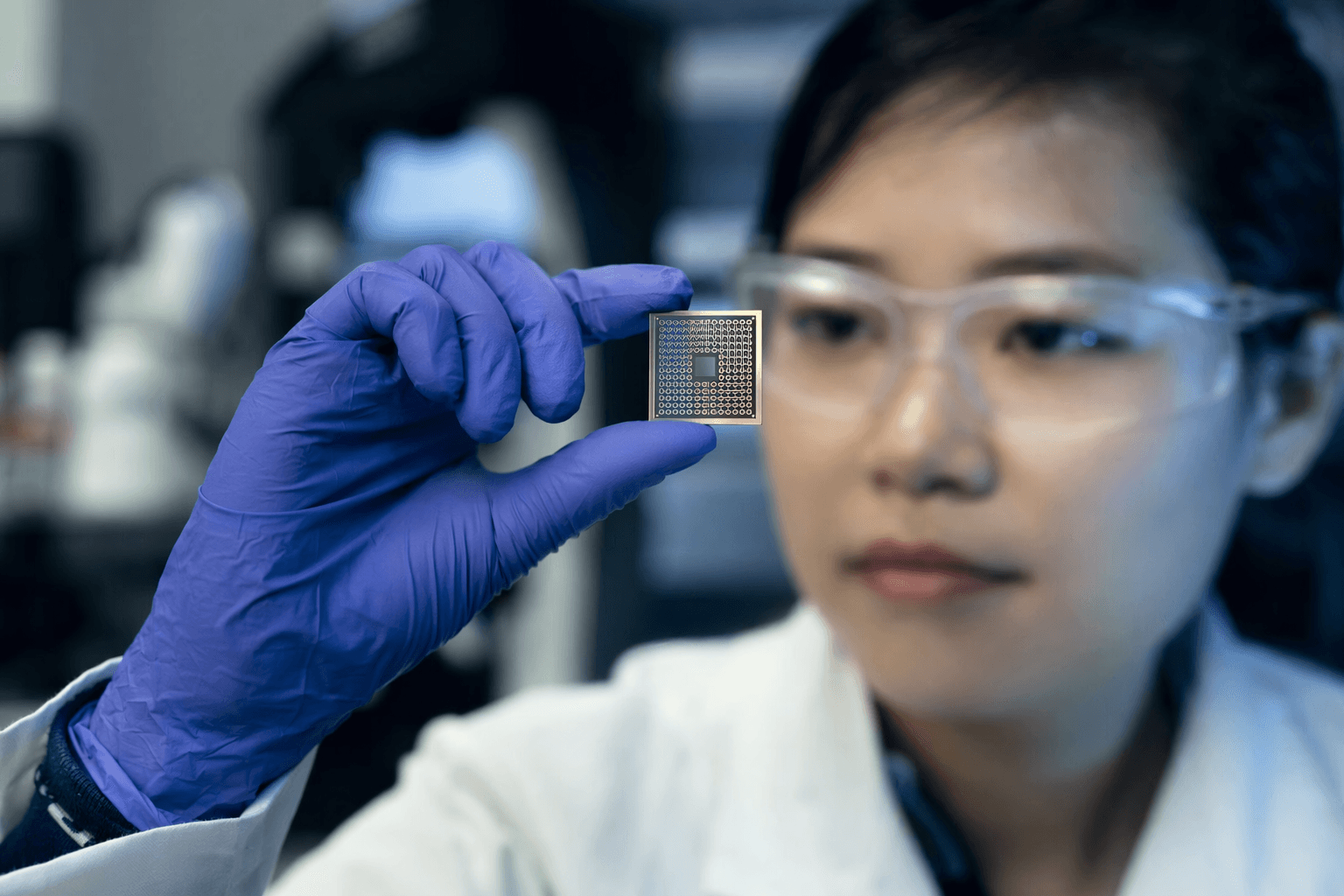
Pumpkinseed says deSIPHR uses Raman spectroscopy on a nanophotonic chip to read proteins at single-molecule resolution. The company describes the system as direct, reference-free, and label-free, with the ability to identify known and unknown proteins and detect post-translational modifications. It also says the chip carries more than 100 billion sensors per square centimeter, a density that points to why the company believes standard semiconductor manufacturing could help it scale faster than many lab-bound proteomics tools.
The technology challenge is straightforward to state and hard to solve: synthetic biology can generate thousands to millions of protein variants, but current workflows often force researchers to screen only a small fraction of them. Pumpkinseed’s pitch is that deSIPHR could change that by providing a broader, more flexible way to read proteins as they are, rather than only matching them to what is already cataloged. In that sense, the company is positioning the chip as infrastructure for discovery, not just another assay.
Pumpkinseed was founded in 2021 by Jen Dionne, Jack Hu, and Nhat Vu. Dionne, a Stanford professor and the company’s chief executive, has helped steer the startup from academic roots into a commercial platform with active programs in biopharma and biosecurity. Axios reported that Pumpkinseed is already thinking about a $30 million to $40 million Series B within the next year, a sign that investors may be backing a foundational platform rather than a single product.
If deSIPHR can move from peptide-scale outputs to full-length protein reads, it could give proteomics a new instrument class, one that competes with mass spectrometry in some settings and complements it in others. For a field still limited by what can be detected, matched, and interpreted, that would be a meaningful shift.
This article was produced by Prism’s automated news system from verified source data, official records, and press releases, then run through automated quality and moderation checks before publishing. The system is built and supervised by the people who set the standards it runs under. Read our full AI policy.
Did this article answer your question?