A Simple Gesture toolkit shows how food banks can partner with health care providers
Food banks can’t stop at food drops. This toolkit shows the real work is building referral systems, with screening, follow-up, and data-sharing baked in.

The next step after a filled pantry shelf is a working referral line
A Simple Gesture’s most useful lesson from the new food bank-health care toolkit is blunt: handing out food is not the same thing as moving people into care. The gap matters because food insecurity is still widespread, with USDA reporting 12.8% of U.S. households, or 17.0 million households, affected in 2022, and more recent national estimates putting the number of Americans in food-insecure households at about 47.9 million in 2024. For a neighborhood food recovery group built on green bags, that is the operational challenge now, not just the charitable one.
The reason this feels urgent is that food insecurity is not a standalone problem. Feeding America says 44.2 million people, including more than 13 million children, lived in food-insecure households in 2022, while USDA reported that 18.4% of U.S. households with children faced food insecurity in 2024. That means many of the households A Simple Gesture reaches are already dealing with health risks, unstable access to meals, or both. If the organization wants to serve those households well, it has to think less like a donation pipeline and more like a connector inside a broader care system.
What the toolkit actually changes
The Center for Health Care Strategies toolkit treats food bank-health care partnerships as a sequence, not a slogan. It starts with readiness and capacity, then moves into preparation, initial meetings, referral design, evaluation, and ongoing monitoring. That ordering matters because partnerships usually fail when organizations jump straight to a pilot without first deciding who will handle intake, what happens after a screen identifies need, and how the work will be measured.
For A Simple Gesture, that sequence maps neatly onto the real work already happening in the field. Green bag pickup routes, pantry partnerships, and volunteer coordination are all forms of logistics. The toolkit pushes that logistics one level further by asking how a food recovery operation can route households from a clinic, school, or social service touchpoint into a food resource quickly enough to matter. In practical terms, that means defining the handoff, not just the relationship.
Readiness comes before referral
The first move is internal. The toolkit recommends assessing organizational readiness and capacity, identifying needs, and using local data before launching any partnership. That is a useful check for A Simple Gesture because food recovery groups often rely on goodwill and volunteer muscle, which can hide gaps in staffing, database systems, or follow-through. A partnership with a health provider will not work if the organization cannot answer basic questions about where referrals go, who answers them, and how quickly.
Executive and board leadership also need to be in the room early. That is not bureaucratic overhead, it is what lets a nonprofit commit to the staffing, technology, and policy changes that a referral system requires. If board members understand that the project is not a side program but a new way of moving people to help, they are more likely to support the data systems and staff time that keep it alive.
The real work is in the handoff
The toolkit’s strongest value is that it turns an abstract idea into an operations checklist. Screening has to identify food insecurity in a way that fits the setting. Referral has to point to a concrete nutrition resource or food partner. Follow-up has to confirm that the connection actually happened. Data-sharing has to be clear enough that both sides know what information moves, what stays private, and who owns the record.
That is where many partnerships get stuck. Clinical social-needs workflows often depend on a trusted professional who can notice need and make the connection, but trust alone does not guarantee completion. A CDC study of an emergency-department workflow in Utah screened 210 patients and found 61% reported at least one need. Of those, 52% wanted follow-up, yet only 49% of patients with complete data who wanted referrals were reached by 2-1-1. The lesson is simple and hard: screening without a reliable handoff creates paperwork, not access.
Why follow-up and data-sharing matter
For food banks and food recovery programs, follow-up is not a bonus feature. It is the difference between saying help exists and proving the person received it. That means somebody has to own the next step after the referral is made, whether that is a pantry coordinator, a clinic navigator, a 2-1-1 partner, or a shared community health worker role. It also means the partnership needs a shared definition of success, not just a count of screens completed.
The toolkit’s emphasis on evaluation and monitoring matters here. A Simple Gesture already lives in the world of route counts, bag returns, pantry drop-offs, and volunteer coverage. Those are the kinds of measurable operations that make a referral system possible if the organization extends the same discipline to referral completion, repeat use, and missed connections. If a household is referred but never reached, the system has failed even if the screen was done perfectly.
Culturally inclusive food access is part of the infrastructure
The toolkit also recommends culturally inclusive food services, and that should be treated as an operational requirement, not a branding detail. A household may accept a referral but still not use the service if the food options do not fit dietary needs, cultural preferences, or household composition. For A Simple Gesture, that means thinking beyond volume and toward fit, especially when serving communities that may have different expectations around staples, produce, or specialty items.
This also affects trust. If a clinic or school sends someone to a food partner and the experience feels generic or mismatched, the referral network loses credibility fast. Inclusive food service is one of the few places where program design and customer experience are exactly the same thing.
Why local data makes the case stronger
Feeding America says its Map the Meal Gap study provides county and congressional-district estimates nationwide, which gives local partners a concrete way to show where need is concentrated. That kind of data is useful for A Simple Gesture because it can help justify where to build referral relationships, where pantry partnerships need reinforcement, and which neighborhoods may be underserved despite active donation routes. The point is not just to prove hunger exists. It is to show where the handoffs should be built.
That local framing is also what moves a partnership from symbolic to durable. Health providers are more likely to engage when a food partner can show neighborhood-level need, not just a broad mission statement. Food recovery groups are more likely to retain volunteers and partners when they can point to specific gaps they are filling, not just generic community impact.
What A Simple Gesture can learn from its own growth
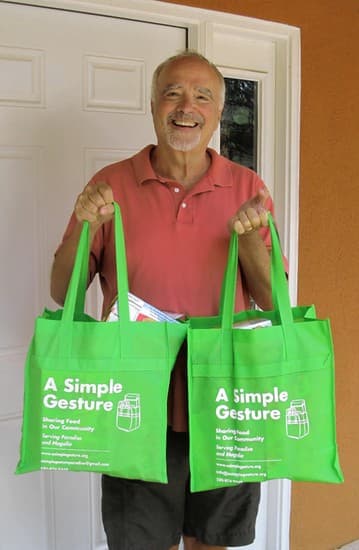
A Simple Gesture has operated in Guilford County since 2015, and an Arlington Community Food Bank account says the model began there with just six families. A PACS A Simple Gesture page places the model’s origin even earlier, in 2011 in Paradise, California, and says it has since been replicated by more than 70 chapters nationwide. That history matters because it shows the model already knows how to scale through simple habits, repeated consistently.
The health care partnership question is whether that same replicable structure can now support referral infrastructure. Green bag pickup routes and pantry partnerships already connect households to food. The next layer is connecting those same households to a health system that can identify food insecurity earlier, route them efficiently, and follow through until the referral is complete. That is how a food recovery program becomes part of the care net instead of only the last stop in it.
The bigger shift is not philosophical. It is operational. Food banks that want to work with clinics and hospitals will need clearer intake, faster routing, better data-sharing, and staff who can manage the handoff instead of just the inventory. The toolkit is useful because it makes that reality visible, and for A Simple Gesture, that may be the blueprint for turning food recovery into a durable referral system.
This article was produced by Prism’s automated news system from verified source data, official records, and press releases, then run through automated quality and moderation checks before publishing. The system is built and supervised by the people who set the standards it runs under. Read our full AI policy.
Did this article answer your question?