NIOSH warns Big Lots workers on backroom ergonomics, pallet jack safety
Backroom shortcuts can turn into lasting injuries fast. NIOSH’s retail ergonomics guidance shows where Big Lots workers face the most risk when freight moves fast and aisles tighten.

Why the backroom deserves more attention
The hardest part of a Big Lots shift is often not the sales floor. It is the backroom, where freight piles up, aisles narrow, and employees repeat the same lifts, turns, and pushes until a normal day starts wearing on the shoulders, back, knees, and hands. That is exactly the kind of work the National Institute for Occupational Safety and Health was warning about in its retail ergonomics guide, which says manual material handling injuries, also called overexertion injuries, account for 60% of injuries and lost work in select retail businesses.
For Big Lots associates, that warning lands in a very familiar place. Seasonal resets, fast replenishment, and pallet movement can create a setting where people are tempted to move faster than the space allows. The hazard is not just a single bad lift. It is the accumulation of awkward reaches, rushed stocking, and repeated twisting that can turn a regular shift into a long-term strain.
What NIOSH and OSHA say actually causes the damage
NIOSH published *Ergonomic Solutions for Retailers* in October 2014 as DHHS (NIOSH) Publication No. 2015-100, and its message is straightforward: retail work becomes more dangerous when employees muscle through tasks that could be handled more safely with the right tools and training. In backrooms, contact-based injuries are also common because space is limited and people are working around pallets, stock, and equipment at close range.
OSHA’s ergonomics guidance points to the same set of problems. Lifting heavy items, bending, reaching overhead, pushing and pulling heavy loads, working in awkward body postures, and doing the same or similar tasks over and over all raise the risk of musculoskeletal disorders. That is the daily rhythm in many discount-retail stockrooms, especially when the store is short on time and the freight has to be worked before the floor opens or before customers start crowding the aisles.
The practical lesson is not to treat pain as part of the job. It is to recognize that repetition, reach, and rush are what make a routine task dangerous.
Pallet jacks are only safe when workers are trained to use them
One of the most important parts of NIOSH’s guidance is training before employees use mechanical devices such as powered pallet jacks. OSHA says powered industrial trucks can be rider-operated or walking-operated machines used to move materials on pallets or in boxes, and they are meant to reduce the need for constant manual strain. But they only help if workers know how to use them correctly and are given room to maneuver.
That matters in a store like Big Lots, where freight can arrive stacked tight and backroom paths can be narrow. A pallet jack can be the safer option, but only if the path is clear, the load is stable, and the associate is not trying to force the equipment through a blocked route. When the route is crowded, the safer move is to pause, clear space, and get help rather than trying to muscle the pallet through a pinch point.
Supervisors can cut risk immediately by making sure employees know which equipment is available, who is trained to use it, and when a two-person move is better than a solo one. A pallet jack, cart, or team lift is not a sign of slowness. It is often the fastest way to avoid an injury that takes a worker out for days or weeks.
The motions that do the most harm
The injuries NIOSH and OSHA are talking about usually start with simple motions that feel harmless in the moment. A box lifted from too low on a pallet. A reach across stacked product that is just a little too far. A twist at the waist when a better path would have been to reposition the pallet. A hurried pull on a load that should have been split into smaller parts.
OSHA’s grocery warehousing guidance adds another important detail: tight pallet configurations can force workers to reach far across loads, which increases stress on the shoulder, back, and knee. Even lighter items can become a problem when they are held away from the body. At Big Lots, where stock may be packed tight and timing pressure can be high, that means the way the load is arranged matters almost as much as the load itself.
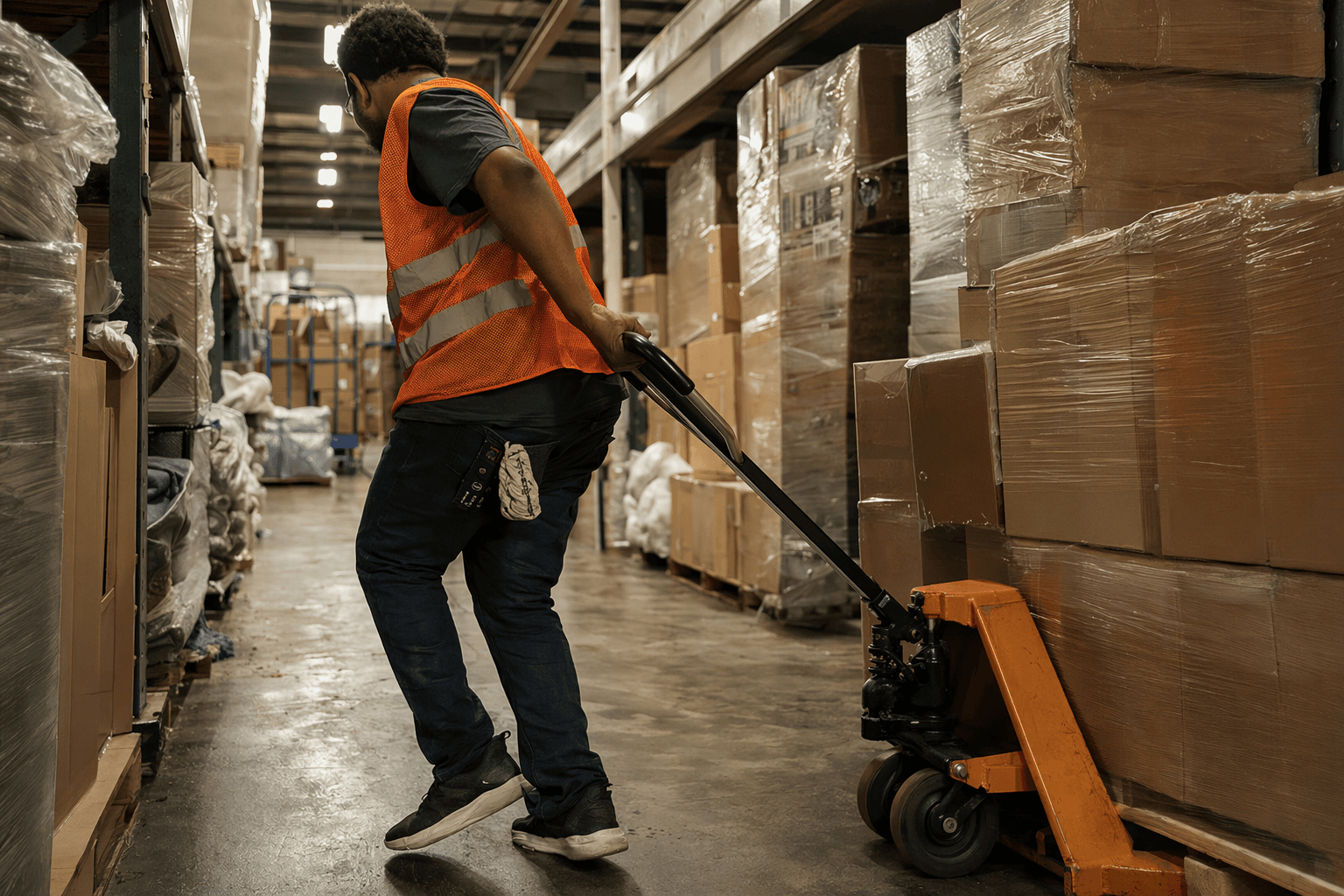
Workers can reduce risk by changing the motion, not just the mindset:
- Keep the load close to the body instead of reaching across it.
- Turn the feet instead of twisting the torso.
- Break large or awkward loads into smaller trips.
- Ask for help when a box is heavy, oversized, or blocked by other freight.
- Stop and reset the path if a pallet, cart, or display is in the way.
These are small corrections, but they are the difference between a controlled lift and a strain that lingers for months.
Why timing pressure makes the backroom more dangerous
Big Lots’ restructuring has added another layer of pressure to an already physical job. The company filed for Chapter 11 bankruptcy protection on September 9, 2024, later said it would not file future regular 10-Qs and 10-Ks, and moved ahead with store-closure plans that kept growing through 2024. In October 2024, Big Lots announced another 56 closures across 27 states, and the total closure plans in its bankruptcy filings went beyond 340 locations.
That kind of shrink-the-footprint environment changes the feel of the workday. Fewer stores, fewer people, and constant freight handling can push crews to move faster with less margin for error. That is when safety shortcuts start looking normal: lifting from awkward heights, rushing a pallet move, skipping a team lift, or powering through a blocked aisle because the truck has to be worked now.
But the bankruptcy pressure does not change the body’s limits. It usually makes them more visible. Strains, sprains, crushed feet, and contact injuries become more likely when associates are undertrained, understaffed, or pushed to hurry through backroom tasks that already demand precision.
What safer backroom work looks like at store level
OSHA says proper design, planning, and training can keep warehouse workers safe, and that advice applies directly to a Big Lots stockroom. Safe backroom work is not complicated, but it has to be consistent. Equipment needs to be available and used properly. Pallets need to be staged so workers are not reaching far across unstable or tightly packed loads. Aisles need to stay clear enough that people can move without turning every trip into a squeeze.
The best stores make prevention part of the routine:
- Train before a worker uses a powered pallet jack or similar equipment.
- Keep paths open so employees are not forced into awkward detours.
- Use team lifts for bulky or unstable freight.
- Rework pallet placement so product is accessible without overreaching.
- Slow the pace when the setup is unsafe, even if the truck is waiting.
At a company like Big Lots, where the backroom can decide how smoothly the whole store runs, ergonomics is not a side issue. It is operational survival. The stores that stay safest are the ones that stop treating strain as the price of moving freight and start treating safe handling as part of the job itself.
This article was produced by Prism’s automated news system from verified source data, official records, and press releases, then run through automated quality and moderation checks before publishing. The system is built and supervised by the people who set the standards it runs under. Read our full AI policy.
Did this article answer your question?