Dollar General’s workforce growth highlights staffing pressure across 20,000 stores
Dollar General’s workforce climbed to about 194,200 in 2025 as its store base topped 20,000. That scale helps workers judge staffing pressure, transfer options and advancement paths.
As of January 31, 2025, Dollar General operated 20,594 Dollar General, DG Market, DGX and pOpshelf stores in the United States and Mi Súper Dollar General stores in Mexico. Revelio Labs tracks the company's employee count, but for associates, district managers and anyone chasing a transfer, the key question is how many people it takes to keep those stores running.
What the store footprint tells you
During 2025, Dollar General provided access to more than 20,800 stores across 48 U.S. states and five cities in Mexico, its 2025 Corporate Social Responsibility & Sustainability Report says. That January 31, 2025, footprint appears in the company's fiscal 2024 annual report and 2025 proxy statement. Its About Us page lists more than 20,000 convenient stores in 48 states.
For workers, that footprint creates more possible points of movement if you are looking for another store, a different format or a different job family. A company with more than 20,000 locations has multiple layers of management and a wide mix of store environments, from rural boxes to busier neighborhood formats.
The headcount trend behind the pressure
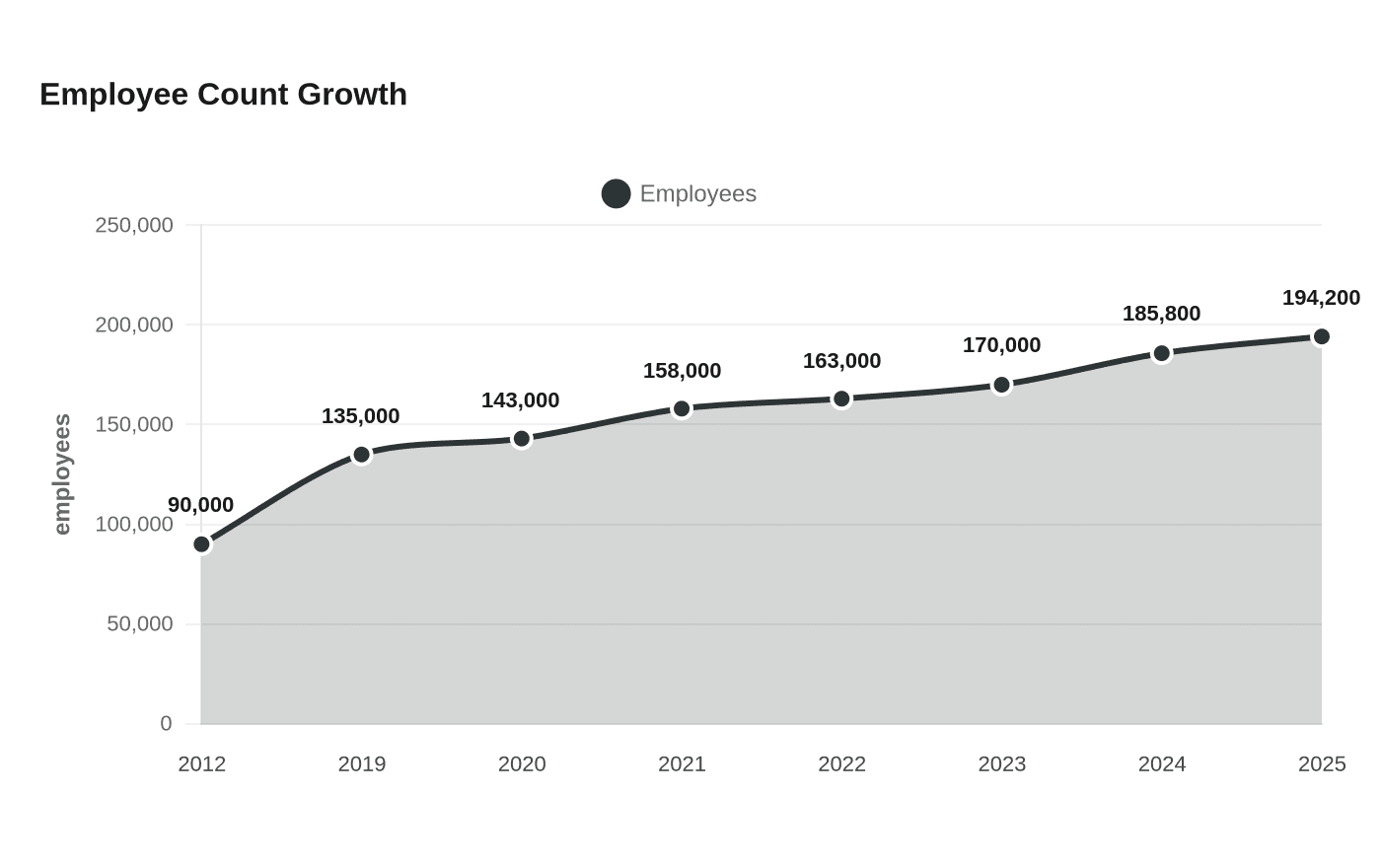
The clearest long-term signal is Dollar General’s employee growth. Macrotrends lists the company at about 90,000 employees in 2012, 135,000 in 2019, 143,000 in 2020, 158,000 in 2021, 163,000 in 2022, 170,000 in 2023, 185,800 in 2024 and about 194,200 in 2025. It has kept adding people while operating one of the largest store networks in U.S. retail.
If the company is adding people but your store still feels constantly short, the problem is usually not a shrinking employer. It can point to churn, rapid expansion, uneven scheduling or a store-level staffing model that is stretched thin even when corporate headcount is climbing.
Reading the role mix for real advancement paths
Dollar General’s careers pages separate retail jobs from distribution jobs. In distribution, employees can do “a little bit of everything,” including work in retail settings such as stocking shelves, working the register and providing customer service, while distribution-center jobs handle receiving, warehousing and shipping products to stores.
The company’s structure shows three broad paths: store work, distribution work and corporate support. If you are already on the sales floor, the move into logistics is one of the clearest internal pivots, especially if a nearby distribution center is hiring. If you are in a store where only a few people know key tasks, it can also explain why advancement feels slow: the chain may be large, but individual stores still depend heavily on a small number of experienced workers.
The role mix also helps district managers think about recruiting. A store job and a warehouse job are not the same labor market, even when they sit under the same company. If store staffing is hard but distribution hiring is steadier, that may say more about the labor market around your location than about the company’s overall size.
What enforcement actions say about the working environment
Dollar General’s public record also shows where labor pressure has spilled into enforcement. In July 2024, the U.S. Department of Labor announced a settlement that required Dollar General to pay a $12 million penalty and improve workplace safety after Occupational Safety and Health Administration-related violations. The July 11, 2024, agreement set fines of up to $500,000 per violation for future safety failures.
If you work in a store that already feels rushed, crowded or under-resourced, those figures help you judge how seriously the company has had to treat safety failures in the past.
Dollar General also faced another public penalty on a different front. In October 2025, Colorado Attorney General Phil Weiser announced a $400,000 settlement with the company over alleged overcharging at the register compared with shelf prices. That kind of case is not a wage issue, but it does land on the same front-end workers who answer customer complaints and ring transactions all day. Price disputes can turn into extra stress for cashiers and managers, especially in stores where staffing is already tight.
How to use these numbers on the job
Use these numbers to separate companywide pressure from store-level chaos:
- Headcount growth: Dollar General’s rise from about 90,000 employees in 2012 to about 194,200 in 2025 tells you the company is still expanding its labor footprint. If your store feels short anyway, the problem is likely in staffing distribution, turnover or scheduling.
- Role mix: The split between retail and distribution jobs shows whether a transfer could realistically move you into receiving, warehousing, shipping or another store environment. That is the clearest path if you want different hours or less customer-facing work.
- Turnover signals: Public headcount does not tell you how many people are leaving, but if total employment rises while trained staff keep disappearing from your store, that is a churn signal worth taking seriously.
- Regional concentration: More than 20,000 stores across 48 states and five Mexico cities means transfer options exist somewhere in the system, but not every market has the same density. If you work in a rural area, the nearest alternative may still be far away; if you work near a cluster of stores, movement may be easier.
In May 2024, Dollar General said consumer spending would remain pressured through 2024. Stores operating under weaker demand often feel every hour and every task more sharply. When sales are tight, labor pressure tends to show up in scheduling, freight handling and the amount of work each shift has to absorb.
This article was produced by Prism’s automated news system from verified source data, official records, and press releases, then run through automated quality and moderation checks before publishing. The system is built and supervised by the people who set the standards it runs under. Read our full AI policy.
Did this article answer your question?