Goldman Sachs 10-K reveals revenue drivers, risks and business structure
Goldman’s filing shows which businesses drive the bank, where risk sits, and why the mix matters for bonuses, staffing and career paths.
Global Banking & Markets, Asset & Wealth Management, and Platform Solutions anchor Goldman Sachs’ 2024 Form 10-K. The filing lays out the bank’s business lines, risk framework and capital structure.
The business map inside the filing

Investor-relations materials break Global Banking & Markets into Investment Banking, FICC and Equities, and Transaction Banking.
The split separates businesses that live and die by markets from businesses designed to gather fees and client assets. For people in investment banking, the filing shows how advisory and underwriting sit inside a broader balance sheet business, not as a standalone rainmaker. For people in markets, it shows how trading performance is measured alongside the risks management has to disclose to investors. For anyone in wealth or asset management, it frames fee-based growth and asset gathering as a deliberate counterweight to volatility elsewhere.
Goldman’s 2025 annual report page steers readers through “What We Do,” Global Banking & Markets, Asset & Wealth Management, Platform Solutions, and Research & Perspectives. The investor-relations site also points readers to the firm’s Exchanges podcast.
What management is trying to prove
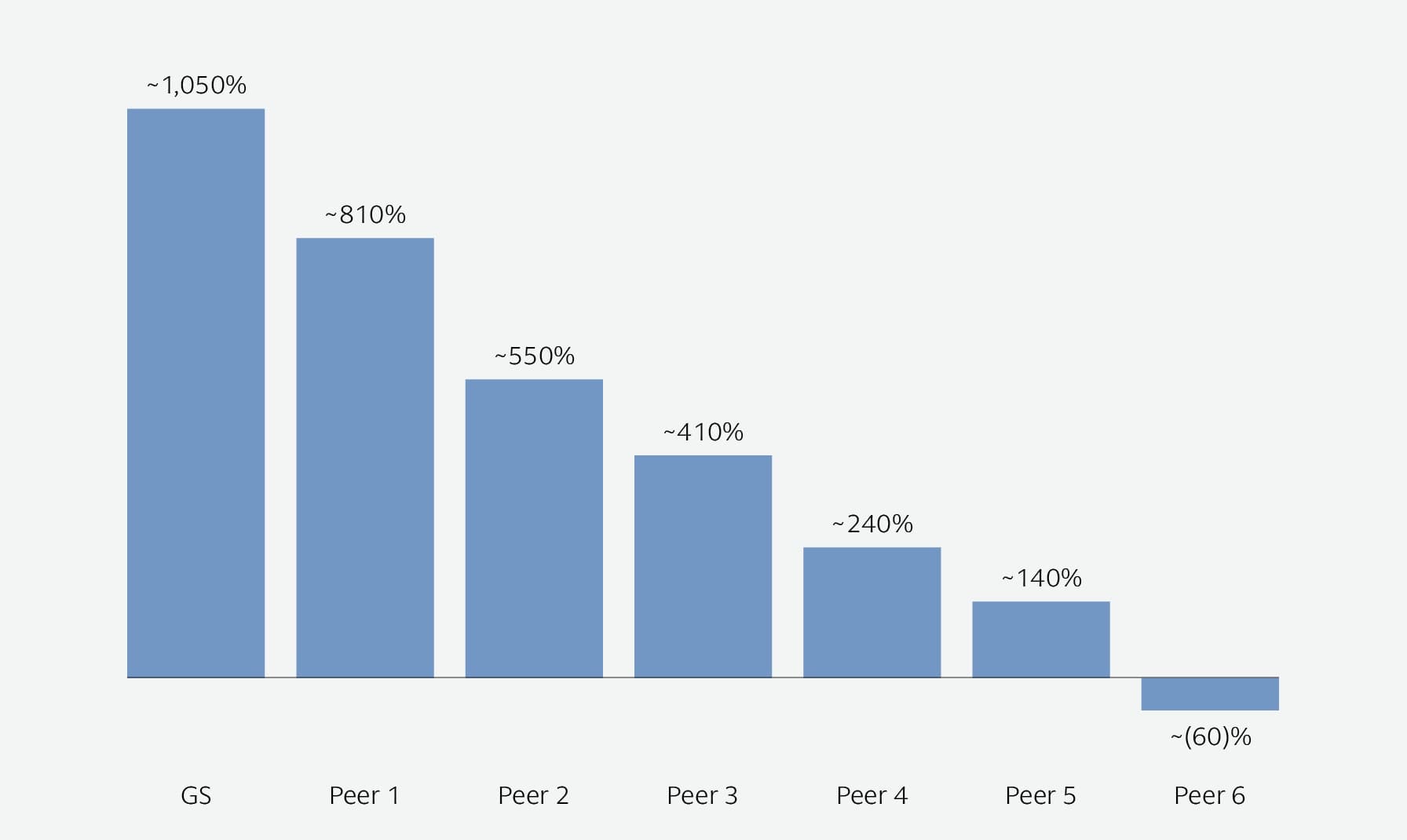
The shareholder letter in Goldman’s 2025 annual report puts a number on the strategy reset that began at Investor Day in January 2020. Since then, Goldman says it has increased firmwide net revenues by roughly 60 percent, grown earnings per share by 144 percent, improved returns by 500 basis points, and delivered total shareholder return of over 340 percent, which it says was the most among its peer group over that period.
They are management’s argument that the 2020 strategy is still working and still defines the firm’s identity in 2025. For employees, a management team that can point to sustained EPS growth and higher returns has more room to defend budgets, keep investing in favored businesses and argue for compensation discipline when markets soften.
The firm is still telling a story built around the same 2020 framework, but now with a larger revenue base and a heavier emphasis on how that growth has translated into returns and shareholder value.
Where risk and restructuring show up
A filing summary of Goldman’s 2025 10-K outlines its 2025 segments, the Apple Card exit and regulation. The Apple Card exit matters because it shows Goldman continuing to unwind earlier consumer bets while focusing attention on businesses that better fit its core economics.
When Goldman decides to exit a product, change a platform or trim exposure, it affects capital allocation, management attention and eventually the internal pecking order between businesses that consume resources and businesses that throw off steadier fees.
Goldman’s disclosures place the firm inside a capital and risk structure that includes market, credit, operational and model risk, all under constant regulatory oversight. That backdrop shapes desk reviews, hiring decisions and compensation conversations inside a global bank that depends on both reputation and execution.
What it means for careers, staffing and pay
The filing is especially helpful if you work somewhere between revenue production and the annual bonus discussion. A business like Global Banking & Markets can swing with market conditions, deal flow and client risk appetite, while Asset & Wealth Management is built more around fee-based growth and asset gathering. That difference shapes year-end compensation, promotion timing and staffing plans.
The shape of the franchise often tells you more about the next pay cycle than the internal rhetoric does. If trading is strong, underwriting is busy and client activity is high, the pressure to defend bonus pools rises with it. If asset gathering and wealth fees are doing the heavy lifting, managers have a better story to tell about durable revenue, which can cushion staffing decisions even when capital markets are choppier.
For analysts and associates, the filing also gives a sober view of what prestige really buys. Goldman’s brand still carries weight on a résumé, but the 10-K shows the firm as a regulated machine whose results depend on market conditions, capital rules and business mix. That is useful information if you are deciding whether to stay for a promotion cycle, move toward a more stable fee-based line or use the brand for an exit into a different part of finance.
Governance, compensation and the formal record
At the April 23, 2025 annual meeting, shareholders approved executive compensation and elected directors, and Goldman’s 2025 proxy statement listed 14 director nominees along with an advisory say-on-pay vote. That puts pay, oversight and board control in the same disclosure ecosystem as the 10-K.
The formal filing itself comes from The Goldman Sachs Group, Inc., based at 200 West Street in New York, New York 10282, and incorporated in Delaware. Goldman filed its 2024 Form 10-K under SEC accession number 0000886982-25-000005 for the fiscal year ended December 31, 2024, with Commission File Number 001-14965.
This article was produced by Prism’s automated news system from verified source data, official records, and press releases, then run through automated quality and moderation checks before publishing. The system is built and supervised by the people who set the standards it runs under. Read our full AI policy.
Did this article answer your question?