Goldman Sachs data shows U.S. AI adoption remains uneven across firms
Only 20.6% of U.S. firms use AI in regular operations, while Goldman Sachs says another 23.9% plan to adopt it within six months.
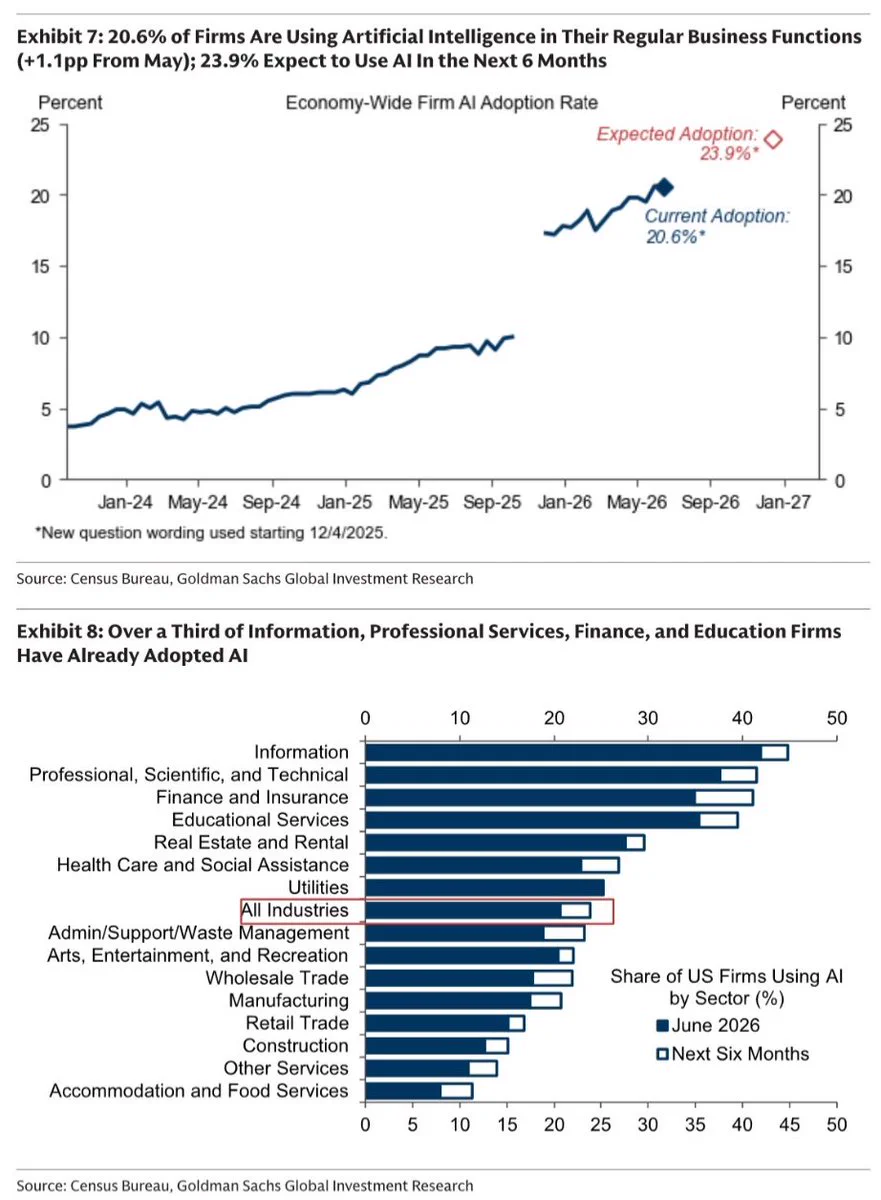
Only 20.6% of U.S. firms are using AI in regular operations, and another 23.9% plan to adopt it within six months, a gap that keeps the technology from looking like a standard workplace tool. Goldman Sachs updated its AI adoption tracker through April 2026 and said AI-related investment in U.S. national accounts had climbed to $360 billion, or 1.1% of GDP, above its 2022 level.
The Census Bureau is now measuring that split in much finer detail. Its Business Trends and Outlook Survey reaches roughly 200,000 businesses every two weeks, and the bureau has added an artificial-intelligence supplement to track firm-level use in real time. Earlier Census work in March 2024 used the Annual Business Survey to frame AI use across more than 300,000 employers, and it found that just 3.8% of businesses were using AI to produce goods and services in 2023.

The adoption curve is uneven even within the U.S. economy’s most digital corners. The information sector shows the highest AI use in Census Bureau reporting, with finance also among the leading adopters at roughly 35% to 43%. At the other end, manufacturing and retail sit in the low teens, while wholesale trade continues to trail the national average. Firms with at least 250 employees are the biggest users, underscoring that AI is still concentrated among larger companies with the budget and internal bandwidth to absorb it.
That pattern points to a harder problem than model quality or investor enthusiasm. For most employers, AI rollout is not a software download; it is a process change that requires new controls, training, data cleanup, security review, and managers willing to redesign workflows. Goldman Sachs has separately argued that generative AI could eventually automate about 25% of work tasks, but the adoption data show that the real bottleneck is still organizational readiness, not headline-grabbing capability.
For workers at Goldman Sachs and elsewhere in financial services, that means AI is more likely to arrive as selective automation inside enterprise systems than as a sudden replacement for entire teams. The firm’s own investment analysis says the market is shifting toward inference and enterprise adoption, but the Census data suggest the business side of that shift is still gradual, and far from universal.
This article was produced by Prism’s automated news system from verified source data, official records, and press releases, then run through automated quality and moderation checks before publishing. The system is built and supervised by the people who set the standards it runs under. Read our full AI policy.
Did this article answer your question?