Goldman Sachs Pillar 3 disclosures reveal capital constraints shaping strategy
Goldman’s Pillar 3 filing shows which businesses can grow and which ones consume too much balance sheet. For bankers, it is a map of regulatory limits that shape pricing, client selection, and staffing priorities.
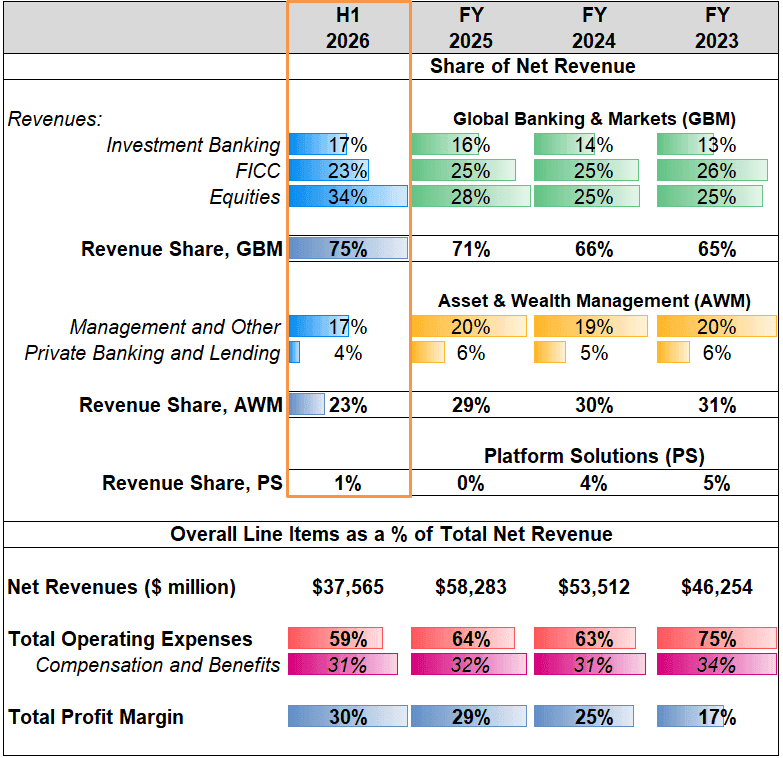
The filing for the period ended March 31, 2026 sits next to earnings that showed $17.23 billion in net revenues, $5.63 billion in net earnings, diluted EPS of $17.55, annualized ROE of 19.8%, and book value per share of $361.19.
What the Pillar 3 filing is really saying
Pillar 3 disclosures are technical regulatory capital documents, not marketing material. They show investors and regulators the firm’s risk profile, capital structure, exposures, and buffers, which makes them especially useful at Goldman because so much of the business depends on trading, underwriting, financing, and other balance-sheet-intensive activities.
The 1Q26 table of contents covers Regulatory Capital, Capital Structure, Risk-Weighted Assets, Credit Risk, Equity Exposures in the Banking Book, Securitizations in the Banking Book, Market Risk, Operational Risk, Model Risk, Interest Rate Sensitivity, and Forward-Looking Statements.
For analysts and associates, that means a trade, financing, or underwriting mandate is never judged only on revenue. It is also judged on how much balance sheet it uses and how it affects returns on capital. In a place where bonus pools and promotion timing are tied to performance and franchise value, capital intensity can matter as much as gross fees.
Why capital ratios matter inside Goldman
The real operational signal in Pillar 3 is the firm’s constraint set. Risk-weighted assets, leverage requirements, and other regulatory buffers tell Goldman how much balance sheet capacity is available for client business, inventory, and financing. If an activity consumes too much capital relative to its economics, it becomes harder to prioritize, even if the headline revenue looks attractive.
A market-making desk, a structured financing team, or an underwriting unit may all generate revenue, but the economic return changes once capital charges are layered in. Senior bankers read those constraints as a guide to pricing, client selection, and product strategy, because the firm cannot scale every line evenly.
When capital efficiency is strong, management can support more clients without straining the balance sheet. When the capital cost is high, the firm has to be more selective, which can affect headcount decisions, deal pacing, and the amount of work pushed toward the most efficient product lines.
The year-over-year structure shows continuity, not noise
Goldman’s first-quarter 2025 Pillar 3 disclosure covered the same major areas, including Regulatory Capital, Capital Structure, Risk-Weighted Assets, Credit Risk, Equity Exposures in the Banking Book, Securitizations in the Banking Book, Market Risk, Operational Risk, Model Risk, and Interest Rate Sensitivity.
The earnings numbers from the prior year put the operating backdrop in context. Goldman reported first-quarter 2025 net revenues of $15.06 billion, net earnings of $4.74 billion, and diluted EPS of $14.12. Against that base, the 1Q26 figures show a materially stronger quarter, but the Pillar 3 architecture stayed largely the same.
Stronger quarterly results do not erase the need to manage leverage, capital ratios, and risk-weighted assets carefully. They simply give management more room to allocate resources where the risk-adjusted economics are strongest.
Goldman’s broader growth tells you what the firm has been trying to optimize
Goldman’s 2025 annual report provides a longer lens. Since Investor Day in January 2020, Goldman’s 2025 annual report shows firmwide net revenues increased by roughly 60 percent, earnings per share grew by 144 percent, returns improved by 500 basis points, and total shareholder return reached over 340 percent.
A bank that has expanded revenues and earnings as sharply as Goldman has still has to do it while respecting capital and liquidity limits. For employees, that means the firm’s most valued businesses are often the ones that deliver strong economics without consuming scarce balance sheet.
Businesses that support returns, preserve flexibility, and avoid tying up capital unnecessarily are more likely to receive backing. Businesses that look good on paper but are heavy users of risk-weighted assets will face more pressure to defend their place in the portfolio.
The entity-level disclosures show where capital is managed
Goldman also publishes separate Pillar 3 disclosures for Goldman Sachs Bank Europe SE, Goldman Sachs Group UK Limited, and Goldman Sachs International Bank Johannesburg Branch. Capital is not managed only at the holding company. It is distributed across legal entities and jurisdictions, including Europe, the United Kingdom, and Johannesburg.
Local balance sheets have their own regulatory expectations and operating constraints. A product that works cleanly in one entity may be more constrained in another, depending on the rules, buffers, and local risk profile. That can influence where work gets booked, how clients are served, and which teams are positioned to capture growth.
Compliance and business strategy are intertwined at Goldman. Entity structure affects capital deployment, and capital deployment affects who gets to grow.
What employees should take from it
Every incremental trade, financing line, or underwriting commitment has a capital cost, and that cost shapes business priorities long before a quarterly result reaches the market.
For junior bankers, that means understanding balance sheet usage is part of learning the job, not a back-office detail. For VPs and managing directors, it is a reminder that client franchise, pricing, and product mix all live inside a capital budget.
This article was produced by Prism’s automated news system from verified source data, official records, and press releases, then run through automated quality and moderation checks before publishing. The system is built and supervised by the people who set the standards it runs under. Read our full AI policy.
Did this article answer your question?