Goldman Sachs proxy reveals 2026 voting on pay and board oversight
Goldman’s 2026 proxy puts 13 board seats, say-on-pay and PwC ratification on the ballot, a live read on how the firm frames pay, oversight and accountability.
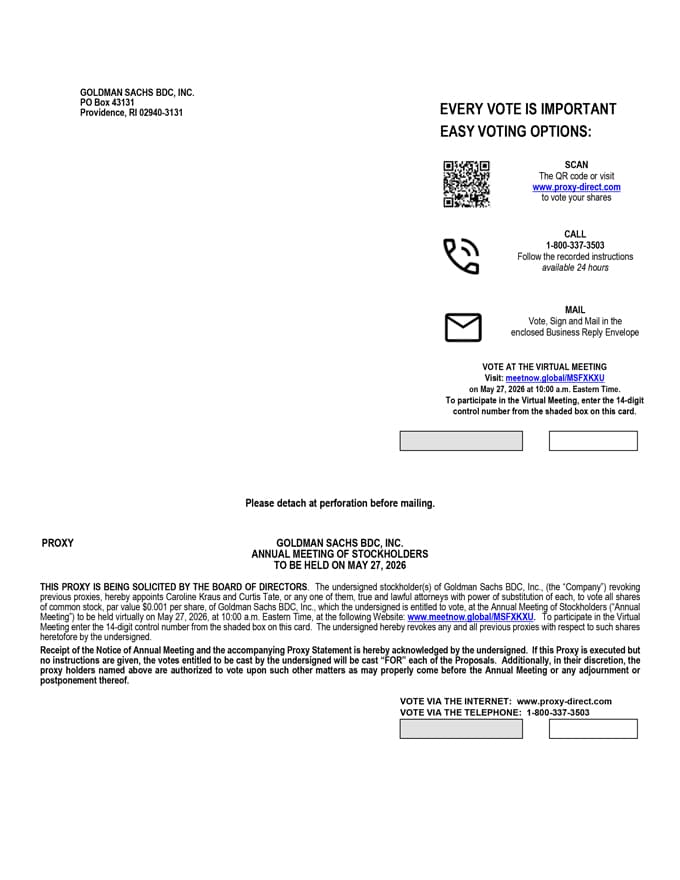
Goldman Sachs is using its 2026 proxy to show shareholders, and its own employees, which levers the board treats as non-negotiable: who sits on the board, how pay is judged, and how the firm signs off on outside oversight. The filing, made as a definitive Schedule 14A with the U.S. Securities and Exchange Commission on March 19, 2026, is the cleanest public guide to what Goldman wants rewarded and what it wants defended.
What the 2026 ballot says about the board’s priorities
The 2026 proxy asks shareholders to vote on the election of 13 director nominees, an advisory say-on-pay proposal, and ratification of PricewaterhouseCoopers as independent auditor. Those are standard items in form, but they are still the board’s most direct public signal of what it expects to be judged on: governance, pay discipline and confidence in the firm’s reported numbers.
The annual meeting gives that message a face. Goldman held its 2026 Annual Meeting of Shareholders on Wednesday, April 29, 2026, and Chairman and CEO David Solomon moderated the meeting. When the top executive is the visible moderator, the company is not trying to hide the leadership chain behind bureaucracy. It is putting accountability and authority in the same room.
That matters inside Goldman because the proxy is where the firm explains itself to the market in a way employees can actually use. It does not shape day-to-day desk life, but it shows which decisions are meant to stand up under shareholder scrutiny, and that in turn tells bankers, traders and dealmakers how senior leadership expects to be judged over time.
Pay, incentives and the message behind say-on-pay
The say-on-pay vote is the clearest window into how Goldman wants to defend executive compensation. A favorable vote signals that the board believes its pay framework is aligned with durable performance, not just a good year in revenues or trading activity. A contested vote, by contrast, tells you shareholders are worried about whether the mix of salary, bonus, stock awards and retention tools is doing what the board claims.
That is not abstract inside Goldman. For analysts and associates working toward bonus season, the way the firm talks about executive pay is part of the same compensation culture that shapes annual awards, promotion decisions and retention packages. If the board is making a public case that top pay is tied to performance and longevity, it is also defining the language managers use when they justify compensation across the firm.
The 2025 cycle showed how quickly that conversation can turn public. Goldman’s 2025 proxy asked shareholders to elect 14 director nominees, approve say-on-pay, and approve The Goldman Sachs Amended and Restated Stock Incentive Plan (2025). Goldman later disclosed on April 24, 2025 that shareholders approved the advisory say-on-pay proposal, but the vote arrived after a sharper round of external pressure than the company would prefer.
Reuters reported on March 29, 2025 that Glass Lewis recommended investors vote against CEO pay at Goldman Sachs, calling it excessive. Reuters also reported on April 1, 2025 that Institutional Shareholder Services urged investors to vote against retention bonuses for David Solomon and John Waldron. That combination matters because it shows the compensation debate is not limited to a simple yes-or-no vote on a proxy item. It is a judgment on whether Goldman is paying for future stability, or paying too much to keep top leaders in place.
Why the 2025 vote still matters in 2026
Goldman held its 2025 Annual Meeting of Shareholders on Wednesday, April 23, 2025, and the company’s later disclosure that shareholders approved executive compensation is important context, not because it ended the debate, but because it did not. The firm still went into 2026 with proxy-adviser criticism fresh in the market and with a board that had to keep explaining why its compensation structure deserves support.
The difference between 14 director nominees in 2025 and 13 in 2026 is small on paper, but it underscores how the board refreshes and resets its oversight story each year. The annual proxy is the one place where employees can see whether the board is broadening oversight, tightening it, or simply re-presenting the same structure with new language. In a firm where reputation, internal mobility and exit opportunities all depend on how the market reads Goldman’s discipline, that annual reset is not cosmetic.
What the auditor vote and board slate tell employees
The ratification of PwC as independent auditor is another reminder that Goldman wants to show external control over the accuracy of its financial reporting. For employees, especially those in businesses where revenue timing, reserves and risk-weighted decisions are all under a microscope, auditor ratification is part of the larger signal that the firm expects its numbers to survive outside inspection.
The board slate matters for the same reason. Director elections are not just a formality for governance specialists. They tell you who is empowered to oversee compensation, risk and strategy at the top, and who gets to explain those choices to investors when the market is unforgiving. In a firm like Goldman, that has a direct effect on how stable leadership looks, how hard it is to defend large awards, and how much latitude senior executives have when they make long-term bets.
For employees trying to read beyond the headlines, the pattern is straightforward. The proxy shows a board that wants shareholders to focus on compensation alignment, independent oversight and leadership accountability, while the 2025 backlash shows those themes are under constant pressure from proxy advisers and investors. That is the real operating context for Goldman’s talent model: not just who gets paid, but who gets trusted to keep the firm’s strategy intact.
This article was produced by Prism’s automated news system from verified source data, official records, and press releases, then run through automated quality and moderation checks before publishing. The system is built and supervised by the people who set the standards it runs under. Read our full AI policy.
Did this article answer your question?