Morgan Stanley says AI dealmaking will spread across industries
Morgan Stanley sees AI M&A moving from chipmakers to power, real estate and telecom, widening Goldman bankers’ pitch book and technical workload.

Goldman Sachs bankers tracking the AI trade need to look past semiconductors. Morgan Stanley said AI acquisitions are now coming in all sizes and across multiple industries, with deal activity spanning the “full spectrum” of M&A, including private and public transactions. For Goldman teams, that is a sign that AI is no longer a narrow tech story but a broader advisory lane that can pull in more coverage groups.
The practical effect is immediate: companies are racing to fill gaps in chips, power, networking and infrastructure, which means industrials, utilities, telecom, data centers, software and real estate can all become part of the same deal conversation. That widens the circle of bankers who need AI fluency. A coverage team that did not think of itself as an AI desk may still need to explain how power availability, grid access and infrastructure bottlenecks shape valuation, timing and execution. For junior bankers, that usually means more technical diligence, more modeling around scaling costs and more calls that go beyond the usual product pitch.

Goldman has already been making that argument internally. In its December 18, 2025 M&A outlook, global head of M&A Stephan Feldgoise said AI would have a “massive impact” on dealmaking and that transactions would extend beyond AI companies and hyperscalers to software, data centers, semiconductors, real estate, power, transmission and more. Goldman Sachs Research has put numbers behind that shift. It said global power demand from data centers is forecast to rise 165% by 2030 versus 2023 levels, AI is projected to make up 28% of the data center market by 2027, and the five highest-spending US hyperscalers were on track for a combined $736 billion of capex in 2025 and 2026. Goldman has also estimated the baseline AI build-out could require about $7.6 trillion of capital between 2026 and 2031.
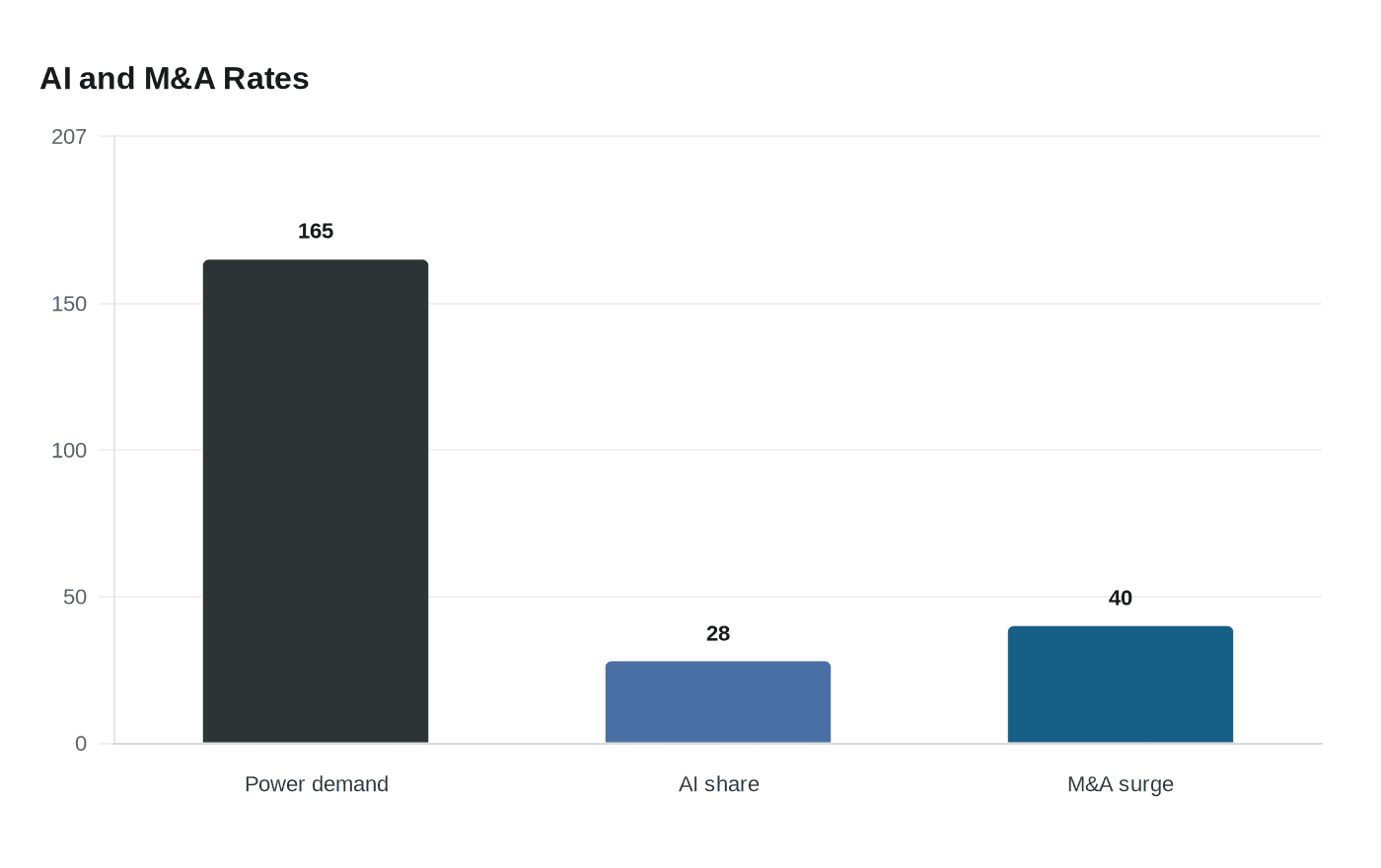
That backdrop matters because it turns AI from a thematic pitch into a repeatable transaction engine. Morgan Stanley said 2025 delivered a 40% surge in global M&A volume and a record 60 deals above $10 billion, while Goldman’s own 2026 outlook said global M&A volumes were up 40% year over year and large deals were rising sharply across the Americas, EMEA and APAC. For Goldman bankers, the opportunity is not just more deal flow. It is a broader set of clients, more cross-border work and a more technical workload for teams that were not built as classic AI coverage groups.
This article was produced by Prism’s automated news system from verified source data, official records, and press releases, then run through automated quality and moderation checks before publishing. The system is built and supervised by the people who set the standards it runs under. Read our full AI policy.
Know something we missed? Have a correction or additional information?
Submit a Tip