McDonald’s operators race to improve retention amid labor shortages
McDonald’s staffing problem is now a retention problem: the stores that keep crew are the ones with steadier schedules, better managers, and real advancement paths.
Retention is the real labor story now
The blunt truth for McDonald’s operators is that filling slots is no longer the hard part. Keeping trained people long enough to stabilize a restaurant is. In an industry shaken by population decline, immigration policy shifts, and the pull of more flexible gig work, restaurants are being pushed to act like places people choose to stay, not just stop through.
The scale matters. The restaurant and foodservice industry employed about 15.7 million people in 2026, roughly 10% of the U.S. workforce, yet eating-and-drinking places were still only 71,400 jobs above their February 2020 employment peak as of April 2026. McDonald’s itself said in May 2025 it planned to hire up to 375,000 workers that summer, a number Restaurant Business noted would be close to half the workforce across its 13,500 domestic restaurants. That is not a minor hiring push. It is a signal that the system is still under strain.
Inside the restaurant, retention is a daily management test
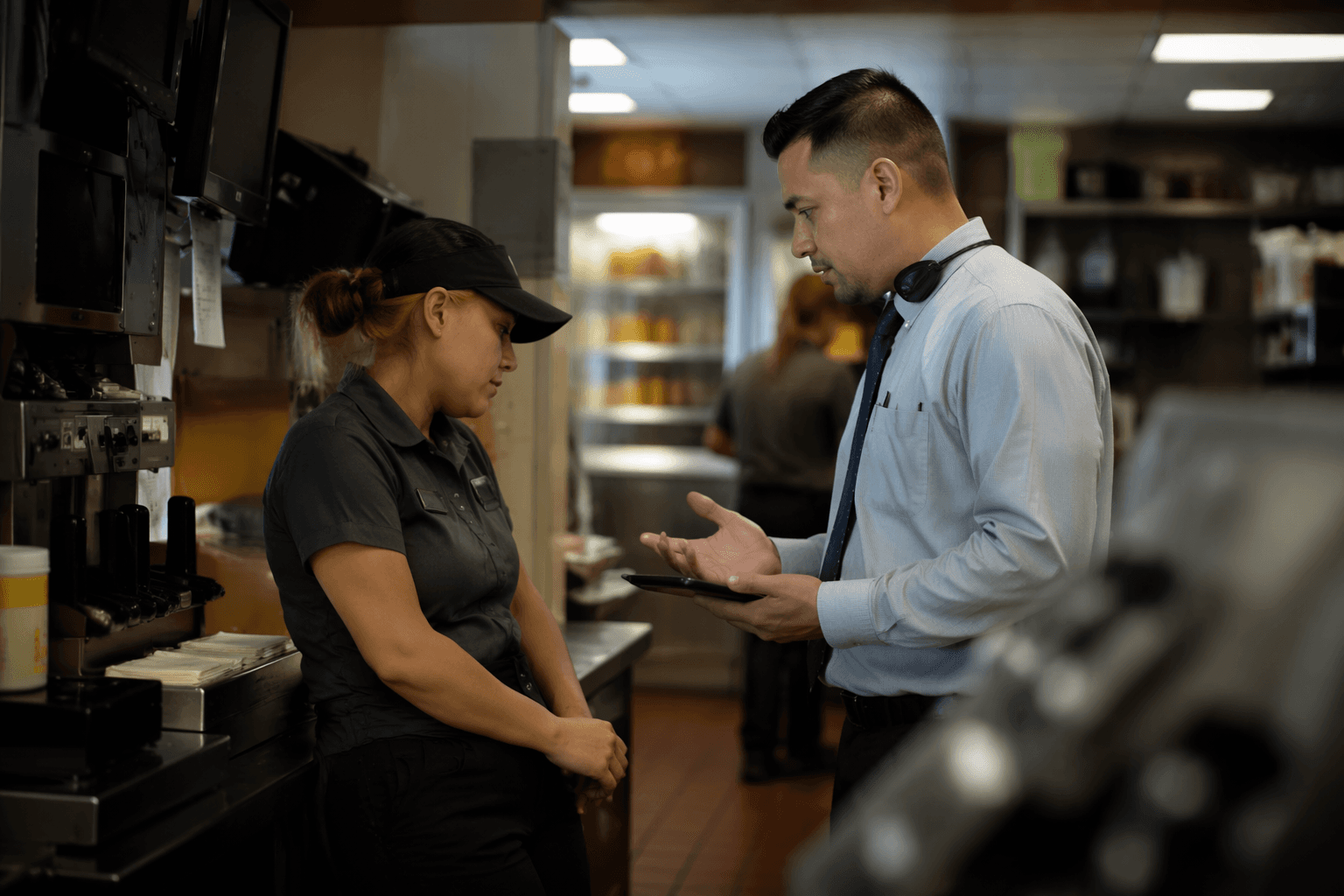
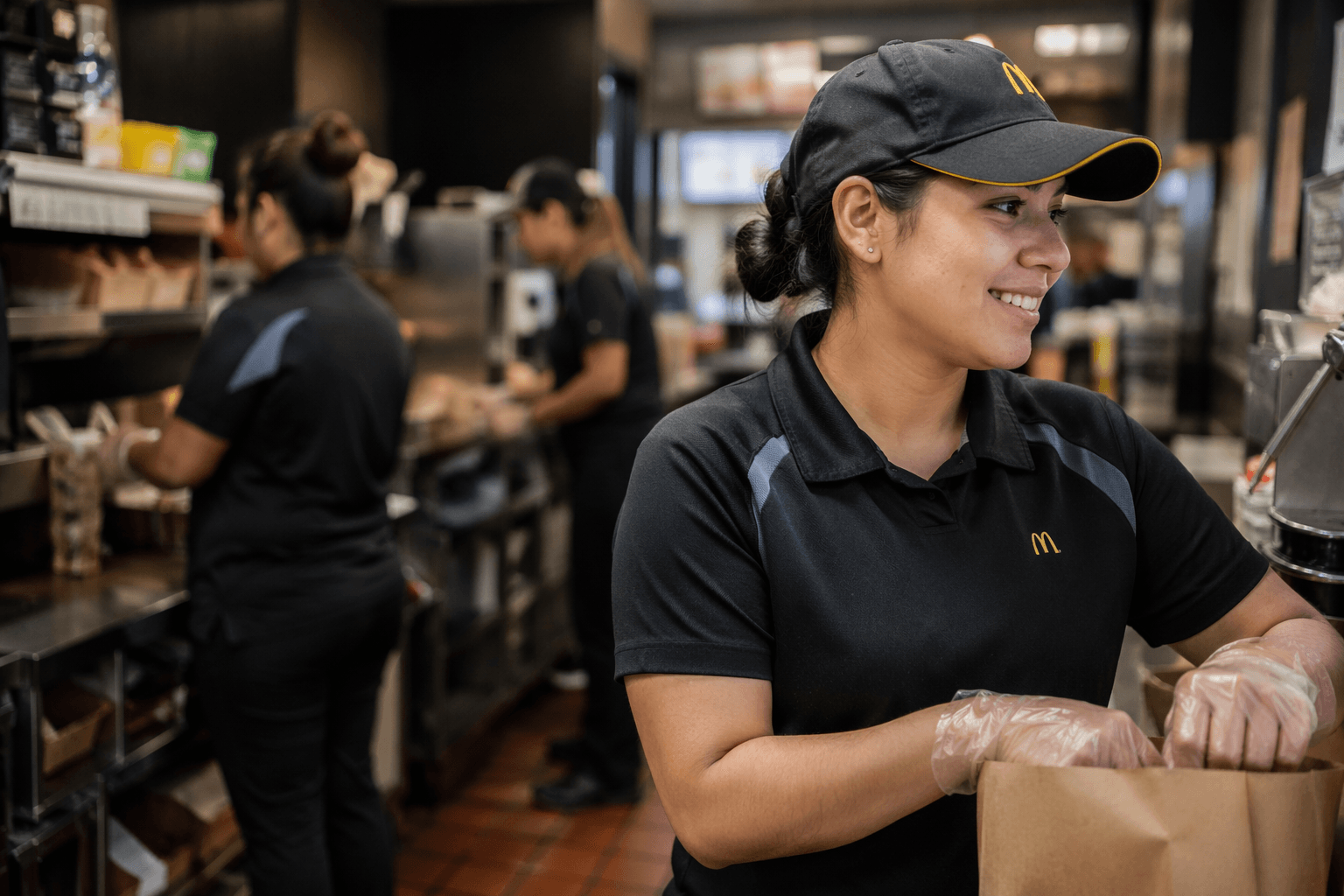
For crew, retention is not an abstract business metric. It shows up in the first schedule, the quality of the trainer, whether breaks are honored, and whether a shift manager treats questions as a nuisance or part of the job. A restaurant that keeps losing people does not just face a hiring headache. It loses speed, order accuracy, morale, and the kind of rhythm that makes a lunch rush manageable.
That is why the old labor-shortage framing misses the point. The better question is what “employer of choice” has to mean in a McDonald’s restaurant where culture stories alone are no longer enough. It has to mean predictable schedules, competent managers, safe stores, clearer advancement, and day-to-day respect. The Fight for $15 era pushed the company into a fight over pay floors; today, many workers are still deciding whether the job is worth the stress even when the wage is technically competitive. Minimum wage legislation may raise the floor, but it does not fix a bad manager, a chaotic schedule, or training that leaves new hires guessing.
McDonald’s own training model shows how expensive turnover really is
McDonald’s says its U.S. franchise training program is built around 12 to 18 months of in-restaurant training, plus part-time self-directed learning, seminars, one-on-one sessions, and operator training classes. That is a long runway for a fast-food business, and it tells you something important: the company knows the job cannot be reduced to showing up and winging it.
When turnover is high, that model gets harder to sustain. A crew member who leaves after a few weeks does not just create an opening. They force the restaurant to restart the learning curve, often while the rest of the team is already stretched. Operators who want faster productivity from new hires have to understand that training quality is not separate from retention. It is retention.
McDonald’s corporate talent page puts the point in corporate language, saying the company wants to be “an iconic talent destination” and calling a best-in-class employee experience a business imperative. The phrase may sound polished, but the underlying message is clear enough: if the company wants people to stay, the work has to feel worth staying for. In a franchise system, that promise lives or dies on local execution.
Benefits and advancement only matter if workers can actually reach them
McDonald’s has also leaned hard on Archways to Opportunity as part of its retention story. The company says the program has helped more than 82,500 restaurant employees and awarded more than $185 million in tuition assistance since 2015. A 10-year anniversary report says more than 90,000 crew have taken steps toward their goals through Archways, and another company report says the program increased access to education for more than 65,000 managers and crew.
Those numbers matter because they show where McDonald’s is trying to compete. In a workforce where younger employees have more options than before, advancement is not just about promotion titles. It is about whether a restaurant gives people a reason to see a future there. Benefits like tuition help can be powerful, but only if the store culture supports them and managers do not treat school schedules, second jobs, or family obligations as inconveniences.
This is where the franchise-corporate tension becomes real. McDonald’s can build the platform, set the messaging, and advertise the opportunity. The operator and the shift manager decide whether a crew member experiences that opportunity as something tangible or just another slogan on a wall.
What workers should notice in a store that is serious about keeping people
The best retention efforts are visible on the floor, not in a poster. In a McDonald’s restaurant that is actually trying to keep its people, the changes should be easy to spot:
- Schedules come out earlier and change less often.
- Managers give feedback without humiliation and handle conflicts consistently.
- New hires get structured training instead of being dumped into the rush.
- Crew can see a path from entry-level work to trainer, shift lead, or manager.
- Safety, breaks, and respect are treated as operating basics, not favors.
Those changes are not cosmetic. They are how a restaurant lowers turnover, protects service, and avoids the constant churn that makes every shift feel like a reset. They also matter more now because the restaurant workforce is younger and more diverse than the overall U.S. labor force, and foodservice employees are three times more likely to be under age 25 than workers in the broader economy. At McDonald’s, that means retention is not only about pay. It is about how the job fits into the realities of school, transportation, caregiving, and the next opportunity.
The operators moving fastest on retention understand that the real competition is not just other restaurants. It is every job that offers more flexibility, more predictability, or less disrespect. In that environment, McDonald’s cannot rely on scale alone. It has to prove that the daily experience inside the restaurant matches the ambition of its talent message, one shift at a time.
This article was produced by Prism’s automated news system from verified source data, official records, and press releases, then run through automated quality and moderation checks before publishing. The system is built and supervised by the people who set the standards it runs under. Read our full AI policy.
Know something we missed? Have a correction or additional information?
Submit a Tip