Atlassian guide maps monday.com’s work management market
Atlassian’s work-management map shows monday.com selling a company-wide operating layer, not just task tracking.
Work management is what shows up after project management stops being enough
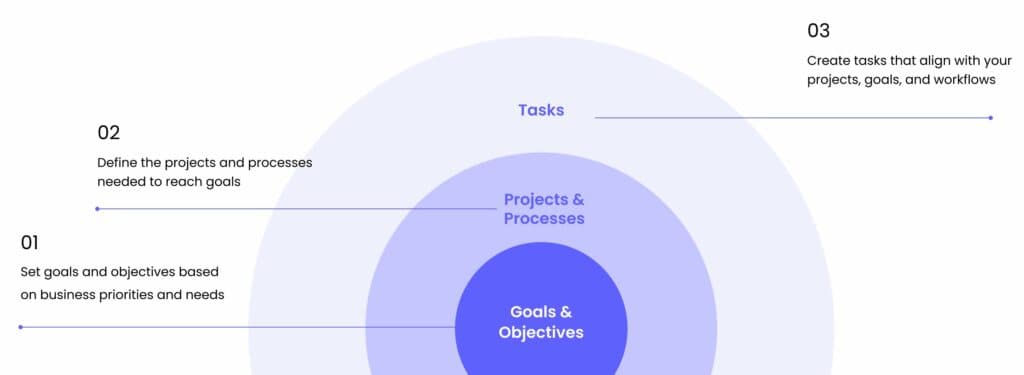
The clearest way to read monday.com’s market is to start with the pain point Atlassian names directly: work management is not a single project board, it is the system a company uses to keep work organized, visible, and moving across the business. That definition captures the moment many teams recognize they have outgrown simple task tracking. Once work crosses departments, priorities collide, and status updates become their own job, the problem is no longer just managing a project. It is managing the company’s coordination.
Atlassian draws a sharp line between project management and work management. Project management covers a specific project lifecycle, while work management expands to resource management, task management, time management, and process management at the company level. The point is not software taxonomy for its own sake. It is the reality that modern teams need complete visibility into workloads, reusable workflows, stored content, and a single source of truth if they want to keep initiatives from fragmenting into duplicate tools, unclear ownership, and endless follow-ups.
Why that definition matters inside monday.com
For monday.com, Atlassian’s framing is basically a category map. It explains why the company’s value proposition has never been only about making to-do lists prettier or replacing a spreadsheet with a board. monday.com says more than 250,000 customers worldwide use its platform, and the company now describes itself as an AI work platform that manages and orchestrates work, and, in its own language, “does the work for you.” That is a broader promise than task tracking. It is a claim about becoming the layer where work actually gets coordinated.
The company’s own product history reinforces that shift. monday.com launched Work OS in February 2020, then became a publicly traded company on Nasdaq on June 10, 2021. Since then, the platform has pushed beyond a single-team use case. Its press kit says the suite now includes work management, CRM, software development, and services, which is exactly what a work-management story looks like when it matures into a broader operating system for multiple business functions.
What this means for product, engineering, and sales
For product teams, Atlassian’s guide is a reminder that the hardest part of work management is deciding where to standardize and where to stay flexible. Not every team works the same way, but every team needs a shared frame for dependencies, handoffs, and accountability. The best products in this category help customers build reusable workflows without forcing every department into the same rigid template.
For engineering, the category is less about surface-level automation and more about coordination problems. Handoffs break down when ownership is unclear. Dependencies stall launches when one team cannot see what another team is waiting on. Resource allocation gets messy when managers cannot trust the data in front of them. A strong work-management platform has to make shared information reliable enough that teams stop asking for the same update five different ways.
For sales, the language has to match the buyer’s pain. Buyers do not wake up wanting “work management” as an abstract category. They want fewer silos, fewer context switches, better visibility, and reusable processes that keep work from getting lost between meetings, inboxes, and chat threads. That is why the distinction from project management matters commercially. It changes the conversation from “Can this track tasks?” to “Can this become the operating layer for how our company runs?”
The market signal is in the company’s numbers
monday.com’s recent results show why the category has expanded so quickly. The company reported fourth-quarter 2024 revenue of $268.0 million, up 32% year over year, and full-year 2024 revenue of $972.0 million. It also said net dollar retention rose to 112% in the quarter, a sign that customers are not only staying but expanding usage.
The seat-count data tells the same story. In the third quarter of 2024, monday.com said it surpassed $1 billion in annual recurring revenue and that its second-largest customer more than doubled its seat count to 60,000. In the second quarter of 2024, the company said it closed an 80,000-seat agreement, calling it the largest deal in its history. Those are not the metrics of a lightweight task app. They are the metrics of a platform being deployed across large organizations with multiple teams and shared workflows.

The business case becomes clearer when you connect those figures to the product’s positioning. A company that can land 60,000-seat and 80,000-seat deployments is not competing only on project convenience. It is competing on organizational coherence, the promise that one system can help companies coordinate work at scale without forcing every department into separate tools and disconnected status rituals.
The internal lesson is the external story
That is why Atlassian’s definition matters so much for monday.com employees. When launches have to move across product, engineering, marketing, customer success, and sales, the company itself lives the same coordination problem it sells to customers. Internal discipline becomes part of the product story. If work management is a single source of truth, then monday.com’s own ability to align around launches, handle customer escalations, and keep functions in sync is not just an operational detail. It is proof of concept.
It also helps explain why the platform’s current framing leans so heavily into AI. monday.com is not presenting AI as a shiny add-on; it is positioning it as a way to make the operating layer do more of the work itself. That only makes sense in a market where the real bottleneck is not task creation, but the friction that comes from moving work across people, systems, and departments.
The bottom line for monday.com’s market
Atlassian’s guide makes the category plain: work management is what companies need when work has become too interconnected for project tools alone. monday.com’s customer base, its billion-dollar ARR milestone, its 112% net dollar retention, and its giant seat deals all point to the same conclusion. The company is no longer selling a better checklist. It is selling the operating system modern teams need when coordination, not isolated execution, is the real work.
Know something we missed? Have a correction or additional information?
Submit a Tip