Atlassian's DACI framework helps monday.com teams speed decisions
DACI turns cross-functional churn into clear ownership, giving monday.com teams a faster way to move features, pricing, and launches without hidden vetoes.
monday.com says more than 250,000 customers worldwide use its platform across work management, CRM, service, and dev products, so the company’s slowest decisions are often the ones that cut across all four. When engineers, product managers, sales, legal, support, and operations all have a stake, the risk is not disagreement itself, but the drift that follows when nobody is clearly driving the call.
Why DACI fits monday.com’s operating reality
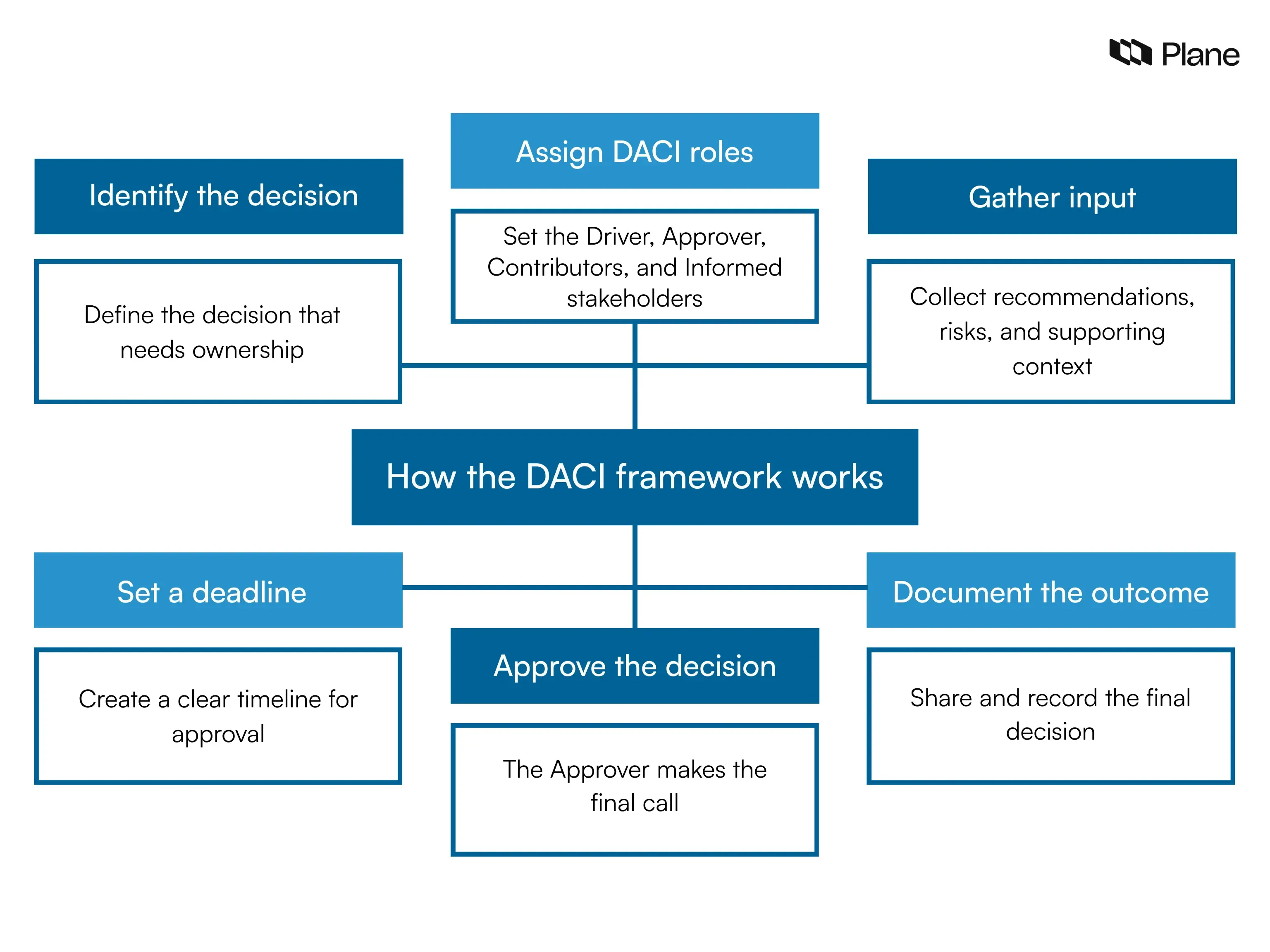
Atlassian’s DACI framework gives teams a simple way to separate participation from decision rights. The acronym breaks the work into Driver, Approver, Contributors, and Informed, and that structure matters most when a project has too many interested parties and too little clarity about who owns the outcome.
It has built its business around a shared AI layer that powers multiple products at once. That scale creates the kind of cross-functional pressure where a feature launch, a packaging change, or a customer exception can get stuck in review loops unless the team names one person to carry the decision forward.
DACI does not try to flatten responsibility into a group consensus. It forces the team to decide who is driving the work, who is approving the final call, who is contributing expertise, and who only needs visibility once the outcome is set.
What each DACI role really means
The Driver is not just a project manager with a nicer title. The Driver corrals stakeholders, gathers information, defines scope, and keeps the process moving so the decision does not dissolve into open-ended discussion.
The Approver is the single person who makes the call. This should be one person, not several, because shared approval sounds collaborative until it becomes a standstill with no one willing to own the tradeoff.
Contributors are there for expertise, not control. They weigh the pros and pitfalls, offer recommendations, and surface risks from their own disciplines, whether that is engineering feasibility, design quality, legal exposure, sales impact, or support burden.
Informed stakeholders are the ones who need to know the outcome once it is made. They are not there to debate the decision in real time, but they do need the final answer so execution can continue without surprise.
The documentation piece is where teams keep themselves honest
DACI works best when it is written down, not just discussed in a meeting. A DACI decision document adds decision status, the people involved, a due date, and the outcome once the choice is made, turning a live debate into a shared record.
Many workplace bottlenecks are not caused by bad ideas. They are caused by memory lapses, duplicate conversations, and late-stage objections that surface because nobody can see what has already been agreed. A documented DACI record gives teams a place to check whether a decision is still pending, who is in the room, what milestone is coming next, and what was ultimately decided.
For monday.com employees, that kind of record is especially valuable in a remote-first or hybrid environment where cross-functional work can happen across time zones and calendars. A written decision trail reduces the risk that one group thinks a feature is approved while another is still waiting for a final sign-off.
Where monday.com teams feel the most friction
Engineering teams can use DACI to avoid the familiar trap where every stakeholder feels empowered to comment but no one feels accountable for the final answer. That is especially useful when a product change has technical debt implications, infrastructure dependencies, or a release window that others want to move around without realizing the downstream cost.
Product managers are likely to get the most immediate value when a feature has multiple dependencies or when launch timing is being negotiated across teams. monday.com filed its 2025 Annual Report on Form 20-F on March 13, 2026, and monday.com said 2025 revenue grew 27% to $333.9 million in Q4.
Sales leaders can use DACI when deciding packaging, pricing, or a strategic account exception. Those calls can invite input from finance, legal, product, and customer success, but the framework keeps the final approval from becoming a pileup of competing opinions. Clear decision rights reduce escalations, cut down on backtracking, and make it easier to explain a choice to a customer without hedging.
monday.com said customers with more than $50,000 in ARR represented 41% of total ARR.
Why this helps a company like monday.com scale
monday.com said revenue grew 27% in fiscal 2025 and that monday vibe was the fastest product to surpass $1 million in ARR in its history. Fast-growing product lines can create their own decision drag if teams are trying to move at startup speed while operating at enterprise scale.
Roy Mann and Eran Zinman, monday.com’s co-founders and co-CEOs, are running a company that has to coordinate product, go-to-market, support, and operations without letting every decision become a negotiation.
This article was produced by Prism’s automated news system from verified source data, official records, and press releases, then run through automated quality and moderation checks before publishing. The system is built and supervised by the people who set the standards it runs under. Read our full AI policy.
Did this article answer your question?