AWS SaaS Lens guides monday.com on multi-tenant cloud design
monday.com’s cloud choices now shape uptime, security reviews, and how fast new features reach enterprise customers.
monday.com’s next big infrastructure story is not about a new feature set. It is about the decisions under the hood that decide whether a work platform can keep hundreds of thousands of customers isolated, responsive, and easy to trust as it scales. AWS’s SaaS Lens turns that into a practical checklist for teams like monday.com: tenant isolation, noisy-neighbor control, and operational automation are not abstract architecture topics, they are the difference between smooth enterprise growth and constant friction.
Why the SaaS Lens matters now
AWS designed the SaaS Lens to help teams design, deploy, and architect multi-tenant SaaS workloads in the AWS cloud and measure those systems against best practices. It pushes teams to think about SaaS across the Well-Architected pillars, including operational excellence, security, reliability, performance efficiency, cost optimization, and sustainability. That matters at monday.com because the company is no longer operating like a small collaboration tool with limited exposure. It says more than 250,000 customers worldwide use the platform, it reported $1.232 billion in fiscal 2025 revenue, and customers with more than $100,000 in ARR rose to 1,756 from 1,207 in a single year.
That scale changes the questions engineers and product managers have to answer every day. A platform serving many tenants on shared infrastructure is not judged only by whether it is up. It is judged by whether one tenant can affect another, whether enterprise buyers can prove their data is protected, and whether the company can ship without turning every release into an operational gamble. AWS explicitly says SaaS metrics should go beyond CPU and memory and include business agility, feature consumption, microservice activity, scaling trends, and tenant activity. For monday.com, that is a better lens for understanding adoption and bottlenecks than simple server utilization ever could be.
Tenant isolation is the first design decision that customers feel
AWS treats tenant context as a first-class concern in identity and access management. In practice, that means each user must be connected with a tenant, and that context can be injected into authentication using tools such as Amazon Cognito and JWT custom claims. AWS’s multi-tenant architecture guidance also lays out three database patterns, Silo, Bridge, and Pool, each with different trade-offs between isolation, cost, and complexity. Those are not just engineering choices. They become the basis for what security teams, procurement teams, and enterprise customers believe about the platform.
monday.com’s own disclosures line up closely with that model. The company says tenant data is segregated at the application level using unique IDs based on several parameters, and that customer data is encrypted at rest with AES-256 and in transit with TLS 1.3 minimum. It also says enterprise customers can use Google SSO, Okta, OneLogin, Azure AD, and custom SAML 2.0. For employees inside monday.com, that combination is important because it shapes how quickly the company can close larger deals and how much work each customer’s security review creates before a contract is signed.
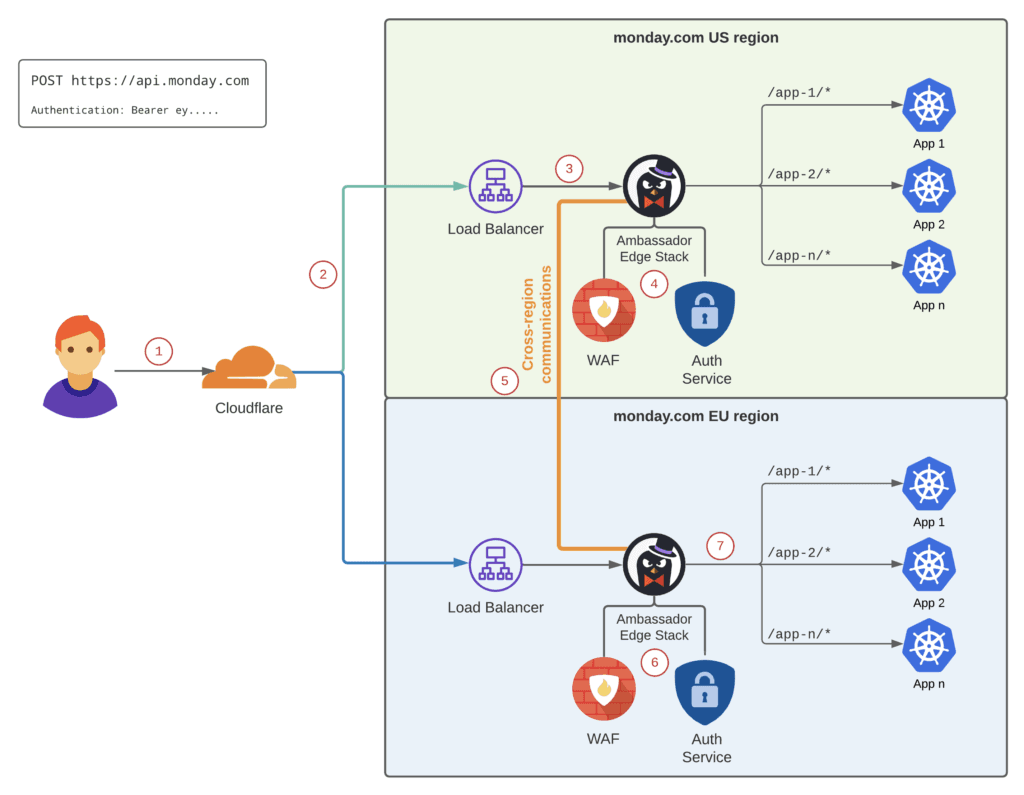
The privacy and residency angle is just as important. monday.com says its service is hosted on AWS infrastructure in Northern Virginia across multiple Availability Zones, with a DR site in another region, and that enterprise plan customers can choose to host their data in Frankfurt, Germany. The company’s engineering team has said the platform started on a single U.S. East Coast region and later moved to a privacy-first multi-regional architecture because customers wanted both lower latency and more control over data location. That is the real-world version of tenant isolation: the architecture has to be strong enough to satisfy regulated industries and flexible enough to serve customers in the European Union without slowing the product down.
Noisy neighbors are a product problem, not just an infrastructure problem
The most practical reason the SaaS Lens matters to monday.com is that noisy-neighbor behavior shows up in the customer experience long before it shows up in a diagram. If shared infrastructure is not designed carefully, one tenant’s burst of activity can affect another tenant’s responsiveness, which turns into support tickets, lower trust, and slower enterprise expansion. AWS’s guidance on performance efficiency is useful here because it pushes teams to think about tenant activity, scaling trends, and microservice behavior instead of only watching generic server metrics.
monday.com says it uses a microservices architecture, multiple Availability Zones, alternative providers for some services, and offers enterprise customers a 99.9% SLA. Those are the building blocks that let the company absorb load and isolate failures without making every incident visible to every customer. They also matter for feature velocity. When engineering teams can observe tenant activity cleanly, they can roll out new capabilities more confidently, see where usage concentrates, and adjust capacity before customers feel the pain.
For PMs, this is where the architecture becomes a roadmap input. Feature consumption and microservice activity tell product teams what is actually being adopted, which enterprise functions are becoming sticky, and where the platform needs deeper controls or better defaults. For sales teams, the same data helps explain why enterprise-grade availability, data residency, and authentication options are not add-ons but part of the buying case. A platform with 1,756 customers above $100,000 in ARR cannot afford to treat performance as a back-end concern that only engineers notice.
Operational automation is what keeps scale from becoming friction
The last decision is operational automation, and it may be the one that most directly affects daily work inside monday.com. AWS’s SaaS Lens is built to help teams consistently evaluate their architecture against best practices, which means the goal is not one perfect deployment but a system that keeps learning. That is especially important in SaaS, where operational excellence and reliability depend on automation that can detect tenant-specific issues, trigger failover, and keep service changes from becoming manual bottlenecks.
monday.com’s multi-region setup shows how this plays out in practice. Moving from a single region to a privacy-first multi-regional design was not only about resilience. It was also about giving customers control over where data lives, reducing latency, and creating a system that could keep serving an expanding enterprise base without forcing every exception through a human escalation path. Once a company reaches the scale monday.com describes, operational automation becomes a way to protect feature velocity as much as uptime.
That is the deeper takeaway from the SaaS Lens. Good SaaS architecture is not just a technical guardrail. It is a business system that makes tenant boundaries visible, turns infrastructure behavior into usable signals, and helps product, engineering, sales, and operations make better decisions faster. For monday.com, the cloud design underneath the work OS is now part of the product story itself.
This article was produced by Prism’s automated news system from verified source data, official records, and press releases, then run through automated quality and moderation checks before publishing. The system is built and supervised by the people who set the standards it runs under. Read our full AI policy.
Did this article answer your question?