ChatGPT slips below 50% market share as Gemini gains ground
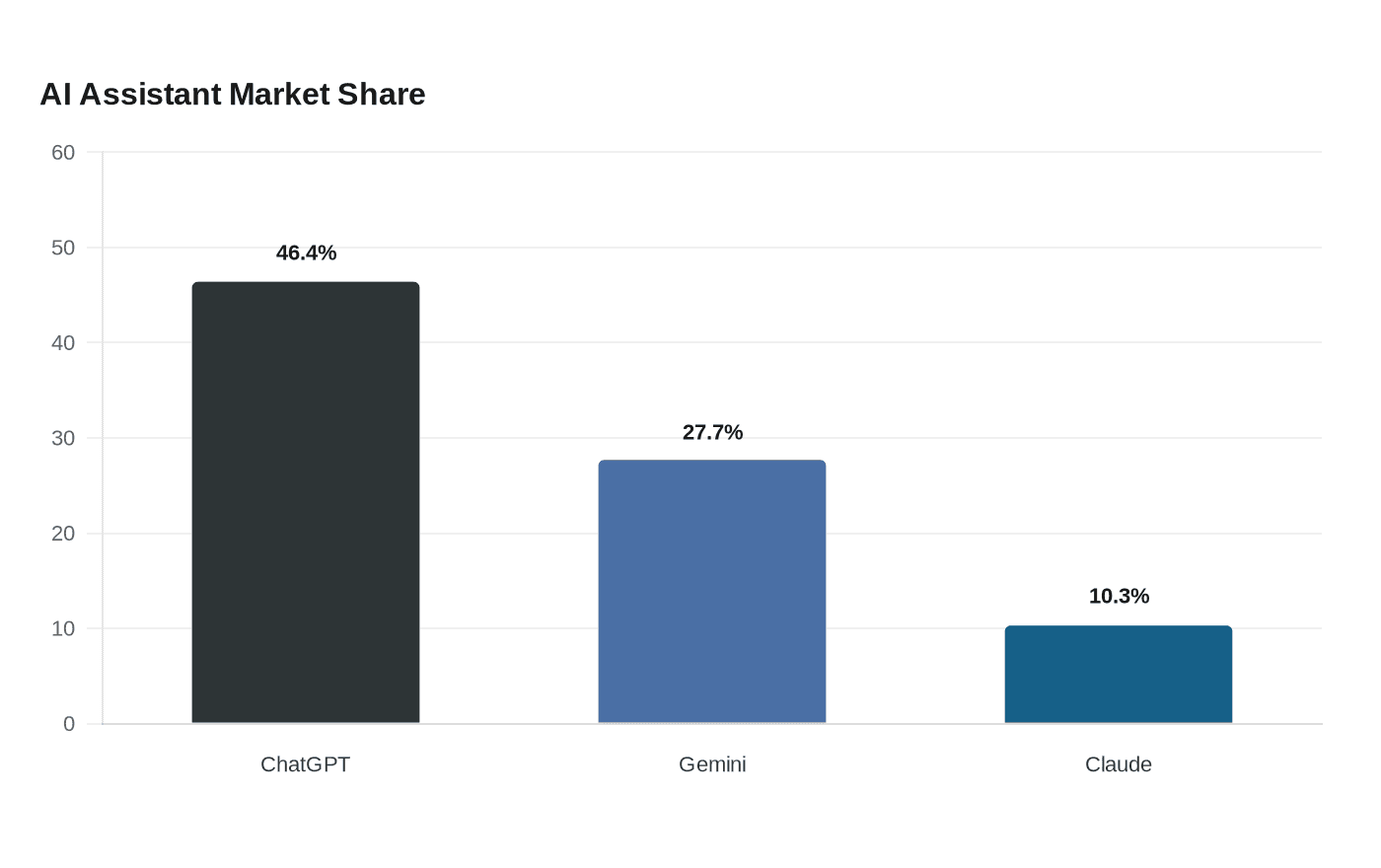
ChatGPT slipped to 46.4% market share as Gemini hit 27.7% and Claude 10.3%. For monday.com teams, the split raises a blunt question: one assistant or a managed stack?

ChatGPT’s hold on the AI assistant market cracked in May, falling to 46.4% for the first time as Gemini climbed to 27.7% and Claude reached 10.3%. The shift matters because it marks the start of the single-assistant era giving way to a more fragmented market, where workers are choosing tools by task instead of defaulting to one brand.
The broader usage numbers show that the market is still expanding fast, even as it splinters. Sensor Tower projects global time spent on generative AI apps will more than double year over year, from 17.2 billion hours in the first half of 2025 to 36 billion hours in the first half of 2026. It also expects nearly 2.3 billion AI app downloads and more than $4.2 billion in user spending in the first half of 2026. ChatGPT still led the category by scale, becoming the fastest mobile app ever to reach 1 billion monthly active users in May 2026, while OpenAI said it had more than 900 million weekly active users and over 50 million consumer subscribers. Google said the Gemini app had passed 900 million monthly users, up from 400 million the year before.

For IT, procurement and team leads, the hard part is no longer whether to adopt AI but how many assistants to support. Standardizing on one tool can simplify onboarding, policy enforcement, data retention rules and vendor review. It can also keep training costs down, since employees learn one interface and one set of approved workflows. The tradeoff is dependency: one provider becomes the bottleneck for model quality, pricing and roadmap changes.
Supporting a stack of specialized assistants gives teams more flexibility, especially when Gemini fits into Google-heavy environments, Claude performs well for certain productivity tasks and ChatGPT remains the broad default. But that approach raises the cost of permissions, connector management, support and governance. Every extra assistant adds another layer of training, another security review and another process for deciding where files, prompts and automations live.
That is why the market shift is relevant for monday.com engineers, product managers and sales teams. monday.com announced new infrastructure that lets AI agents sign up, authenticate and operate directly inside its platform, and the company describes itself as an AI work platform where people and agents work side by side. The message is clear for customers building on monday.com: AI is moving toward a managed mix of models and agents, not a single assistant that owns every workflow.
This article was produced by Prism’s automated news system from verified source data, official records, and press releases, then run through automated quality and moderation checks before publishing. The system is built and supervised by the people who set the standards it runs under. Read our full AI policy.
Did this article answer your question?