DOL clarifies overtime rules, salaried monday.com employees may still qualify
Salaried status does not erase overtime rights, and monday.com’s fast-moving service, support and sales roles can still trigger pay questions.
Many salaried employees assume overtime rules stop at the word salaried. The Department of Labor says that is wrong, and for monday.com workers the difference can mean real money when a role is labeled exempt but does not meet the legal test.
Under the Fair Labor Standards Act, most employees in the United States must be paid at least minimum wage for all hours worked and overtime at not less than one and one-half times the regular rate for hours over 40 in a workweek unless a valid exemption applies. The DOL says the law runs on a workweek basis, so employers cannot average hours over two or more weeks to avoid overtime. It also says overtime generally must be paid on the regular payday for the period in which it was earned.

That matters at monday.com, where job titles can move faster than duties. The company reported $972.0 million in full-year 2024 revenue, up 33% year over year, and said fourth-quarter revenue reached $268.0 million as it surpassed $1 billion in annual recurring revenue. It also said it serves more than 250,000 customers worldwide and operates from Tel Aviv, New York, Denver, London, Warsaw, Paris, Munich, São Paulo, Sydney, Melbourne, Singapore and Tokyo.

In a business that sells implementation packages and ongoing support, classification questions can get messy. monday.com’s services include 30-hour, 60-hour and 90-hour engagements that cover boards, automations, native integrations, AI workflows, agent configurations, change management, user testing and team training. Those are the kinds of variable, deadline-driven assignments that can push product operations, customer support, implementation, sales and customer-success staff into after-hours work even when their pay is set on a salary basis.
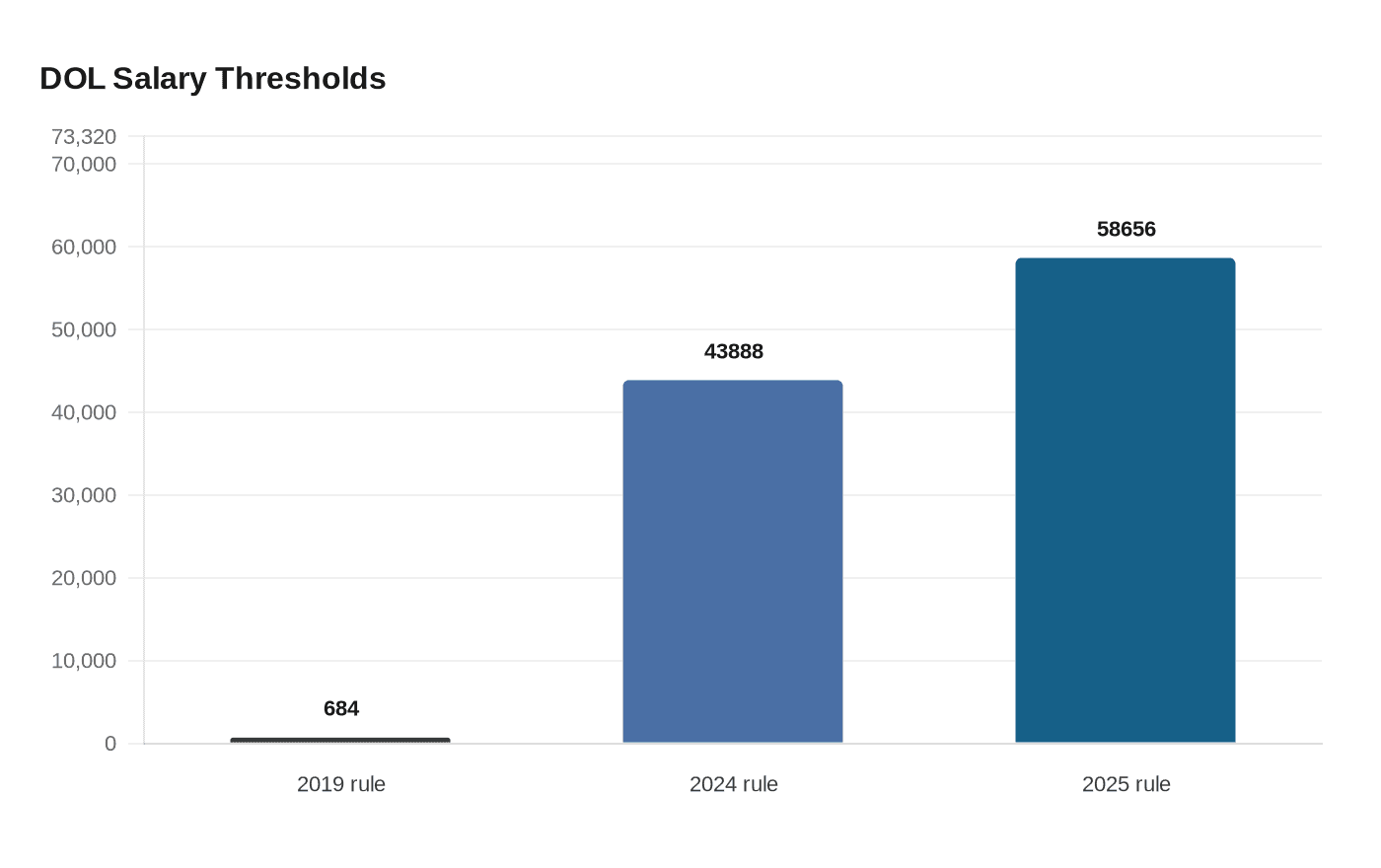
The DOL says a salary does not automatically make someone exempt. The real question is whether the role and pay meet the exemption tests. For now, the department is enforcing the 2019 salary level of $684 per week and the highly compensated employee threshold of $107,432 a year after a November 15, 2024 court ruling vacated the 2024 rule. That 2024 rule would have lifted the threshold to $43,888 on July 1, 2024 and $58,656 on Jan. 1, 2025, with updates every three years starting July 1, 2027.
For managers, the message is to stop treating seniority as a shortcut for exempt status. For employees, the safer move is to track hours and revisit classification whenever responsibilities expand, especially in a company that scales through cross-functional work and rapid product rollout. In a workplace like monday.com, where a salary can mask a changing workload, overtime mistakes are not just compliance risks. They are payroll errors waiting to happen.
This article was produced by Prism’s automated news system from verified source data, official records, and press releases, then run through automated quality and moderation checks before publishing. The system is built and supervised by the people who set the standards it runs under. Read our full AI policy.
Did this article answer your question?