EEOC guide explains pregnant workers' accommodation rights under federal law
The PWFA turns pregnancy accommodations into a fast, documented workflow, not a courtesy. For managers and HR, the real test is how quickly you identify a request, respond, and keep work moving.
EEOC guide explains pregnant workers' accommodation rights under federal law
What the PWFA changes in day-to-day work
The biggest shift under the Pregnant Workers Fairness Act is operational: when a worker or applicant has a pregnancy-related limitation, the question is no longer whether the company feels flexible enough, but whether it can move through a reasonable-accommodation process quickly and consistently. The EEOC says covered employers generally must provide a reasonable accommodation for known limitations related to pregnancy, childbirth, or related medical conditions unless doing so would create an undue hardship. That puts the burden on managers and HR to recognize a request early, document the limitation, and keep the conversation moving without turning it into a drawn-out debate.
The law is focused on accommodations, not a broader leave entitlement. It applies when the employer knows about the limitation and the employee or applicant is otherwise qualified for the job. That distinction matters in real workplaces because the issue often shows up first as a scheduling, task, or workstation adjustment, not as a formal medical leave request. For a company like monday.com, where teams work across offices and hybrid schedules, the process needs to be simple enough that managers can handle it without improvising policy on the fly.
What a request can look like
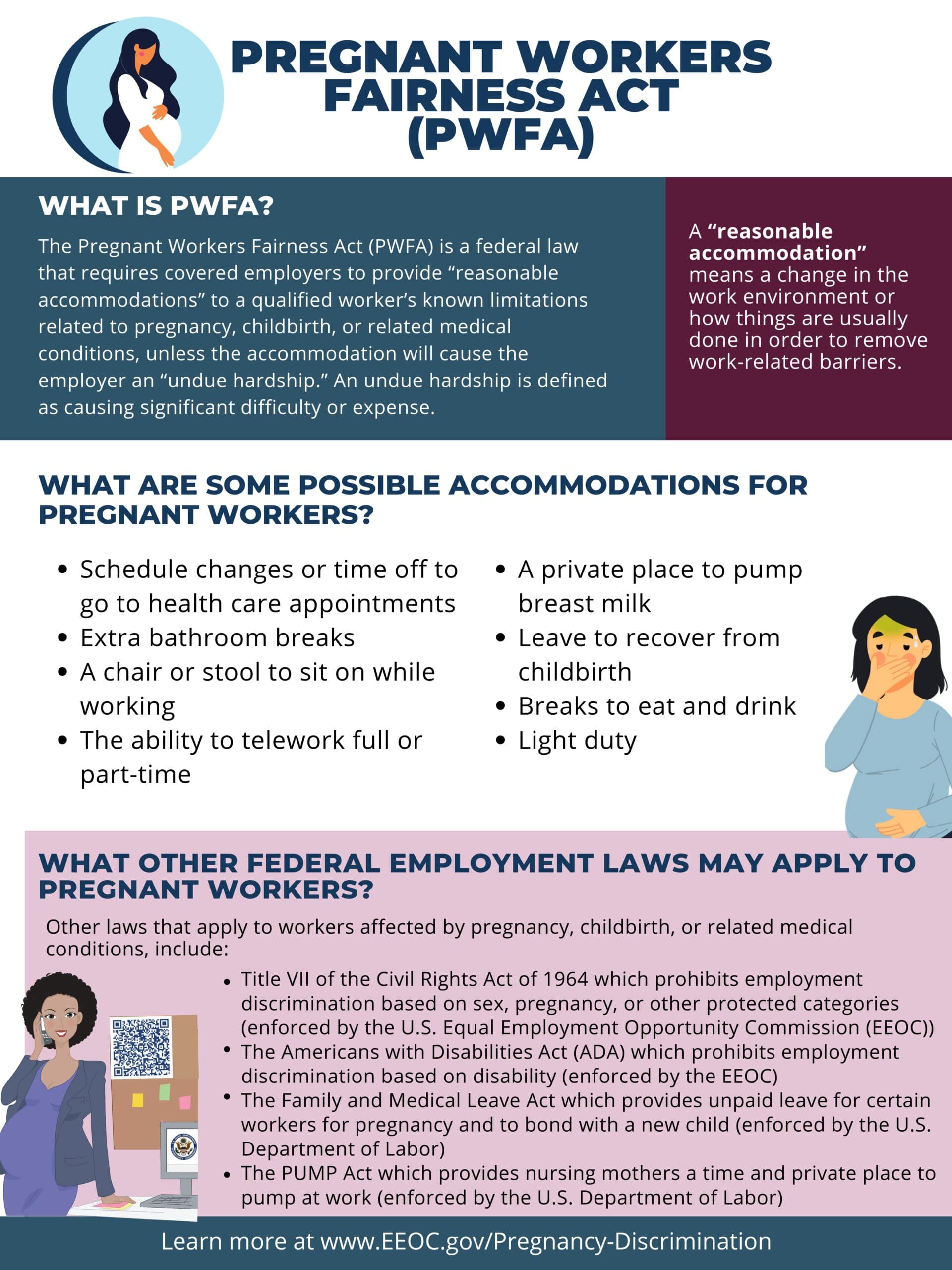
A PWFA request does not need to arrive in legal language. In practice, it may look like a worker saying they need more frequent breaks, temporary reassignment of marginal tasks, a schedule change, a seating adjustment, access to water or food, or a modification to remote-work expectations. The exact accommodation depends on the role and the limitation, but the common thread is that the worker needs a change that helps them keep working safely and effectively.
That is where many employers go wrong. They wait for perfect documentation before starting the conversation, or they treat the request as if the worker is asking for a special favor rather than a legal accommodation. The better approach is to treat the first notice as the start of the interactive process. A manager does not need to solve everything alone, but the manager does need to respond promptly, preserve privacy, and route the issue to the people who can evaluate it.
Why the interactive process matters so much
The EEOC’s guidance makes clear that timely communication is central to how the law works in practice. Once the employer knows about a limitation, the goal is to work through the accommodation question rather than stall. That means asking only for the information needed to understand the limitation and the proposed change, then deciding whether the request is reasonable or whether another effective option exists.
This is where HR teams can cut friction. A clear intake form, a named point person, and a standard escalation path can prevent a pregnant worker from having to repeat the same story to multiple managers. It also helps managers avoid making casual promises they may not be able to keep. In a distributed or hybrid company, where employees may be working from different locations and on different schedules, a clean process is not just a compliance issue. It is a coordination issue.
Where employers commonly get it wrong
The most common failure points are speed, consistency, and documentation. Some managers delay because they assume the accommodation will be temporary and informal. Others respond unevenly, approving one employee’s request while denying a similar request because they did not involve HR or did not understand the standard. That kind of inconsistency is exactly what creates risk.

Another common mistake is confusing accommodation rights with leave rights. The PWFA is about keeping a qualified worker on the job with a reasonable accommodation whenever possible. It is not a blank check for open-ended absence, but it is also not a reason to push a worker toward leave when a small operational change would solve the problem. For a SaaS company that relies on retaining engineers, product managers, and sales staff through critical product cycles, that distinction matters. The point is to preserve productivity without forcing a worker to choose between health and employment.
How the legal timeline shapes employer obligations
The statute was signed by President Joe Biden on December 29, 2022, as part of the Consolidated Appropriations Act, 2023. The EEOC began accepting charges on June 27, 2023, the law’s effective date, and issued its final rule on April 15, 2024. That final rule took effect on June 18, 2024, and it says the PWFA applies to most employers with 15 or more employees.
The law is codified at 42 U.S.C. 2000gg and is administered and enforced by the EEOC. It builds on existing protections under Title VII and the ADA, which means employers cannot treat pregnancy-related accommodation as a side issue separate from the rest of their workplace obligations. The message from the agency has been consistent: the law is meant to help workers stay employed while maintaining a healthy pregnancy, and it is also meant to help employers retain critical talent.
What a faster response system looks like
For managers and HR teams, the best PWFA workflow is simple enough to use under pressure. It should not require a legal background to activate.
1. Recognize the request early. If a worker mentions pregnancy-related limitations, treat it as an accommodation issue and escalate it immediately.
2. Open the interactive process. Ask what limitation is affecting work and what adjustment might help.
3. Review the role. Separate essential functions from marginal tasks so you can see what can be changed without breaking the job.
4. Evaluate reasonable options. Consider schedule changes, temporary task shifts, seating, breaks, remote-work modifications, or access to food and water when they fit the role.
5. Document the decision. Capture what was requested, what was approved, what was denied, and why.
6. Check back. Pregnancy-related needs can change quickly, so follow-up matters.
That kind of process is especially useful at monday.com, where the company says it uses a hybrid work model and most teams spend three days a week in the office. Hybrid schedules can make accommodations easier in some cases and more complicated in others, especially when commuting, on-site presence, and meeting schedules all collide. The more predictable the system, the less likely a worker is to get stuck navigating policy by rumor.
Why this matters inside monday.com
monday.com says more than 250,000 customers worldwide use its platform, which is a reminder that scale depends on repeatable systems. The same is true for people operations. A company that builds workflow software cannot afford a workplace process that feels ad hoc when a worker needs support for a pregnancy-related limitation.
The practical lesson for managers is straightforward: handle PWFA requests as a structured workflow, not a one-off favor. Do that well, and the company reduces legal risk, avoids unnecessary employee friction, and keeps people working through a life event that is common, temporary, and manageable when the process is clear.
This article was produced by Prism’s automated news system from verified source data, official records, and press releases, then run through automated quality and moderation checks before publishing. The system is built and supervised by the people who set the standards it runs under. Read our full AI policy.
Did this article answer your question?