Gallup says hybrid work remains the default for U.S. workers
Hybrid is still the rule, but Gallup says employees judge it fairer when teams help shape it, a warning for monday.com as it balances three-day office norms with global scale.

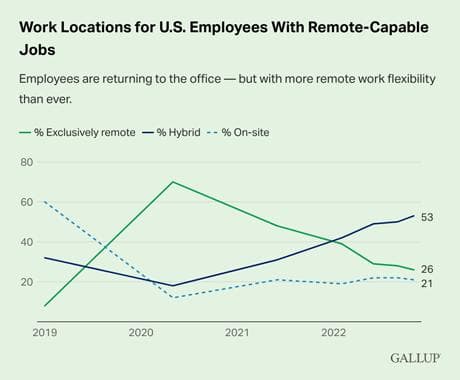
Hybrid work has not faded into a perk for a small elite. Gallup’s latest readout shows 52% of remote-capable U.S. workers are in hybrid schedules, compared with 26% who work exclusively remote and 22% who are on-site.
That split matters because it lines up with what employees say they want. Gallup found that six in 10 remote-capable workers prefer hybrid, about one-third want fully remote work, and fewer than 10% want to be in the office full time. The broader pattern has been steady since 2022, with hybrid workers now spending about 46% of the workweek in the office, or roughly 2.3 days.

For workplace leaders, the real issue is no longer whether hybrid exists. It is whether the policy feels fair. Gallup says employees are more likely to view hybrid arrangements as fair and beneficial when teams help shape them, and the share of workers saying their hybrid schedule is entirely up to them fell from 37% in 2024 to 34% in 2025. In other words, the most durable hybrid model is less a promise of personal freedom than a set of clear rules around eligibility, promotion visibility, meeting norms and who is expected in the office when.
That is the practical backdrop for monday.com, which says it offers a hybrid work model and that most teams spend three days a week together in the office. The company said it had 3,211 employees as of March 31, 2026, serves more than 250,000 customers worldwide and counts 4,547 customers paying more than $50,000 in annual recurring revenue. Its footprint stretches from New York and Tel Aviv to Denver, Miami, Chicago, Sydney, London, Warsaw, São Paulo and Tokyo, which makes consistency across locations a management problem as much as a culture question.
monday.com already signaled that shift when it announced a new hybrid regional structure effective September 1, 2023. For engineers, product managers and sales teams, that means the policy has to work not just in principle but in the day-to-day mechanics of staffing, onboarding, customer coverage and cross-office collaboration.
SHRM’s remote-work guidance adds another layer: distributed work creates legal, tax and employment-compliance issues, especially when people cross state lines. That is where fairness and governance collide. A hybrid policy can feel flexible and still fail if it is vague, unevenly applied or impossible to manage at scale.

Gallup’s data suggests the future of work is not a tug-of-war between office and home. It is a test of whether companies can make structured flexibility feel legitimate enough that people trust it, even when they do not control every day on the calendar.
This article was produced by Prism’s automated news system from verified source data, official records, and press releases, then run through automated quality and moderation checks before publishing. The system is built and supervised by the people who set the standards it runs under. Read our full AI policy.
Did this article answer your question?