GitLab shows monday.com teams how to work better asynchronously
GitLab's async playbook shows monday.com how to move decisions into durable workflows and save live meetings for the moments that truly need them.
GitLab’s approach to asynchronous work is a sharp reminder that meetings are often a default, not a requirement. The company’s handbook treats async as a core operating habit: do as much as possible with the information available, document everything, transfer ownership cleanly, and keep the work moving. For monday.com teams, that is not just remote-work theory. It is a practical blueprint for how engineers, product managers, and sales teams can work faster across offices, time zones, and schedules without losing accountability.
Why GitLab’s model matters to monday.com
GitLab has spent years turning remote work into a system rather than a perk. Its public handbook documents nearly every part of how the company operates, and its remote playbook says GitLab has been working on remote work since 2014. By 2021, that handbook had grown to more than 50 guides, and the company’s Remote Manifesto, published on April 8, 2015, called on teams to communicate asynchronously, reduce email overload, and avoid copying office behavior into digital channels.
That matters for monday.com because the company is not remote-only. Its careers page says most teams spend three days a week together in the office, with flexibility to work where they do their best work the rest of the time. In other words, monday.com has to make async work inside a hybrid operating model, where some coordination happens face-to-face and some happens across locations. The lesson from GitLab is not to eliminate live discussion. It is to make sure live time is reserved for the work that truly needs it.
Treat documentation like part of the product
The clearest takeaway from GitLab is that documentation is not administrative overhead. It is the infrastructure that lets a team move without waiting for a meeting. GitLab’s guidance says async works best when people write down what they know, hand off ownership clearly, and continue with the next task. That idea maps directly onto monday.com’s day-to-day work, where product, engineering, and go-to-market teams all depend on context that can survive a calendar invite.
For engineering teams, that means design notes, decision logs, and conventions for handoffs that make it obvious what changed and why. For product teams, it means visible tradeoffs, named owners, and status updates that do not force everyone to re-ask the same questions. For sales and customer-facing teams, it means crisp summaries that let another colleague step into a deal, a renewal, or an escalation without reconstructing the entire history.
GitLab’s TeamOps guidance makes the people side of that system explicit. It says asynchronous communication creates equal opportunities to participate regardless of level, function, or location. It also says clear documentation bridges the knowledge gap and creates more total iterations. For monday.com, that is a culture point as much as a workflow point: if the strongest ideas are trapped in live calls, the company is wasting the very coordination discipline it sells.
What a meeting-free workflow can look like
GitLab’s materials give a concrete example of how this works in practice. A policy change can start as documentation in a merge request, then be reviewed by the relevant owners and stakeholders, and never require a meeting at all. That is the kind of routine monday.com teams can translate into their own environment by using durable workflows instead of one-off calls.
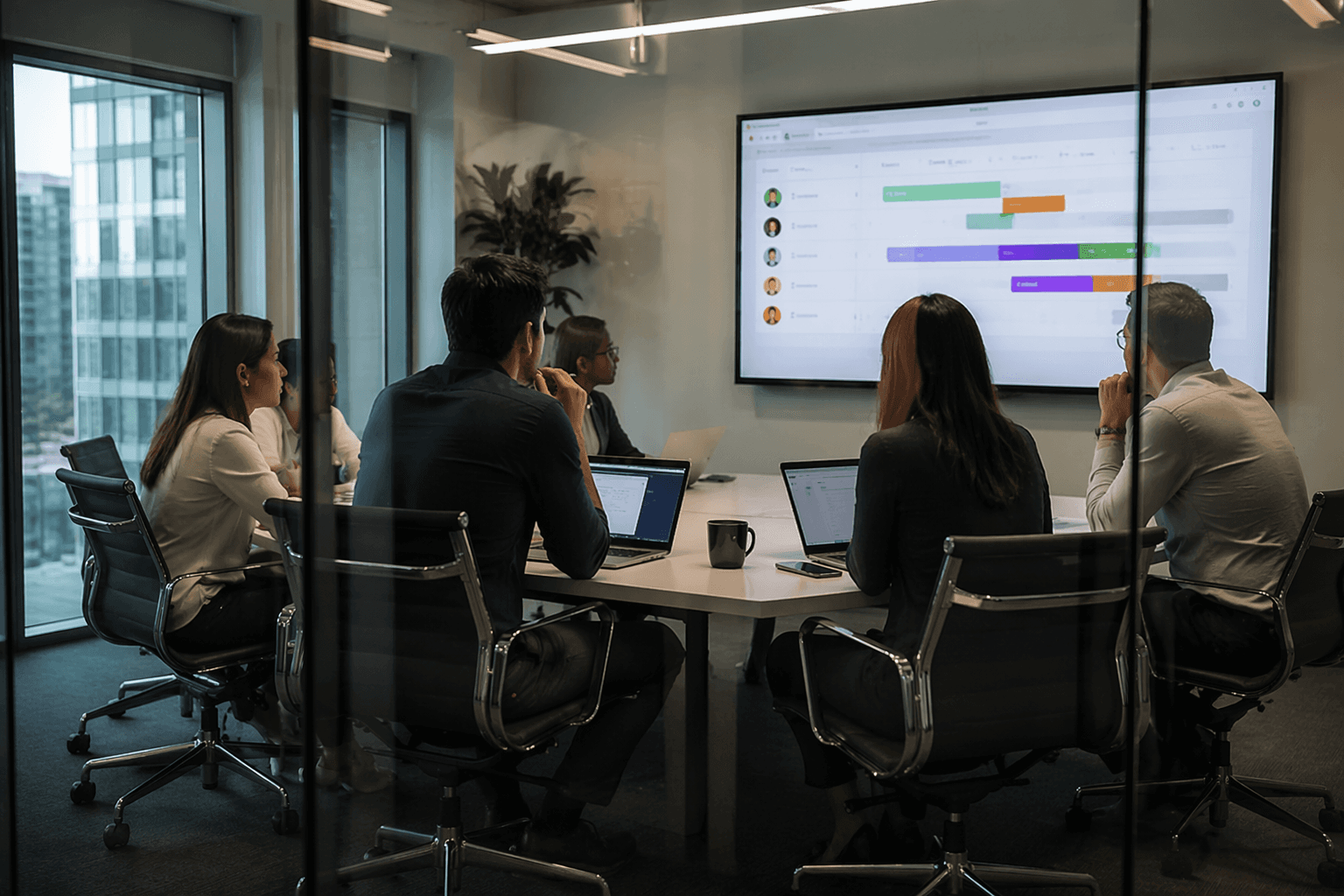
A useful async loop for a hybrid SaaS company looks like this:
- Write the decision or proposal first, before the meeting request.
- Identify the owner, the reviewers, and the deadline in the same place.
- Capture tradeoffs and open questions where the work lives.
- Use live time only when discussion, negotiation, or relationship-building is actually needed.
- Close the loop by recording the final decision and the next handoff.
That is not just efficient. It changes the daily rhythm of work. Fewer meetings mean fewer interruptions for engineers trying to protect deep work, fewer status calls for product managers who already know the project state, and fewer handoff gaps for sales teams moving deals across regions. The payoff is faster cross-time-zone execution and a cleaner paper trail when something changes.
Why this is a credibility test for monday.com
monday.com has built its identity around work orchestration, transparency, and flexible workflows. That makes the company’s own operating habits part of the product story. If monday.com wants to convince customers that structured work management improves coordination, it helps to show that the same logic works inside its own walls.
The scale of the company makes that especially important. As of March 31, 2026, monday.com reported 3,211 employees and 4,547 customers over $50,000 in annual recurring revenue. By June 2026, it said it had more than 250,000 customers worldwide. It also reported 2025 revenue of $1.232 billion, up 27% year over year, and said its net dollar retention rate was 110% as of March 31, 2026. At that size, coordination is not a side issue. It is part of the operating system.
The company’s physical footprint tells the same story. monday.com opened a 110,000-square-foot North American headquarters in New York City at 225 Park Avenue South in 2022, then opened a Denver office in 2023. Public materials and job listings point to a distributed organization with people working across multiple locations. That makes async discipline even more valuable, because it gives the company a way to keep decisions visible and ownership clear even when people are not sharing the same room.
The hybrid lesson for monday.com teams
GitLab is a useful comparison point precisely because monday.com is not trying to copy it. A remote-first company can build almost everything around async by design. A hybrid company has to be more deliberate, because it is constantly balancing in-person collaboration with distributed execution. The goal is not to turn every process into a document. It is to make sure the right information is available when someone needs it, no matter where they are working from.
For monday.com teams, that means the strongest async habit is usually the simplest one: write things down early, assign ownership clearly, and make the next step obvious. Live meetings still have a place for judgment calls, tough tradeoffs, and relationship-building. But the routine work of coordination should not depend on everyone being online at the same moment.
That is the real lesson from GitLab’s model. When information is durable and ownership is easy to transfer, teams spend less time repeating themselves and more time moving work forward. For a company built on helping others orchestrate work, that is the standard worth meeting internally first.
This article was produced by Prism’s automated news system from verified source data, official records, and press releases, then run through automated quality and moderation checks before publishing. The system is built and supervised by the people who set the standards it runs under. Read our full AI policy.
Did this article answer your question?