How monday.com employees should understand stock awards and vesting rules
Your monday.com grant is only valuable if you know when it vests, when you can sell, and what tax bill may follow. The headline number can mislead fast.
The grant line in a monday.com offer letter can look bigger than the salary, but the real value sits behind the paperwork. Before you treat equity like cash, pin down the vesting schedule, whether the award is options, RSUs, or performance-based stock, when you can sell, and what happens if you leave before vesting.
Start with the type of award
The first mistake employees make is assuming every stock grant works the same way. FINRA advises workers to identify the award type first. Stock options, restricted stock units, and performance-based awards all work differently. An option can rise or fall with the strike price and the market price, while an RSU usually becomes yours only when vesting happens, and a performance award can depend on hitting specific goals before the shares fully belong to you.
At monday.com, equity is often presented as a clean headline number in an offer, while the actual value depends on rules buried in the grant documents. If the award is tied to continued service, the clock matters just as much as the share count. If it is tied to performance, the payout may depend on company results, team execution, or other targets that are not in your control.
Vesting is the part that turns a promise into compensation
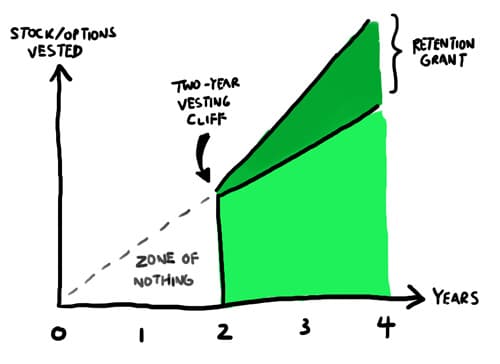
Awards may vest over time and may depend on continued service, which means the real question is not just how many shares you got, but when you actually earn them. If you leave before vesting, the unvested portion usually does not become yours, which is why the schedule matters as much as the headline grant.
That is especially important for people joining monday.com in engineering, product, or sales roles where compensation packages can lean heavily on equity. Ask for the full vesting schedule in writing, not a rough verbal summary. If there is a performance condition, ask what has to happen before the shares vest. If there is a cliff or delayed start date, make sure you understand how much of the grant is locked up during that period.
Liquidity and taxes can change the real value
A vested share is not the same thing as spendable money. Employees need to understand any restrictions on when shares can be sold, because tax treatment and liquidity can change depending on timing.
For monday.com employees, the timing question matters because the company is public, and its ordinary shares trade on Nasdaq under MNDY. If your shares vest but you cannot sell immediately, your paper value can move sharply before you turn it into cash. Taxes can also land before you have sold the shares, which is why the vesting date, exercise date, and sale date should never be treated as the same event.
A smart offer-letter review should include these questions:
- Is this grant stock options, RSUs, or performance-based equity?
- What is the vesting schedule, and is there a cliff?
- If it is an option grant, what is the strike price?
- Can you sell immediately when shares vest, or are there trading windows?
- What taxes apply at vesting or exercise?
- What happens to unvested shares if you resign or are laid off?
monday.com’s share count shows why concentration risk matters
The broader risk is concentration. monday.com reported 51,551,462 ordinary shares outstanding as of June 30, 2025, up from 50,773,337 at December 31, 2024, and 51,160,822 ordinary shares outstanding as of December 31, 2025. Every employee grant sits inside a much larger capital structure, where dilution, market movement, and investor expectations all affect the value of your award.
Company stock can feel familiar because you help build the product, close the deals, or ship the roadmap, but familiarity does not cancel volatility. If too much of your wealth is tied to MNDY, a drop in the stock can hit your net worth even when your base salary stays the same.
monday.com says more than 250,000 customers worldwide use its platform, and its fourth-quarter and fiscal 2025 results showed record net adds of customers with more than $100,000 in annual recurring revenue.
Read the filings, not the rumor mill
If you want the cleanest picture of what you actually own, start with the company’s public filings. monday.com filed its 2025 Form 20-F on March 13, 2026, and the filing lists the company at 6 Yitzhak Sadeh Street, Tel Aviv, 6777506 Israel. Public-company paperwork is where the real mechanics live: share counts, compensation expense, and the structure behind the equity story that gets summarized much more loosely in recruiting conversations.
Stock awards are a material cost on the business side as well as a meaningful part of worker pay. monday.com reported $87.603 million in share-based compensation expense for the first six months of 2025.
This article was produced by Prism’s automated news system from verified source data, official records, and press releases, then run through automated quality and moderation checks before publishing. The system is built and supervised by the people who set the standards it runs under. Read our full AI policy.
Did this article answer your question?