How monday.com pricing architecture shapes product strategy and growth
monday.com’s pricing tiers do more than set a bill. They shape trust, packaging, and expansion as the company pushes four products deeper into the market.

Pricing is the product people feel first
monday.com’s pricing is not a finance detail tucked away from the customer experience. It is part of the product itself, shaping whether a buyer feels clarity or confusion, whether a rep can explain value quickly, and whether a team trusts that costs will scale in step with usage. Chargebee’s SaaS pricing playbook points to the same truth: the right model has to match the value customers actually recognize, or even a strong product can create friction.

That is why monday.com’s structure matters so much. The company now sells four standalone products, monday Work Management, monday CRM, monday dev, and monday service, each priced separately based on its own features and functionality. For employees inside the company, that means pricing is not a back-office afterthought. It is one of the clearest ways product strategy shows up in the market.
How monday.com packages value
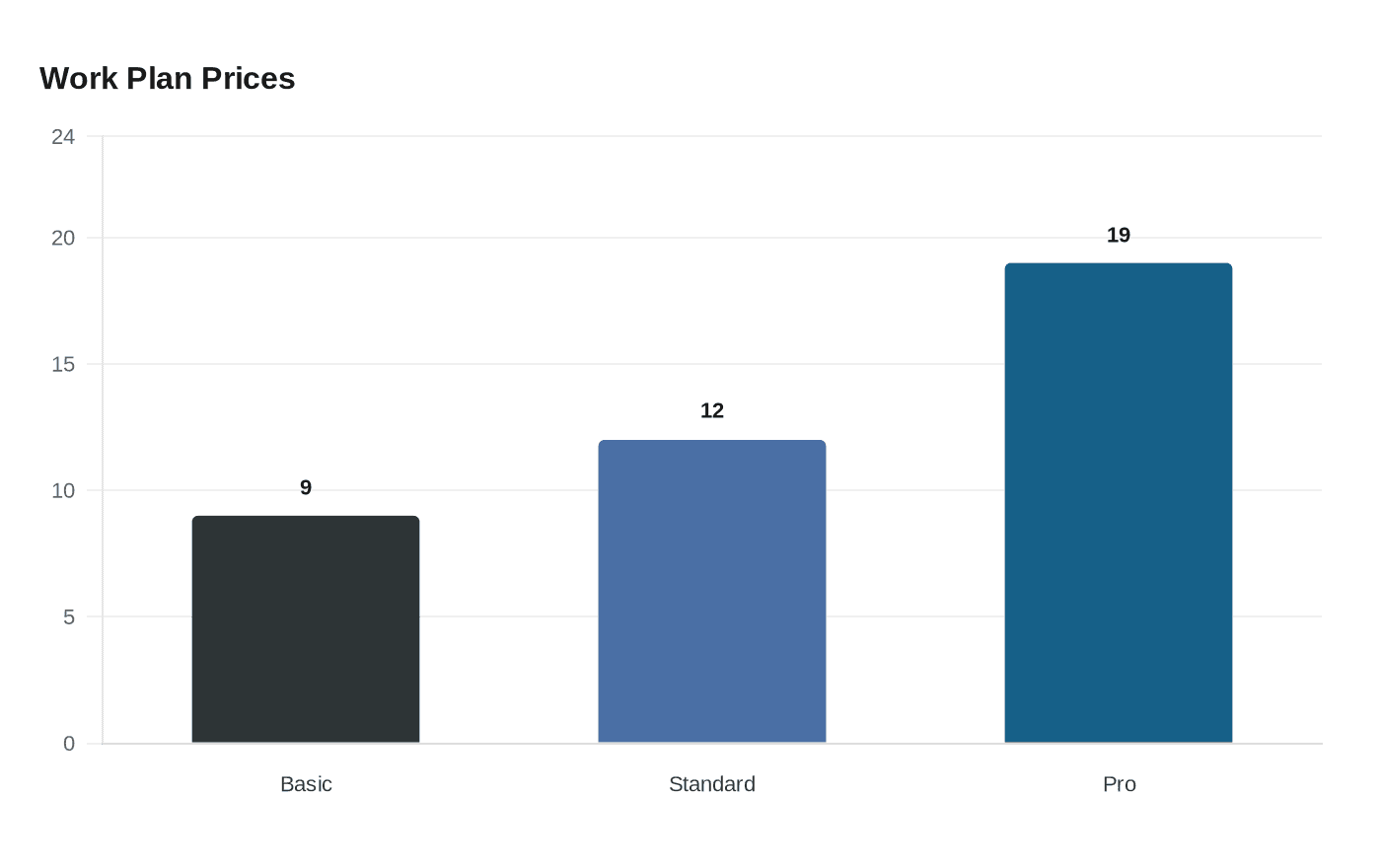
Work management remains the clearest window into the company’s logic. The public pricing page shows Free, Basic, Standard, Pro, and Enterprise tiers. The Free plan is capped at up to 2 seats, while Basic starts at $9 per seat per month, Standard at $12, and Pro at $19, all billed annually by default. Enterprise is sales-led, which is the company’s way of reserving custom negotiation for larger accounts with more complex needs.
The real signal is in the usage limits. monday.com ties automation and integration capacity to tier, with Standard set at 250 actions per month, Pro at 25,000, and Enterprise at 250,000. That is pricing architecture doing double duty: it sets revenue per seat, but it also defines how much workflow scale a customer can unlock before they have to move up. In practice, that changes user behavior. Teams start thinking not just about headcount, but about how much operational weight they want the platform to carry.
The company’s support materials also say new users automatically start a 14-day free Pro plan trial for the selected product. That detail matters because it lowers the barrier to first use while still exposing buyers to a higher-value tier. It is a classic SaaS balancing act: make it easy to try, then make the value visible enough that conversion feels justified rather than forced.
Why packaging decisions shape sales friction
The most useful lesson from a pricing-model guide is that pricing should follow the value metric customers already understand. monday.com’s current approach reflects that logic, but it also shows the tradeoffs. The more the company separates products and gates capabilities by plan, the more it has to explain why one team’s bill grows faster than another’s.
That explanation burden lands directly on sales. A buyer comparing plans wants predictability: what is included, what is limited, and what happens when the team expands? For product managers, pricing decisions influence which features are bundled, which are reserved for higher tiers, and which capabilities create the strongest upgrade path. For engineers, that means pricing is often tied to the mechanics of the product itself, because the limits around automations, integrations, and workflows are not marketing flourishes. They are operational rules.
monday.com’s 2024 product-separation update made that even more explicit. Early adopters of monday CRM and monday dev were told they would keep discounted pricing until their first renewal in 2026, while added seats and added products would be billed individually. That is not just a billing change. It is a transition from a more bundled relationship to a more modular one, and transitions like that can either deepen trust or create resentment depending on how clearly they are communicated.
The company’s 2024 list price increase for work management sharpened the point further. Basic moved to $9, Standard to $12, and Pro to $19 per seat per month, billed annually, with Enterprise increased at a similar rate. Price hikes are rarely neutral, but when they are paired with clearer packaging and stronger product separation, they can support expansion rather than scare buyers away. If they are not explained well, they become a support problem as much as a revenue one.
The growth story behind the numbers
This pricing architecture would matter less if monday.com were still a single-product collaboration tool. It matters because the company has become a multi-product platform with real scale. As of December 31, 2025, monday.com said it had more than 250,000 customers, 110% net dollar retention, 4,281 customers with more than $50,000 in annual recurring revenue, and 3,155 employees.
The top line shows why pricing discipline is central. monday.com reported fourth-quarter 2025 revenue of $333.9 million, up 25% year over year, and full-year 2025 revenue of $1.232 billion, up 27%. The company also said customers with more than $50,000 in ARR represented 41% of total ARR in the quarter. That is a reminder that the mix is shifting upward: larger accounts now matter more to growth, which makes pricing structure more consequential, not less.
The enterprise motion has already been building. In 2024, monday.com said enterprise customers with more than $50,000 in ARR grew 39% year over year, from 2,295 at the end of 2023 to 3,201 at the end of 2024. That kind of growth changes the pricing conversation inside the company. A model built only for small, self-serve teams would not be enough. A model built only for enterprise sales would lose the simple, low-friction entry point that helped the company scale in the first place.
There is also a product signal buried in the numbers: monday vibe became the fastest product in company history to surpass $1 million in ARR. That matters because it suggests the company is still finding new products that can monetarily prove themselves fast. When that happens, pricing is not just about capture. It is about deciding how quickly a new product can move from experiment to business line.
The trust test monday.com has to keep passing
The sharpest way to read monday.com’s pricing is this: the company is trying to scale without making the product feel like a trap. Seat-based annual billing gives finance teams predictability. Tiered automation and integration caps give product teams a way to map value to usage. Separate pricing for monday Work Management, monday CRM, monday dev, and monday service gives the suite a more modular shape. But every layer of structure also raises the burden of explanation.
That is the real product and trust decision. If monday.com can keep pricing legible while its suite expands, it preserves the simplicity that brings teams in and the expansion path that keeps them growing. If it gets too opaque, the company risks turning the clearest part of the buying journey into the hardest one to defend.
This article was produced by Prism’s automated news system from verified source data, official records, and press releases, then run through automated quality and moderation checks before publishing. The system is built and supervised by the people who set the standards it runs under. Read our full AI policy.
Did this article answer your question?