Monday.com guide says change management must drive lasting adoption
The launch is only the beginning: monday.com says lasting adoption depends on change management, real-time visibility, and keeping people aligned as workflows shift.
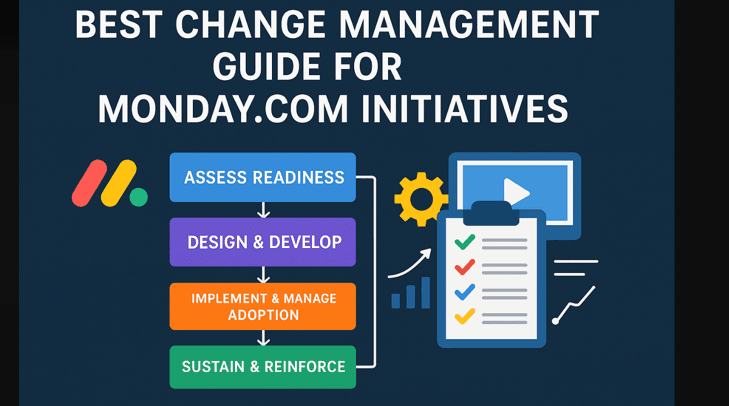
The rollout is the easy part. Adoption is where the work starts.
monday.com’s change management guide pushes on a familiar weak spot in modern workplaces: too many teams treat launch day as the finish line. A new system can go live, a new process can be announced, or a new policy can be published, but none of that matters if people keep working the old way. The guide’s core message is simple and useful inside a company built around work operating systems: change has to become part of how the organization works, not just something it names in a kickoff meeting.
That distinction matters at monday.com because the company lives inside constant motion. Product changes, AI rollouts, sales process updates, and internal policy shifts all depend on whether employees actually absorb the new approach. In a fast-moving SaaS environment, a technically sound launch can still underperform if employees are confused, managers are passive, or teams never build the new habit into daily work.
Change management is a capability, not a calendar event
The guide frames organizational change management as an ongoing discipline, not a one-time event. That is the useful corrective for companies that confuse rollout with readiness. A system can be deployed in days, but adoption is measured in behavior, not in launch emails or project plans.
That framing is especially relevant for engineers, product managers, and sales teams. Engineers may ship a feature that works exactly as designed, but if users do not understand the workflow, support questions rise and value drops. Product managers can define the right motion, but unless teams learn it and repeat it, the feature becomes shelfware. Sales teams see the same pattern with customer-facing process changes, where a clean internal transition still fails if the customer does not understand how the new workflow fits into their day.
Visibility is what turns rollout into follow-through
One of the guide’s strongest practical points is that teams should track how people are using the change as it unfolds. That means reading adoption data in real time, not waiting until the quarter closes to discover that half the organization ignored the new process. Visibility gives leaders a chance to adjust communications, reinforce what is working, and correct friction before it calcifies into resistance.
That approach reflects a broader truth about workplace change: people rarely reject a change because it exists. They reject it when it is unclear, inconvenient, or disconnected from their daily tasks. Real-time information helps leaders spot where the message is landing and where it is not. It also creates a feedback loop, which is the difference between a launch that fades and a rollout that compounds.
For monday.com readers, that lesson has direct operational value. Product teams can use adoption data to see whether a feature is being used as intended. Sales teams can watch whether new processes are shortening handoffs or slowing them down. Engineers can see where a change is generating support noise, which often means the product and the rollout are out of sync rather than the code itself being the problem.

Human alignment is the part companies often underinvest in
The guide does not treat change as a systems-only problem. It emphasizes human alignment, which is where many rollouts fail quietly. Employees need to understand not just what is changing, but why it matters, how it affects their work, and what success looks like after the shift. Without that, people improvise, managers create exceptions, and the organization ends up with a patchwork of partial adoption.
That is why the guide’s advice lands as more than internal process language. It recognizes that people are part of the system. If teams are not brought along, even strong initiatives stall. If they are, communication gets cleaner, adoption gets easier, and the organization can absorb change without losing speed. That tradeoff matters in a company that relies on fast iteration, because speed without alignment can create hidden drag that shows up later in missed usage, inconsistent execution, or confused customers.
monday work management is presented as the operating layer
The guide also points to monday work management as a way to centralize initiatives, automate tasks, and give leaders a clearer view of risk and follow-through. That is a practical workflow argument, not just a branding one. Centralization helps teams stop scattering change efforts across email threads, slide decks, and disconnected trackers. Automation reduces the manual overhead that often derails follow-through. Visibility into risk lets leaders see where ownership is weak, where deadlines are slipping, and where communications need another pass.
That matters because change management fails when accountability becomes blurry. A rollout can have a clear start date and still lack a clear owner for training, manager enablement, or post-launch check-ins. A centralized work system helps turn those loose ends into trackable work. It also gives leadership a better line of sight into whether the organization is actually moving with the change, rather than merely acknowledging it.
What this means inside monday.com
The most useful takeaway from the guide is that adoption is a management problem as much as a product problem. Inside monday.com, that principle should resonate in every function. Product innovation only pays off if teams and customers change how they work. Internal policy changes only matter if managers explain them, reinforce them, and model them. Sales process updates only stick if the field understands the reason behind them and sees the payoff in daily execution.
That is where the company’s own culture and SaaS dynamics intersect. A work-OS company cannot afford to treat change as cosmetic. Every new workflow, every AI feature, every operational shift becomes a test of whether the organization can move people, not just systems. The guide’s value is that it makes that pressure visible and manageable. It argues, in effect, that the real product is not the launch. It is the behavior that comes after it.
Know something we missed? Have a correction or additional information?
Submit a Tip